The first time I really smelled it, I was on the floor at six in the morning, cheek against a warm ribcage, one arm around a snoring rescue mutt named Otis. He exhaled. And it hit me the way a stranger's cologne hits you in an elevator... except this wasn't cologne. This was something rotting.
I remember thinking, well, that's just doggy breath.
I was wrong. And if there's one sentence in this whole article I want a busy dog parent to steal, it's this one.
"Doggy breath" is not a smell. It is a symptom.
Halitosis in dogs is not a personality quirk of the species. It's a chemical fingerprint of active bacterial fermentation happening inside your dog's mouth. That odor is the byproduct of anaerobic bacteria breaking down proteins in the subgingival biofilm... the same bacterial community that, unchecked, drives periodontal disease in over two-thirds of adult dogs. According to the American Veterinary Medical Association, most dogs show clinical signs of periodontal disease by age three. The smell you're smelling is not "normal." It is early warning.

The Myth We All Grew Up With
Somewhere in the last fifty years, a piece of folk wisdom got laminated into the culture: dogs have bad breath, that's just how it is, buy a chew, move on.
That folk wisdom is doing enormous damage.
It normalizes the exact clinical presentation that veterinary dentists are trained to flag on day one. A dog with truly healthy oral tissue and a balanced oral microbiome does not have an odor problem. Puppies don't smell like that. A dog with a well-tended mouth in year eight doesn't smell like that either. The "doggy breath" you were told was inevitable is a species-wide dental health crisis that we've been marketed into ignoring.
Here's what makes me angry as a founder... the pet aisle knows this. And instead of solving it, an entire industry has organized itself around a masking economy. Bacon-scented breath sprays. Mint-dusted rawhide. Chlorophyll water additives that swap the odor of decay for the odor of chewing gum. None of that is oral care. It is fragrance layered over pathology.
What That Smell Actually Is (The Chemistry)
The specific chemical class responsible for the classic canine halitosis odor is volatile sulfur compounds, or VSCs. Three molecules do most of the work: hydrogen sulfide (the rotten-egg note), methyl mercaptan (the sock-drawer note), and dimethyl sulfide (the sweet-decay undertone). If you've ever leaned in for a nose-boop and involuntarily leaned back out, you were smelling a VSC blend.
These molecules do not come from your dog's stomach. They do not come from the last thing he ate. Research summarized in the veterinary dentistry literature is consistent on this: the overwhelming majority of canine oral malodor originates in the mouth itself, specifically from anaerobic bacteria living in the subgingival crevice, on the back of the tongue, and inside the biofilm coating the teeth. Those bacteria feed on the protein and dead cells your dog can't help but produce, and they exhale VSCs the same way we exhale carbon dioxide.
Which means the odor is telling you two very specific things:
-
Which bacteria are winning. A VSC-heavy exhale means the anaerobic, sulfur-metabolizing strains have colonized past the point where saliva and normal chewing can dislodge them.
-
Where they're living. VSCs are strongest when the biofilm has already migrated below the gumline into the subgingival pocket. That is the exact zone a toothbrush cannot reach and a hard dental treat cannot scrape.
Put more bluntly. If your dog smells, the fight is already inside the gumline.
The Cascade From Nose to Kidneys
Here is the part of this conversation that most "dental hygiene" articles refuse to have with you, and it is the part that made me stop treating my own dog's breath as a cosmetic issue.
The oral cavity is not a closed system. Every time your dog swallows, licks a wound, or even breathes with a partially open mouth, they are inoculating the rest of their body with whatever is winning in their mouth. This is the mechanism we call the Oral-Gut Axis. When oral dysbiosis sets in, the same pathogenic species that produce VSCs also translocate downstream into the gut lumen and, in more advanced periodontal disease, directly into the bloodstream through the inflamed gingival tissue.
From the bloodstream, they distribute where the blood goes. Which is, unfortunately, everywhere important. The kidneys filter it. The liver processes it. The heart valves catch it. This is not a hypothetical mechanism... it is a well-documented feature of advanced periodontal disease in dogs, and it's the reason we've written at length about how oral bacteria contribute to kidney strain in senior dogs.
The American Animal Hospital Association's 2019 Dental Care Guidelines are explicit that periodontal disease is a systemic concern, not a local one. The odor is the first, cheapest, non-invasive diagnostic test you have. And most of us are trained by marketing to ignore it.
Why Cover-Up Sprays Actually Make It Worse
I want to be careful here because I know a lot of well-meaning pet parents own a bottle of dental spray. This is not a shame piece. It's a mechanism piece.
Most "breath fresheners" in the pet aisle fall into two categories, and both make the underlying problem worse:
Category one... aromatic masking agents.
Chlorophyll, peppermint oil, artificial mint flavor, synthetic "green tea" fragrance. These are perfume for a wound. They neutralize the human nose's ability to detect VSCs for anywhere from twenty minutes to two hours. During that window, the bacterial community that produced the VSCs is not just unaffected... it's actively growing. You've silenced the smoke alarm while the fire keeps burning.
Category two... starch-heavy dental treats with flavor coatings.
This is the one that really gets me. The single most common "breath fixer" a dog owner reaches for is a dental chew, and the top-selling dental chews on the market are more than half starch by weight. Starch is a fermentable carbohydrate. Fermentable carbohydrate is exactly what the anaerobic bacteria producing VSCs eat. We've called this dynamic the Starch Trap, and it's the reason a lot of dogs on daily "dental" treats develop worse breath over time, not better.
A masking agent doesn't reset the microbiome. A high-starch chew feeds the exact community you're trying to displace. If your entire dental protocol is a spray and a green treat, you are, chemically, running a subsidy program for the bacteria you're trying to defeat.
What Actually Shifts the Source
Real halitosis correction has one requirement. You have to change which bacteria are winning in your dog's mouth. That is a microbiome problem, not a fragrance problem, and it has three practical levers.
Lever one... starve the anaerobes.
You do this by removing the fuel they preferentially metabolize. That means cutting the starch-heavy "dental" treats and replacing them with a chew engineered around the opposite chemistry... low fermentable carbohydrate, prebiotic fiber that feeds beneficial oral flora instead of pathogenic ones, and a delivery matrix that keeps working after the chew is swallowed. This is the design intent behind the Arterra nHA dental chew. Banana and chicory root prebiotics selectively feed commensal bacteria. Nano-hydroxyapatite continues releasing into saliva for hours, which is what we mean when we talk about residual bio-activity. The chew is gone in ninety seconds. The chemistry lingers.
Lever two... rebuild the terrain the pathogens are exploiting.
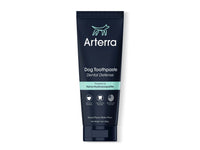
Halitosis-driving bacteria don't just float around loose. They colonize surfaces, and their favorite surfaces are the microscopic defects in the enamel and the exposed dentin tubules where the enamel has already been compromised. A tooth with intact enamel is a hostile environment for the biofilm. A tooth full of tiny fissures is an invitation. This is where the science of nano-hydroxyapatite earns its place in the ritual. nHA is chemically nearly identical to the mineral your dog's enamel is already made of. Applied nightly, it deposits into those microscopic fissures and re-mineralizes the surface, closing the front doors the anaerobic biofilm has been walking through. The Arterra nHA Toothpaste is a fluoride-free, non-abrasive delivery system engineered for exactly this application.
Lever three... reach where the odor actually lives.
Remember, most VSCs originate in the subgingival biofilm, below the visible gumline. That's the zone a toothbrush bristle physically cannot enter and a hard chew mechanically cannot scrape. This is where the difference between our approach and the legacy dental chew becomes clinically real. Mechanical scraping addresses the crown of the tooth. Residual bio-activity in saliva reaches the subgingival crevice. If your goal is to reduce the odor at its actual origin site, you need chemistry, not just abrasion.

A Note on Peanut Butter (And Why We Don't Use Mint)
You may have noticed we don't lean on peppermint, spearmint, or synthetic "fresh scents" in any of our formulations. That is deliberate.
Mint is the fragrance industry's shortcut for signaling clean. It does not clean anything. It numbs the human nose for a few minutes while doing nothing for the underlying oral health of your dog. Meanwhile, dogs are not evolutionarily drawn to mint. They crave rich, appetizing flavors they actually recognize. Our formula features Natural Peanut Butter Flavor—sweetened with sorbitol and stevia—ensuring that when your dog gets their daily brushing session, their taste receptors register an enjoyable treat rather than a synthetic masking agent.
Compliance is everything when it comes to daily dental routines. A dog who looks forward to the ritual receives the benefits of Nano-Hydroxyapatite every single night. A dog who resists gets nothing. High-reward flavor signals win. Synthetic mint doesn't.
What to Do Tonight
Here is the smallest possible version of a real protocol. Not a marketing funnel, an actual thing you can do in the next twelve hours.
-
Smell. Once. Consciously. Now you have a baseline. Not because "doggy breath" is normal, but because you deserve a before-and-after.
-
Stop buying starch. Read the ingredient panel on whatever dental chew is in your pantry. If the first ingredient is a starch (wheat, tapioca, potato, corn), it is not a dental product. It is a bacterial buffet in packaging.
-
Add a nightly nHA ritual. Sixty seconds. Fluoride-free. Non-abrasive. The purpose is not to "brush plaque off" like you're washing a dish. The purpose is to deposit liquid enamel into the microscopic zones where the anaerobes are colonizing.
-
Swap the chew. Move from a mechanical-scraping, high-starch chew to a low-starch, prebiotic, nHA-infused chew. The point is not to add another product. The point is to stop paying to feed the bacteria you're trying to defeat.
-
Re-smell in fourteen days. Real microbial shifts take real time. Not four hours. Not overnight. Two weeks of consistent nightly ritual and a chew swap is a fair, honest window.
Longevity Insights: Key Takeaways
- "Doggy breath" is a symptom of oral dysbiosis, not a normal feature of dogs.
- The characteristic odor is a mix of volatile sulfur compounds produced by anaerobic bacteria living below the gumline.
- Mint sprays and starch-heavy dental treats do not fix halitosis. They mask it and, in some cases, worsen the underlying dysbiosis.
- Real correction requires shifting which bacteria are winning, which means starving the anaerobes, rebuilding the enamel terrain, and reaching subgingival zones with residual chemistry.
- The odor is a diagnostic tool. Use it.
Health Is an Investment in Time
Otis is thirteen now. His breath is unremarkable. That is, and I say this as his person and as a founder, one of the small quiet victories I am most proud of, because it took me embarrassingly long to understand that the smell I was ignoring at six in the morning on the living room floor was the earliest, cheapest, most obvious warning sign I was ever going to get.
Your dog is telling you something with his breath.
Please stop calling it doggy.
Experience the science of nHA and start the nightly ritual tonight. Your dog's mouth... and his kidneys, and his heart, and his next summer at the lake... will thank you for it.
Tags:
canine health,
dog dental care,
halitosis,
nano-hydroxyapatite,
oral microbiome