Your dog is not weird for hating this
I want to say this first because almost every owner I talk to who is struggling with tooth brushing thinks there is something wrong with their dog. There is not. Having something foreign jammed into your mouth by a much larger primate is not an instinctive favorite activity for dogs. Most dogs do not come out of the box tolerating it. The ones who do were desensitized young enough that nobody remembers teaching them.
If your adult dog fights the brush, pulls her head away, snaps at your hand, or just clamps her mouth shut and waits you out, you are in the normal range. The fix is not more force or more determination. The fix is to spend four weeks teaching her that hands near her mouth means something good is about to happen. After that, the actual brushing is a non-event.
This is the specific protocol. It assumes a dog with no history of fear-based aggression. If your dog has a bite history or has ever growled or snapped when you touch her head or mouth, work with a positive-reinforcement trainer or a veterinary behaviorist before running this at home.
 What the chew does for you while you are building up
The reason I am confident recommending a slow four-week ramp is that your dog is not going without dental care during those weeks. One Dental Chew per day is doing the work.
The chew delivers nano-hydroxyapatite (20 to 80 nm particles) to the sulcus, the interproximal surfaces, and the subgingival area. It provides mechanical crown cleaning as your dog works through it. It supports oral microbiome balance through the prebiotic fiber base (banana flour, chicory root). It does this every day, hands-free, with no fight. The chew is the floor.
What the chew does not do is deliver concentrated remineralizing toothpaste to the gum line under your direct control. That is what nightly brushing adds. So the four weeks of desensitization are weeks where the chew is maintaining the baseline, and you are building the ability to add the brush on top. You are not starting from zero.
This matters because a lot of owners give up on brushing after a bad first attempt and then also stop the chew because they feel defeated. Do not do that. The chew runs through everything. The brushing comes on top when the dog is ready.
Week 1: hands near the mouth, zero resistance
Goal: your dog accepts you touching the outside of her muzzle and briefly lifting her lip without pulling away.
Daily session, 30 seconds, after the chew in the evening.
Sit calmly with your dog. Pet her head and jaw normally. Briefly cup her muzzle with your hand, say nothing dramatic, release. Repeat 2 or 3 times. If she pulls away, let her. Praise her when she stays.
Then, lift the upper lip on one side for about 1 second. Release. Praise. Treat if you use food rewards. Lift the other side for 1 second. Release. Praise.
That is week 1. You are not putting anything in her mouth. You are only teaching her that your hand near her face is not a threat and that staying still gets her something good.
Do not advance to week 2 until your dog is sitting through the full week 1 session with relaxed body language.
Week 2: finger on the gum, with flavor
Goal: your dog accepts your finger briefly along the outside of her teeth and gum line, with toothpaste flavor as the reward.
Daily session, 60 seconds, after the chew.
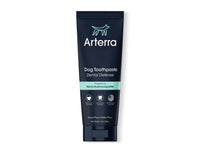
Put a pea-sized amount of Remineralizing Toothpaste on your finger. The flavor is natural peanut butter, which is the point. Let your dog lick it off your finger. This is session one of week 2, and it is the whole session. She has now associated the toothpaste smell and flavor with something good.
From session two onward, put the toothpaste on your finger, let her get the first lick, then gently run your finger along the outside of her upper teeth on one side. About 2 seconds. Release. Praise.
Build up over the week to: finger along the upper teeth both sides, finger along the lower teeth both sides, about 5 seconds per quadrant. Reload the toothpaste between quadrants if the flavor is what is keeping her engaged.
You are not scrubbing. You are not trying to clean. You are just getting her used to your finger running along her gum line and associating it with a flavor she likes.
Week 3: finger brush, front teeth and canines only
Goal: your dog accepts a textured finger brush with toothpaste along her front teeth and canines, without flinching.
Daily session, 60 to 90 seconds, after the chew.
Introduce the finger brush. Let her sniff it. Put toothpaste on it. Let her lick the toothpaste off the bristles so she associates the new texture with the familiar flavor.
Run the finger brush gently along the front incisors (the little teeth at the very front) for 5 seconds. Release. Praise. Reload toothpaste.
Run the brush along the canines (the big fang teeth) on one side for 5 seconds. Release. Praise. Other side. Release. Praise.
Avoid the back molars this week. The back teeth are harder to reach, more sensitive for most dogs, and where resistance typically shows up first. Save them for week 4.
If your dog starts resisting mid-week, back off. Drop the session back to week 2 for a day or two, then rebuild. There is no prize for finishing on schedule.
Week 4: full brush, including back molars
Goal: your dog accepts the full 60-second nightly brushing routine.
Daily session, 60 to 90 seconds, after the chew.
Start with the front teeth and canines she is already used to. 5 seconds per quadrant. Then lift the upper lip higher on one side to expose the upper molars. Gently run the brush along the gum line of the molars for about 5 seconds. Release. Praise. Reload toothpaste.
Repeat on the other upper side, then both lower sides. The lower molars are often the hardest, because the lip has to be pulled down and the bristles come close to the tongue. If she gets uncomfortable at any point, release and reward the holding-still, not the finishing.
By the end of week 4, you should be running the full 60-second nightly ritual as a routine, not an event.
What to do if you plateau
Most owners plateau somewhere. The most common plateau points:
-
Week 2, the finger phase. If she will not let your finger into her mouth even with toothpaste, go back to week 1 for another week. The problem is usually trust, not technique.
-
Week 3, the textured brush. Some dogs tolerate the finger fine but recoil from the bristle texture. Try a different finger brush (silicone bristles are softer than rubber nubs for some dogs) or spend an extra week doing finger only before reintroducing the brush.
-
Week 4, the back molars. This is the most common plateau. If your dog will accept front and canines but fights the back molars, split the routine: brush the front half nightly, and do the back half every other night for two weeks until she is accepting all four quadrants.
A plateau is not a failure. It is the dog telling you the step is too big. Make it smaller. The chew is still running underneath all of this, so you have time.
From one owner who got through it
From a dental-chew subscriber whose picky dog accepted the chew where others failed: "First and only Dental chew that actually works, my picky dog will eat willingly, and I have repurchased." Picky and resistant are often related traits. The chew earns the first trust. The brushing builds on the trust the chew earned.
Longevity Insights
- Your dog is not unusual for resisting tooth brushing. Four weeks of desensitization is the normal path for most adult dogs who did not get used to it as puppies.
- The Dental Chew runs through the entire four weeks. You are not starting from zero on dental care. You are adding brushing on top of a working chew routine.
- Week 1: hands on the muzzle, briefly lifting the lip, no mouth contact. Week 2: finger with toothpaste along the gum line. Week 3: finger brush, front teeth and canines only. Week 4: full brush including back molars.
- If you plateau, make the step smaller rather than pushing through. The dog is telling you the increment was too big.
- Natural peanut butter flavor on the toothpaste is doing real work here. Let her lick it off your finger first, every session, until she associates the smell with reward.

Monday, if you are starting
Give the chew tonight as part of her normal evening. Thirty seconds of calmly touching her muzzle and briefly lifting her lip, release, praise. That is day one. Tomorrow the same. On day 8, add toothpaste on your finger.
The dog you have by day 28 is a dog who sits still for a 60-second nightly brush. The dog you have for the next 10 years is a dog whose mouth you can maintain without a fight.
None of this is medical advice. Always consult your licensed veterinarian for your dog's specific needs. If your dog has any bite history or has growled or snapped at hand contact near her head or mouth, work with a positive-reinforcement trainer or veterinary behaviorist rather than running this protocol at home.
Shop The Dog Dental Chews → Shop Remineralizing Toothpaste →
Tags:
brushing,
dental chews,
desensitization,
how-to,
nano-hydroxyapatite,
nha,
resistant dog,
toothpaste