Cavaliers have the worst teeth in the breed book, by a wide margin
I do not say that lightly. Cavalier King Charles Spaniels are a breed I love, and there are a hundred reasons owners stay loyal to them across generations. But the clinical record on this breed's dental health is clear, and it is harder than any owner is told at the puppy visit.
A 2024 UK primary-care study of more than 41,000 dogs across breeds found that Cavaliers sit at the top of the periodontal-disease prevalence rankings, with roughly 1 in 4 Cavaliers over the age of one carrying a diagnosis of periodontal disease, against a cross-breed average closer to 1 in 10. Smaller studies looking specifically at older Cavaliers put the prevalence past 80 percent by middle age, which is higher than almost any other recognized breed group.
This is not a "teeth will yellow over time" problem. It is a specific breed-level risk profile that layers on top of the Cavalier's other well-known medical realities, including mitral valve disease. And it means the standard "give them a dental chew once in a while" approach that works adequately for many dogs is nowhere near enough for this one.
If you own a Cavalier, this piece is the specific risk profile, why it matters more in this breed than in most, and the routine I would build if I owned one tomorrow.
The Cavalier-specific risk profile
Four things stack up in a Cavalier's mouth that do not stack up in a Labrador's:
-
A compressed jaw holding a full set of 42 adult teeth. This is the mechanical driver behind most small-breed dental trouble, and it reaches a peak in Cavaliers. The teeth are crowded. Crowding creates plaque traps the owner cannot reach and the chew cannot scrape.
-
A high rate of retained deciduous teeth. Toy and small-breed puppies often keep their baby teeth past the age the adult teeth come in, creating a temporary double row of crowded teeth that bakes plaque into the gum line early. Cavaliers show this pattern frequently enough that vets often extract retained deciduous teeth during the spay or neuter appointment.
-
A soft palate and brachycephalic tendencies. Cavaliers are technically mesaticephalic (moderate-length skull), but they share enough soft-tissue traits with brachycephalic breeds that mouth breathing and dry oral tissue are more common than in long-nosed breeds. Dry oral tissue reduces saliva's natural remineralization effect on enamel.
-
The oral-systemic loop with mitral valve disease. This is the one that raises the stakes most. Oral bacteria entering the bloodstream through inflamed gum tissue contribute to systemic inflammation, and several studies link chronic periodontal disease to progression of heart disease in affected dogs. In a breed where roughly half of all individuals will develop mitral valve disease by middle age, the dental routine is not just about the mouth. It is about the heart.
Put those together and the Cavalier mouth is a specific clinical case, not a smaller version of the generic dog mouth.

Why most dental chews fail a Cavalier
Three failure modes are common in this breed specifically:
The chew is too big and the dog inhales it. Many Cavaliers will swallow a dental chew in two or three bites, especially at the front of the mouth. The molars and premolars (the back teeth, where most of the periodontal disease lives) never get worked. A chew that gets inhaled is a treat, not a dental intervention.
The chew works mechanically but not mechanistically. A chew that only scrapes the crown surface the dog contacts does nothing for the sulcus, the interproximal spaces, or the subgingival area. Those are the three zones where periodontal disease actually lives in a crowded Cavalier mouth.
The chew is given occasionally instead of daily. Plaque mineralizes into tartar in 24 to 72 hours. A chew given three times a week is working on a problem that re-establishes itself between sessions. Daily is the floor, not the ceiling, and for a Cavalier it is non-negotiable.
The routine I would build for a Cavalier
One Dental Chew per day, broken into two pieces so your dog has to work the back teeth. The chew includes nano-hydroxyapatite (nHA) at 20 to 80 nm particle size, which is small enough to reach the interproximal compartments and the sulcus where bristles cannot, plus prebiotic fibers (banana flour, chicory root) that support the oral microbiome balance.
If your Cavalier will swallow the chew whole, the solution is to hand-feed it in halves at the back of the mouth, one side then the other, slowing down the inhale and forcing the molar contact.
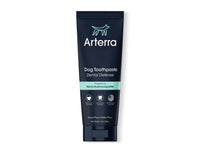
Nightly Remineralizing Toothpaste, a pea-sized amount, along the gum line with a finger brush or soft-bristled dog brush. Nightly is the cadence, not two or three nights a week. The combination of the chew's microscale coverage and the toothpaste's manual delivery to the gum line is what addresses both the crown surface and the vulnerable gum-tooth interface.
Twice-yearly professional dental exam rather than annual. Cavaliers accumulate problems fast enough that a 12-month gap is often too long. Catching stage 1 gingivitis is inexpensive and reversible. Catching stage 3 periodontitis is expensive, invasive, and not fully reversible.
A weekly visual mouth check. Lift the lip on both sides, look at the back teeth and the gum line. You are looking for red or bleeding gum, new tartar at the gum line, any tooth that looks darker than the others, and any sign the dog is chewing on one side only. Cavaliers hide dental pain the way most small dogs do, which is to say almost completely until it is advanced.
From an owner of a dental-chew subscriber whose picky dog accepted the chew where others failed: "First and only Dental chew that actually works, my picky dog will eat willingly, and I have repurchased." Palatability is not a small concern in this breed. A dental intervention your Cavalier will not eat is a worksheet, not a routine.

The connection to heart health, and why this routine matters more
I mentioned mitral valve disease up top. It is worth returning to because it is the piece that most Cavalier owners are not told at the puppy visit.
Chronic periodontal inflammation drives systemic inflammation. Systemic inflammation puts additional load on a heart that, in this breed, is already more likely than average to develop valve dysfunction with age. The research linking periodontal disease to cardiovascular disease progression in dogs is strongest in the breeds with the highest baseline cardiac risk, and Cavaliers are near the top of that list.
Resolving periodontal inflammation through consistent at-home care does not cure mitral valve disease. Nothing at the home-care level does. What it does is remove one of the compounding inputs, which matters in a breed where the compounding inputs stack faster than owners expect.
This is why I argue the daily routine is a cardiac decision as much as a dental one for a Cavalier. The mouth is the easiest systemic lever the owner controls.
Longevity Insights
- Cavaliers show the highest recorded periodontal-disease prevalence of any major breed in recent primary-care data, driven by jaw crowding, retained deciduous teeth, soft-tissue traits, and a breed-wide risk profile that compounds with age.
- The oral-systemic inflammation loop matters more in Cavaliers because of the breed-level mitral valve disease prevalence. The dental routine is a cardiac decision as much as a dental one.
- One Dental Chew daily (broken in halves if your dog inhales it), nightly toothpaste at the gum line, twice-yearly professional exams, weekly visual mouth check.
- Palatability is non-negotiable. A chew your Cavalier will not eat is not a routine. Our chew uses real meat palatants rather than synthetic palatants or added sugar, which is what most Cavalier owners report accepts most readily.
- Stage 1 gingivitis is reversible. Stage 3 periodontitis is not. In a breed that accumulates fast, catching early is the entire game.
Monday morning, if you own a Cavalier
Start the chew today. Break it into halves. Hand-feed one half to the left molars, one half to the right. Tonight, pea-sized toothpaste along the gum line, both sides. Book the six-month dental check with your vet this week rather than waiting for the annual. Lift the lip and look at the back teeth every Sunday morning.
None of this is dramatic. For this breed specifically, it is also not optional.
None of this is medical advice. Always consult your licensed veterinarian for your Cavalier's specific needs, especially if your dog has a diagnosed heart murmur or confirmed mitral valve disease that affects anesthesia and dental cleaning decisions.
Shop The Dog Dental Chews → Shop Remineralizing Toothpaste →
Tags:
breed,
cavalier,
dental chews,
nano-hydroxyapatite,
nha,
periodontal disease,
small breed