
Start Rebuilding Your Dog's Enamel Today.
Join 22,500+ owners who have made the switch from surface-level dental care to something that actually rebuilds the tooth.

Shipping & Taxes calculated at checkout
Ditch the harsh abrasives and artificial additives. Clean teeth, fresh breath, and stronger enamel, backed by next-generation dental science.


The same mineral your dog's enamel is made of. Rebuilt in a form small enough to fill the microscopic damage that daily wear creates.
Most dog dental chews rely on brute force abrasion to scrape plaque off the surface. While that helps clear away immediate buildup, it does nothing to fix the actual wear and tear of their teeth. Nano-Hydroxyapatite (nHA) takes a completely different route by rebuilding and strengthening the enamel underneath.
Hydroxyapatite is the primary mineral that makes up natural tooth enamel. In its nano form, measuring 20 to 80 nanometers, it is small enough to slip into the microscopic craters that daily chewing and acid leave behind on the tooth surface. Once it gets inside those tiny spaces, it bonds directly to the enamel, hardening and rebuilding the tooth in the process.
Arterra uses the rod-shaped form of nHA specifically. It is the morphology proven safe for dogs, and the shape that most efficiently anchors into damaged enamel. Not all nHA is created this way, which is why particle shape matters as much as size.
Human dentistry has trusted this science since the 1970s, following research by NASA astronauts. This bioavailable formula is a game changer for dogs that stays stable in a chew and remains completely safe if swallowed.
Most dog dental chews have an abrasive design to scrub plaque off the surface. Nano-Hydroxyapatite takes a regenerative approach by rebuilding and strengthening the enamel underneath. Here is how they compare head-to-head.


1. Micro-Damage. Tiny craters form in your dog's enamel, simply from daily chewing, acid from food, and bacteria exposure. These spots are too small to see, but they are big enough for plaque to anchor into.

2. Delivery. The nHA particles, at 20 to 80nm, are small enough to enter those craters. Suspended in Arterra's toothpaste and bound into the daily chew, they reach the damaged sites directly.

3. Remineralization. The nHA bonds to the surrounding enamel and hardens into a fresh mineral layer. The surface becomes smoother, denser, and more resistant to the next round of damage.
1. Micro-Damage. Tiny craters form in your dog's enamel, simply from daily chewing, acid from food, and bacteria exposure. These spots are too small to see, but they are big enough for plaque to anchor into.
2. Delivery. The nHA particles, at 20 to 80nm, are small enough to enter those craters. Suspended in Arterra's toothpaste and bound into the daily chew, they reach the damaged sites directly.
3. Remineralization. The nHA bonds to the surrounding enamel and hardens into a fresh mineral layer. The surface becomes smoother, denser, and more resistant to the next round of damage.

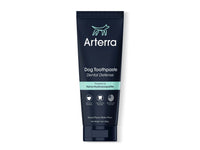
Bioavailable nHA toothpaste with a peanut butter flavor your dog will actually love. Fluoride-free, safe if swallowed, and rebuilds enamel with every brush.

Bioavailable particle size (20 to 80nm), verified batch by batch.

Suspended, not just added, so it stays evenly dispersed in every serving.

Paired with prebiotics that support the whole oral microbiome, not just the tooth surface.

Fluoride-free, meaning it is completely safe if your dog swallows the paste, which they usually do.

Produced in a cGMP-certified US facility with zero fillers, synthetic dyes, or artificial flavors.

Formulated by veterinarians and safely tested on real dogs, not just in a lab.

Yes. Hydroxyapatite is the mineral your dog's enamel is already made of, and the nano form is safe if swallowed, which is critical for dogs since they always swallow the paste. Fluoride is toxic to dogs at higher doses, but nHA is not. It has been used safely in human dentistry for over 40 years, including in toothpastes designed to be swallowed by children.
Standard toothpastes clean the surface by sweeping away plaque with foaming agents and mild abrasives. nHA does that, and it also actively fills the microscopic craters where new plaque anchors. Think of it as the difference between wiping a countertop and resealing it. Both matter, but only one prevents the next problem.
By the time you can see plaque, tartar, or early gingivitis on a dog's teeth, the damage underneath is already established. Periodontal disease affects roughly 80% of dogs over the age of 3. nHA is preventative, meaning it works best when used routinely on healthy teeth, not just when problems appear.
Yes, and we recommend it. nHA pairs well with mechanical cleaning like brushing and our daily dog dental chews. It is not a replacement for a professional veterinary cleaning if your dog already has advanced tartar, but it is what you use afterwards to keep the enamel strong.
Yes, significantly. Only nano-sized particles measuring 20 to 80nm are small enough to enter the microscopic craters where enamel damage lives. Micro-hydroxyapatite sits on the surface, providing polishing but no meaningful remineralization. We break this down in detail in our article Nano vs. Micro Hydroxyapatite: Does Particle Size Actually Matter?
Talk to your vet first. Advanced periodontal disease usually needs a professional cleaning under anesthesia. Once that is done, Arterra's dental dog treats and nHA toothpaste are what you use to keep the results. nHA reinforces the enamel your vet just cleaned, and the prebiotics support the gum microbiome. See our full guide to dog periodontal disease stages.

Join 22,500+ owners who have made the switch from surface-level dental care to something that actually rebuilds the tooth.


© 2026 Arterra Pet, All Rights Reserved.
© 2026 Arterra Pet, All Rights Reserved.