Anesthesia-Free Dog Dental Cleanings: The Clinical Truth (And Why the AVMA Won't Endorse Them)
There is a certain kind of Saturday morning appointment that feels like a win. You drop your dog at the pet salon, or the mobile wellness van parked in the shopping center lot. They come home an hour later. Teeth visibly whiter, breath temporarily neutralized, no anesthesia, no fasting, no bloodwork required. You have avoided the vet, avoided the sedation, and avoided the bill.
It felt gentle. It felt smart.
I understand the appeal. I have watched hundreds of dog parents make this exact choice for exactly the right reason... an honest, protective instinct to keep their dog off the anesthesia table.
But here is the clinical reality nobody selling this service is going to volunteer.
As of 2026, Arterra defines an anesthesia-free dental cleaning as a cosmetic scaling of the visible tooth crown, performed on a restrained awake dog, that does not access the subgingival space where 100 percent of clinically relevant periodontal disease originates. It is not a dental cleaning. It is a photograph of clean teeth. The bacteria that damage the gum, erode the jawbone, and eventually shorten your dog's life do their work below the gumline, in a place a hand scaler and a squirming dog will never reach.
Both the American Veterinary Medical Association and the American Animal Hospital Association have formally advised against non-anesthetic dental scaling in pets for over a decade. Both recognize it as a procedure that gives owners visual reassurance without addressing the underlying disease.
Let's break down what actually happens, what it misses, and what the real third option is between "anesthesia every year" and "hope for the best."

What Actually Happens During an Anesthesia-Free Cleaning?
Here is the honest anatomy of the procedure. A technician (often not a veterinarian, often not credentialed as a veterinary dental hygienist) restrains your dog, typically wrapped in a towel or held between the knees, and uses a hand-held metal scaler to scrape visible tartar off the crown of each tooth. In a compliant dog, they might get through most of the front teeth. In a dog who wiggles, they get what they can and move on.
What they cannot do, by physics and by consent:
-
Probe the gumline. A standard periodontal exam requires inserting a fine probe into the sulcus — the pocket between tooth and gum — at six points on every tooth. Awake dogs do not tolerate this. Without probing, there is no way to grade periodontal disease.
-
Clean subgingivally. Every meaningful dental cleaning happens below the gumline, where the biofilm colonizes the root and quietly dissolves the jawbone. Reaching that space requires a still patient and an ultrasonic scaler tip descending into the sulcus. That is anesthesia territory. Full stop.
-
Take dental radiographs. Roughly sixty percent of canine dental pathology is invisible on the surface. Tooth resorption, root abscesses, retained roots, jaw lesions... you find them on X-rays, not with a flashlight.
-
Polish the enamel. Hand-scaling leaves microscopic scratches on the tooth surface. Without a polishing pass afterward, those scratches become the perfect anchor for the next generation of biofilm. Every veterinary dental college teaches that scaling without polishing accelerates plaque accumulation.
What you get is a photograph. A tooth that looks whiter. A mouth that briefly smells better. And a mouth in which the actual disease continued undisturbed the entire time you were paying for the cleaning.
Why the AVMA and AAHA Have Formally Opposed This for Over a Decade
The AVMA has published a specific policy on anesthesia-free dentistry for years. The AAHA followed with detailed dental care guidelines that state plainly: comprehensive oral examination, cleaning, and treatment cannot be adequately performed on an awake patient.
The reasoning is not political. It is anatomical.
The American Veterinary Dental College is even more direct. Their position statement lists what a real Comprehensive Oral Health Assessment and Treatment (COHAT) actually requires: full-mouth radiographs, sulcus probing at six points per tooth, subgingival scaling, root planing where indicated, and polishing. None of these are compatible with an awake dog. The AVDC classifies non-anesthetic dentistry as offering cosmetic value only, and warns owners that they are being given a false sense of security that their dog's oral health has been addressed.
Read that phrase again. False sense of security. That is a veterinary dental college telling you, in official language, that this service actively harms your dog by convincing you the problem is handled.
The Optimization Trap: Why Smart Dog Parents Fall for This
I want to be careful here, because I have this conversation weekly with the smartest, most engaged dog parents I know. The people booking anesthesia-free cleanings are not neglectful. They are the opposite.
They are the ones who read the anesthesia consent form line by line. They saw the words cardiac arrest, aspiration pneumonia, and hepatic risk in senior patients, and decided, with entirely defensible logic, that avoiding the anesthesia table was the protective move. They are the ones who watched a friend's dog die under sedation. They are the ones whose vet ran the bloodwork, said "her liver values are borderline," and then said "we should still do the cleaning."
The impulse is right. The execution is where the trap closes.
Because the real choice is not "risk anesthesia vs. safe alternative." The real choice is "risk anesthesia every two or three years vs. accept invisible, accelerating periodontal disease that will eventually require a much more aggressive anesthetized procedure, or worse, contribute to systemic organ damage that shortens their life."
The anesthesia-free cleaning is a placebo. It relieves your anxiety. It does nothing for your dog's mouth.
What Is Actually Threatening Your Dog's Mouth?
The disease you should be afraid of is not the yellow film on the visible crown. It is the subgingival biofilm. The bacterial colony that lives in the pocket between tooth and gum, produces endotoxins, triggers a chronic inflammatory response, and quietly dissolves the periodontal ligament and alveolar bone over months and years.
This is the process that leads to:
- Tooth mobility and eventual loss.
- Jaw fracture in small breeds, where bone loss outpaces bone density.
- Bacterial translocation into the bloodstream, seeding renal, hepatic, and cardiac tissue.
- The chronic low-grade inflammation known as inflammaging that accelerates biological aging across every organ system.
None of this is addressed by scraping visible plaque. Not one bit of it.
According to research indexed on PubMed, plaque begins reforming within 24 hours of even a proper anesthetized cleaning. Which means the entire question of "how often do I need a professional cleaning" was always the wrong question. The right question is: what is happening in the mouth during the 364 days between cleanings?

The Third Option Nobody Tells You About
This is the part the pet-services industry has no incentive to explain. There is a third path between "anesthesia-free cosmetic scaling" and "annual anesthetized COHAT."
It is called daily biological maintenance. And it is what our own dentists have been telling us to do for our own mouths for a hundred years.
Daily maintenance works because the enemy is not tartar. Tartar is calcified plaque, already too late for a topical intervention. The real enemy is the soft plaque biofilm, which reforms every 24 hours, and which can be disrupted every 24 hours if you have the right tools. Not scraped. Not scrubbed. Chemically and mechanically disrupted at a molecular level, in a way that:
- Reaches into the sulcus where the actual disease lives.
- Rebuilds the enamel and dentin the bacteria are trying to erode.
- Feeds the beneficial oral flora and starves the pathogenic species.
- Persists in the saliva long after the ritual is over.
This is what nano-hydroxyapatite delivers. The full molecular breakdown of nHA is here, but the short version is that nHA is the exact mineral your dog's enamel is already made of. When you brush it onto the tooth, it doesn't just polish the surface. It fills the microscopic dentin tubules... the same microscopic fissures where subgingival bacteria hide and hand-scaling can never reach. It rebuilds the tooth's structural defense from the same material the tooth was originally built from.
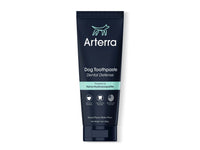
A 60-second nightly ritual with Arterra's nHA remineralizing toothpaste, paired with a residual bio-active dose from an Arterra dental chew during the day, does more for your dog's mouth over a year than any number of cosmetic scalings. And it does it without ever putting your dog on a restraint mat, or into a mask.
This is not a substitute for veterinary anesthetized dentistry when your dog actually needs it. It is what makes the difference between needing that cleaning every 12 months and needing it every 3 to 4 years.
When You DO Need Real Anesthetized Dentistry
Let me be honest about this too, because the pendulum can swing too far the other way. Daily nHA maintenance is not a replacement for real dental care when the disease is already established. If your dog has:
- Grade 2 or higher periodontal disease on a real veterinary exam.
- Loose, painful, or infected teeth.
- Persistent halitosis after 90 days of consistent daily nHA use (a strong signal that something is happening below the gumline).
- Advanced age with no dental history — meaning you are inheriting years of biofilm accumulation you cannot fully undo topically.
...you need a real Comprehensive Oral Health Assessment and Treatment. Under anesthesia. With radiographs. With a credentialed veterinary team who can actually see, probe, scale, root plane, and extract what needs to come out. The AAHA guidelines are not a suggestion. They are what a proper cleaning requires.
The anesthesia risk is real. But modern veterinary anesthesia protocols, with pre-anesthetic bloodwork, IV catheters, active monitoring, and warming, have brought reported mortality risk in healthy dogs down to roughly 0.05 percent. That is dramatically lower than the systemic risk of leaving Grade 3 periodontal disease untreated for another two years.
The point is not "always avoid anesthesia." The point is to make sure your dog's daily care is doing 95 percent of the work, so that when anesthesia is genuinely needed, the procedure is short, targeted, and rare.
Longevity Insights: Key Takeaways
- Anesthesia-free dental cleanings are cosmetic scalings of the visible crown. They do not access the subgingival space, where 100 percent of clinically relevant periodontal disease lives.
- The AVMA, AAHA, and American Veterinary Dental College have all formally advised against non-anesthetic dentistry, calling it a false sense of security.
- The correct alternative to unnecessary anesthesia is not scraping. It is daily biological maintenance that disrupts biofilm, remineralizes enamel, and modulates the oral microbiome from the inside.
- Real anesthetized COHATs are still required when established disease exists. Daily nHA is what makes them rare. It is not what replaces them.
The Cleaner Path Forward
The nightly ritual is not glamorous. It is 60 seconds. A pea-sized amount of nHA paste. Ten strokes down one side, ten on the other, focus on the gumline, done. Add a residual bio-active dental chew during the day, and you have covered the entire 24-hour biofilm cycle.
Compare that to booking a cosmetic scaling every four months for years, feeling reassured, and then discovering at age nine that your dog has advanced periodontal disease you didn't know was progressing the whole time.
Health is an investment in time.
The daily minute you invest is the one that actually saves the years.
Experience the Science of nHA →
Tags:
anesthesia-free dental cleaning,
canine dental health,
dog teeth cleaning,
nano-hydroxyapatite,
oral-gut axis,
periodontal disease,
subgingival biofilm