The referring vet's chart said "healthy mouth." The dog was seven. A Golden named Poppy, best girl a family could ask for. Owner brushed her teeth every night. Ate a premium diet. No visible tartar. No obvious redness at the gumline. By every metric you can see with the naked eye, Poppy's mouth looked fine.
Then she took intraoral X-rays.
Below the gumline, on the buccal surface of her upper premolars, the enamel was pockmarked with fine erosive craters. The kind of loss that doesn't show on a physical exam because it hides under a thin cosmetic film of saliva and plaque. Poppy was not sick yet. She was six months from being sick, and nothing her owner was doing at home was going to bend the trajectory. Not the brushing. Not the enzymatic paste. Not the chew.
I want every dog parent reading this to understand what took me a decade to fully understand. Enamel is not a shell. It is a scaffold. And a scaffold, unlike a shell, can be rebuilt.
The pet-dental category has quietly hidden this from you for years, because rebuilding requires a molecule most of the industry does not sell.

The 100-Word Answer: What Is Enamel Scaffolding?
Enamel scaffolding is the biomimetic process by which nano-hydroxyapatite crystals migrate into demineralized sites on a tooth, physically dock into the existing crystal lattice, and rebuild the tooth's mineral architecture from the outside in. Because canine enamel is roughly 97 percent hydroxyapatite by weight, applying particles of the same molecule creates a chemical bond, not a coating. Enzymatic pastes only clean. Silica pastes scrub. Only nano-hydroxyapatite scaffolds new enamel onto the damaged sites where periodontal disease actually begins. As of 2026, this is the clinical standard for at-home canine enamel repair.
The Myth We Have to Bury First: "Enamel Cannot Regrow"
Ask most veterinarians whether canine enamel can be rebuilt, and you will hear a version of the same sentence: enamel is the hardest substance in the body, but once it is gone, it is gone. That sentence is repeated in vet school. It is repeated in continuing education. It is, in the strictest cellular sense, technically true. Ameloblasts, the cells that laid down your dog's enamel in puppyhood, retire after eruption. The body does not grow new enamel the way it grows new skin.
But the sentence is also a category error. It confuses biological regeneration with mineral reconstruction. The body cannot make new enamel cells. It can absolutely accept new enamel mineral from an outside source... if the mineral is the right shape, the right size, and the right chemistry.
That is the entire premise of biomimetic scaffolding. And it is why the 2026 clinical conversation has moved on from "enamel is a lost cause" to "which molecule are we using to rebuild it."
What Enamel Actually Is (The Part Vet School Skips)
Picture a wall built from millions of tiny hexagonal crystal rods, packed together like the honeycomb inside a beehive. Each rod is a hydroxyapatite crystal with the chemical formula Ca10(PO4)6(OH)2. The rods run roughly perpendicular to the tooth surface. Between them sit tiny protein-rich spaces that give the enamel its slight flex, so the wall does not shatter every time your dog crunches a bone.
Two facts about this wall matter enormously.
First, canine enamel is thinner than human enamel. A dog's enamel layer averages around 0.1 to 0.6 millimeters, compared to roughly 2.5 millimeters at the human molar cusp. That is why a dog develops periodontal problems on a timeline that would be considered aggressive in a human patient. There is simply less mineral standing between the outside world and the dentin.
Second, the wall is porous. On a microscopic level, even a "healthy" tooth has interrod spaces and microscopic surface fissures. When the mouth swings acidic, mineral leaks out of these spaces. When the mouth swings alkaline, mineral tries to move back in. This is the demineralization-remineralization cycle, and it runs every day in every mouth, canine and human.
Traditional dog dental care ignores this cycle entirely. It focuses on the surface. Scrape the plaque. Kill the bacteria. Freshen the breath. That approach treats the tooth as a static object to be cleaned. It is not. It is a living mineral system in constant flux.
How Enamel Actually Gets Destroyed
The story of periodontal disease in dogs is not a story about tartar. Tartar is the visible symptom. The mechanism is quieter and starts weeks earlier.
Oral bacteria adhere to the tooth surface within minutes of a cleaning. Within hours, they build a biofilm... a protected microbial community with its own chemistry. The bacteria ferment carbohydrates and shed acidic byproducts, especially lactic and acetic acid. These acids drop the local pH at the tooth surface below the critical threshold of roughly 5.5, at which point calcium and phosphate ions begin dissolving out of the enamel crystal lattice. This is called demineralization.
Under normal conditions, saliva buffers the mouth back to neutral, and calcium and phosphate ions in the saliva slowly redeposit into the damaged sites. This is remineralization. Every dog's mouth is doing this all night, every night.
The problem is that in a modern canine diet, the acidic hits are frequent, the plaque burden is heavy, and the salivary rebuild cannot keep up. Net mineral loss accumulates. Microscopic craters form. The craters trap more bacteria. The cycle accelerates. By age three, according to the American Veterinary Medical Association, more than 80 percent of dogs show evidence of periodontal disease. That is not a hygiene problem. That is a mineral-balance problem.
You can brush every night for nine years and still lose the mineral fight if all your paste is doing is cleaning.
What The Pet-Dental Category Actually Puts In The Tube
Here is the piece almost no one explains honestly. Walk down the dog-toothpaste aisle at any pet retailer and you will find, essentially, two categories.
Enzymatic pastes (Virbac C.E.T., Petsmile, Vetoquinol) use enzymes like glucose oxidase and lactoperoxidase to disrupt bacterial biofilm. They are effective at cleaning. They do nothing to rebuild the tooth. They were designed for a bacterial problem, not a mineral one.
Silica-based pastes use tiny abrasive particles to scrub plaque off the surface. They clean, and they polish. They also, over years of use, erode the very enamel they are supposed to protect. Abrasion has been the dental hygienist's compromise for decades. It works, until it works against you.
Notice what is missing. Neither category puts a single milligram of enamel mineral back on the tooth. The pet-dental industry walked away from fluoride years ago on safety grounds. Dogs cannot rinse and spit, so a swallowed fluoride dose became a real toxicity concern. That was the right call. What the industry did next, though, was reach for enzymes and silica to replace fluoride, and those replacements do not rebuild anything.
The rebuild gap has been sitting open for a decade. Nano-hydroxyapatite is the molecule that closes it.
How Biomimetic Scaffolding Actually Works, Step By Step
Here is the mechanism I would draw on a napkin for a curious pet parent. This is what happens in your dog's mouth in the 8 to 12 hours after a nighttime application of nHA toothpaste.
Step 1. Docking.
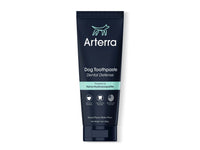
The nano-hydroxyapatite particles in Arterra's paste are engineered to a size range of roughly 20 to 100 nanometers. That is small enough to slip into the microscopic surface fissures and interrod spaces on the enamel. The particles carry a slight surface charge and, because they are chemically identical to the tooth's own mineral, they are electrostatically attracted to sites of active demineralization. They dock. They do not just sit on the surface.
Step 2. Crystal Growth.
Once docked, the nHA particle serves as a nucleation site. Calcium and phosphate ions from saliva accrete onto the docked particle in the same crystalline orientation as the surrounding enamel. New crystal grows outward from the scaffold, layer by ionic layer, until the crater is filled. This is not adhesion. This is epitaxial crystal growth, the same process by which the tooth was originally built.
Step 3. Lattice Integration.
Over successive nights, the newly grown crystal integrates into the surrounding enamel. It shares atomic bonds with the neighboring hydroxyapatite. Under microscopy, you cannot easily distinguish the rebuilt zone from the original enamel. The tooth has physically added mineral, not just polished what was left.
Step 4. Biofilm Displacement.
A remineralized surface is a hostile surface for pathogenic bacteria. The pockmarked craters that trapped biofilm are gone. The tooth is smoother at the microscale, more mineral-rich, and less hospitable to the acid-producing species that started the cycle. This is the systemic downstream benefit of scaffolding: you do not just repair the tooth, you take away the habitat the pathogens were using.
This four-step cycle runs every night the paste is used. It is not dramatic. There is no immediate visible change. It is patient, molecular, cumulative work. Six months in, the intraoral X-ray tells a different story than it would have.

Why The "Peanut Butter" Choice Matters More Than It Sounds
Arterra's nHA toothpaste is flavored with natural peanut butter. Not mint. Not synthetic chicken. Not "poultry-type." This is deliberate, and it matters for a reason that has nothing to do with taste and everything to do with the chemistry above.
Scaffolding requires contact time. The nHA particles need to stay against the tooth long enough to dock and initiate crystal growth. If your dog fights the paste, the ritual dies inside a week. Every parent knows this. The paste that never gets used works zero percent of the time.
Peanut butter is a food a dog recognizes. It is not a synthetic palatant that mimics an aroma the dog has never actually encountered in the wild. Natural peanut butter carries fat and protein signals that the canine olfactory system rewards. Compliance goes up. Contact time goes up. The scaffolding process gets the window it needs to work.
The dog-toothpaste market is full of "poultry" and "beef" flavored gels that are largely chemical facsimiles of the real thing. Arterra took the harder road. The paste is a food-grade formulation because the biology of at-home dental care fails without it.
What This Means For The Ritual
The clinical implication of biomimetic scaffolding is that the nighttime application is not a hygiene step. It is a therapeutic dose. Your dog's mouth remineralizes overnight because that is when saliva flow slows, the mouth stays undisturbed, and the docked nHA particles have hours to nucleate crystal growth. The paste is doing its most important work while your dog is asleep.
Which is why the 60-second bedtime application is worth more than the rushed morning brush. If you have to pick one, pick the one closest to bedtime. Let the scaffolding run.
The American Veterinary Dental College has been clear for years that at-home care is the single largest determinant of a dog's long-term dental outcome, above cleanings, above chews, above anything else you buy at the vet. Scaffolding is what makes at-home care finally live up to that responsibility.
Frequently Asked Questions
Can enamel really regrow in an adult dog?
The enamel cells (ameloblasts) do not regenerate after tooth eruption. That part of the old teaching is correct. But the mineral component of enamel absolutely can be rebuilt from an outside source, provided the source is the right molecule at the right particle size. Nano-hydroxyapatite is chemically identical to the mineral in your dog's enamel, which is why the rebuild is possible without cellular activity. The scaffold does the work the cells no longer can.
How is this different from fluoride?
Fluoride works by exchanging fluoride ions into the enamel crystal to form fluorapatite, which is more acid-resistant than the original hydroxyapatite. It hardens what is still there. It does not add new mineral. Fluoride was never a rebuilder. It was a fortifier. And the pet-dental industry moved off it years ago because dogs cannot rinse and spit, making swallowed fluoride a real safety concern. nHA is safe to swallow, biomimetic, and it adds mineral where there was none.
How long before I see results?
Cosmetically, most owners notice a smoother tooth surface and less morning breath within a few weeks. Structurally, the meaningful change is what shows up on intraoral X-rays and periodontal probing over six to twelve months of consistent nightly use. This is not a whitening trick. It is a mineral rebuild, and mineral rebuild is measured in months, not days.
Longevity Insights: Key Takeaways
- Canine enamel is 97 percent hydroxyapatite. It cannot regrow cellularly, but it can be rebuilt mineralically from an outside source of the same molecule.
- Enzymatic pastes clean. Silica pastes scrub. Only nano-hydroxyapatite scaffolds new mineral onto the sites of active demineralization.
- The pet-dental industry left the rebuild gap open when it dropped fluoride on safety grounds. nHA is the molecule that closes it, and it is safe to swallow.
- Scaffolding happens overnight. The bedtime application is a therapeutic dose, not a hygiene step. Compliance is the single biggest variable, which is why real-food flavor (peanut butter) matters.
- Meaningful structural change is measured in six to twelve months of nightly use, not days.
Poppy is now nine. Her most recent intraoral series shows those buccal craters partially filled in, the surrounding enamel intact, and the periodontal probe depths holding steady. Her owner did not do anything heroic. She swapped one paste for another and stayed with the 60-second bedtime ritual. The scaffolding did the rest.
Your dog's teeth are trying to rebuild themselves every single night. The only question is whether the paste on your bathroom counter is helping or getting out of the way.
Experience the Science of nHA and give your dog's enamel the scaffolding it has been waiting for.
For the foundational overview, read The Science of nHA. For the nightly implementation, read Repair, Refresh, Remineralize, Restore.
Tags:
biomimetic scaffolding,
canine enamel remineralization,
canine periodontal prevention,
dog dental repair,
nano-hydroxyapatite,
nHA toothpaste,
peanut butter dog toothpaste,
tooth demineralization