I want to tell you something that took me a long time to admit, even to myself. When I lost my first dog to congestive heart failure, I blamed genetics. I blamed age. I blamed everything except the one thing sitting in plain sight, six inches from her heart... her mouth.
Her breath had been bad for years. I brushed sometimes. I bought the crunchy kibble. I did what a "good" dog dad was supposed to do. And still, a colony of bacteria was launching from her gum line into her bloodstream every time she ate, every time she panted, every time she slept.
That's not guilt talking. That's the peer-reviewed literature.
What the Science Actually Shows
Canine periodontal disease is not a cosmetic problem. It is a cardiovascular risk factor. In a landmark study published in the Journal of the American Veterinary Medical Association, Dr. Larry Glickman and colleagues at Purdue University followed more than 59,000 dogs and found that severe periodontal disease was associated with a significantly higher risk of cardiovascular-related conditions, including endocarditis and cardiomyopathy. The mechanism is not mysterious. Every inflamed gum pocket is an open door. Bacteria from the subgingival biofilm cross the epithelial barrier, enter systemic circulation, and physically colonize distant organs... including the heart valves.
This is what we call the systemic tax. Your dog's mouth is not a closed system. It is the front gate to their entire biology.

How Bacteria Travel From the Mouth to the Heart
Here's the part most owners never hear at the annual checkup. A healthy mouth is not a sterile environment. It hosts a balanced microbial ecosystem. When that ecosystem tips into dysbiosis (imbalance), the dominant species shift from commensal (helpful) to pathogenic (harmful). The gumline inflames. The junctional epithelium (the thin seal between tooth and gum) breaks down. And then the real damage begins.
The Bloodstream Bridge
Every chew, every lick, every drink of water produces a phenomenon called bacteremia... a brief release of oral bacteria into the bloodstream. In a healthy mouth, the immune system handles it in seconds. In a diseased mouth, the release is constant, high-volume, and includes the worst actors in the microbial rogues' gallery. Once in circulation, these bacteria follow the blood back to the heart. Some are filtered out. Some adhere to the endothelium (the interior lining of blood vessels and heart chambers). Some settle on the valves.
Porphyromonas gulae: The Canine Culprit
Porphyromonas gulae is the primary periodontal pathogen in dogs, closely related to the human pathogen P. gingivalis. Research published through the National Center for Biotechnology Information (NCBI PMC) has identified this bacterium in cardiac tissue samples from dogs with confirmed periodontal disease. It secretes proteases called gingipains that degrade tissue proteins, destabilize the endothelial lining, and create the exact conditions where fibrin clots and vegetative growths form on heart valves. That is the pathological definition of endocarditis. And it starts in the mouth.
Why Small Breeds Are Doubly at Risk
If you share your life with a Chihuahua, a Poodle, a Doodle, a Cavalier King Charles Spaniel, or a Yorkie, this section is for you. Small breeds carry two overlapping vulnerabilities that stack like compound interest.
First, crowded dentition. Small mouths hold the same 42 adult teeth as a Great Dane, packed into a fraction of the real estate. Teeth rotate. Teeth overlap. Food and biofilm wedge into interproximal spaces that a brush can barely reach. The oral microbiome tips into dysbiosis earlier and stays there longer.
Second, myxomatous mitral valve disease (MMVD). This is the most common heart condition in small-breed dogs, affecting a significant percentage of Cavaliers by age five and a majority of small breeds by age ten. When you overlay chronic bacterial seeding onto a valve that is already structurally compromised, you accelerate a timeline that was already too short.
The American College of Veterinary Internal Medicine (ACVIM) has published consensus guidelines on MMVD staging that emphasize modifying every controllable risk factor. Oral health is one of the few risk factors an owner can control directly, at home, every night.
Signs You Are Already Behind
By the time you see the following, the systemic tax has been running for months or years.
-
Halitosis (bad breath). Not "dog breath." A sulfurous, metallic, or fecal odor. That is the volatile sulfur compound signature of anaerobic bacterial metabolism. It is a chemical distress signal.
-
Red, rolled, or bleeding gums, especially at the gum-tooth interface.
-
Yellow or brown accretions at the gumline. That is calculus, and it is a bacterial fortress.
-
Reluctance to chew hard food, dropping kibble, favoring one side of the mouth.
-
Facial pawing, head shyness, or a subtle personality shift. Chronic oral pain is a mood-shifter in dogs, just as it is in people.
None of these are "just getting older." They are diagnostic signs of an active infection with cardiovascular downstream.

The Standard Industry Myth: "Crunchy Kibble Cleans Teeth"
This is the myth that has cost more canine lifespan than any other single piece of pet marketing.
Kibble does not clean teeth. The kibble particle shatters on the tooth cusp and leaves the gumline (where periodontal disease actually lives) completely untouched. Worse, most commercial kibble is 40 to 60 percent starch. Starch is metabolized by salivary amylase into simple sugars, which are the preferred fuel source for the exact anaerobic bacteria you are trying to starve. You are not brushing your dog's teeth by feeding kibble. You are feeding the biofilm.
The same critique applies to most "dental treats" on the market. If the treat is 50 percent starch, the residual metabolic activity in the mouth continues fueling pathogen dominance long after the mechanical scrape is gone. This is The Starch Trap, and it is why dental treats can genuinely make oral health worse over time.
Reversing the Systemic Tax: A Nightly Protocol
The good news is that the heart-mouth axis works both directions. If bacterial dysbiosis in the mouth drives systemic inflammation, then restoring oral homeostasis reduces it. The protocol is not complicated. It is nightly, consistent, and biologically targeted.
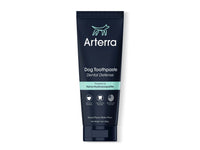
Step 1: Rebuild the Enamel Defense (nHA Toothpaste)
Enamel is your dog's first firewall against bacterial invasion. When it is intact, pathogens cannot access the dentin tubules and the pulp. When it is fissured, they colonize the microscopic cracks and set up permanent residence. Nano-hydroxyapatite (nHA) is a synthetic version of the calcium-phosphate mineral (Ca10(PO4)6(OH)2) that makes up 97 percent of tooth enamel. It behaves as "liquid enamel"... a biomimetic material that fills microscopic fissures, restores the mineral matrix, and closes the doors that bacteria use to hide.
Unlike fluoride, nHA carries no systemic toxicity concern for a dog who inevitably swallows the paste. It never taxes the liver or kidneys. It is not an antibacterial in the traditional sense. It is a structural repair material. The peer-reviewed dental literature on PubMed now contains hundreds of studies validating nHA remineralization in human dentistry. The chemistry translates directly to canine enamel.
Step 2: Shift the Microbiome (Dental Chews with Prebiotic Support)
Brushing addresses the tooth surface. It does not address the microbial community itself. That is why the Oral-Gut Axis matters. Prebiotic ingredients like banana fiber and chicory root selectively feed beneficial oral bacteria and starve the pathogenic anaerobes that drive periodontal disease. Combined with nHA delivered in chew format, the residual bioactivity in saliva continues working long after the chew is gone. This is the difference between mechanical scraping (a snapshot) and microbial modulation (a trajectory).
Step 3: Support Systemic Resilience (Longevity Multivitamin)
A dog with chronic periodontal inflammation is a dog with elevated pro-inflammatory cytokines circulating through every tissue, including the heart. Comprehensive nutritional support targeting inflammaging at the cellular level gives the immune system the bandwidth to handle bacteremia when it does occur, and reduces the baseline inflammatory tax on the cardiovascular system.
The 60-Second Investment Your Dog's Heart Cannot Make For Itself
Every night, before the couch, before the last walk, before the bedroom door closes... one minute. That is what stands between your dog and the slow, silent bacterial migration to their heart valves. The heart is downstream of the mouth. Always was. Always will be.
Health is an investment in time.
Longevity Insights: Key Takeaways
- Severe canine periodontal disease is associated with a measurable, significant increase in cardiovascular-related conditions, per the Glickman et al. 2009 JAVMA study of more than 59,000 dogs.
-
Porphyromonas gulae, the primary canine periodontal pathogen, has been identified in cardiac tissue samples. Its gingipains destabilize the heart's endothelial lining.
- Small breeds face compound risk: crowded dentition accelerates periodontal dysbiosis, and myxomatous mitral valve disease makes the heart valves structurally vulnerable to bacterial colonization.
- Kibble does not clean teeth. Starch-heavy dental treats can worsen the oral microbiome. Mechanical solutions do not address the subgingival biofilm.
- The reversal protocol is nightly and three-part: nHA to repair enamel, prebiotic dental chews to shift the microbiome, and comprehensive nutritional support to reduce systemic inflammation.
Related Reading
If this piece resonated, dig deeper into the science:
Experience the Science of nHA. The Arterra Nightly Repair Ritual takes 60 seconds. Your dog's cardiovascular system gets the rest of the night to recover. Explore the Arterra dental system and start the ritual tonight.
Tags:
canine health,
cardiovascular,
dental care,
heart health,
oral-gut axis,
periodontal disease