The first time I heard that an owner was crying because her nine-year-old lab was pacing the same hallway for forty minutes at 3 a.m., I did not talk to her about supplements. I asked her the question no one had asked her in nine years of vet visits.
How does his breath smell?
She went quiet. Then she said, "Bad. It has been bad for years."
I want to be careful here, because grief is not a place for oversimplification. Canine Cognitive Dysfunction is not caused by a single thing. But there is a conversation happening in veterinary neurology right now that most owners have never been let in on. It is called the oral-brain axis. And the peer-reviewed literature is getting louder every year.
The 100-Second Answer
Canine Cognitive Dysfunction (CCD) is a progressive neurodegenerative condition in aging dogs that shares striking pathological features with human Alzheimer's disease, including beta-amyloid plaque accumulation and chronic neuroinflammation. Emerging research has identified periodontal pathogens, specifically Porphyromonas gulae in dogs and its human analog P. gingivalis, as measurable contributors to systemic inflammation and blood-brain barrier disruption. In other words, the biofilm in your dog's mouth is not confined to the mouth. It taxes the entire nervous system. As of 2026, the clinical standard for cognitive preservation begins with oral dysbiosis intervention long before behavioral symptoms appear.
What Canine Cognitive Dysfunction Actually Is
CCD is often described in owner-friendly terms as "dog dementia." That translation is fair, but it undersells the biological reality. In a landmark cross-sectional survey published in the Journal of the American Veterinary Medical Association, Neilson and colleagues found that 28 percent of dogs aged 11 to 12 and 68 percent of dogs aged 15 to 16 showed clinical signs of cognitive impairment. Later work by Salvin et al. in The Veterinary Journal confirmed that the vast majority of these cases are never formally diagnosed. Owners chalk the changes up to "getting old." Vets, pressed for time, often do the same.
That silence has a cost.
The classic clinical framework is called DISHAA: Disorientation, altered social Interactions, Sleep-wake cycle disruption, House-soiling, altered Activity levels, and Anxiety. On a cellular level, we see beta-amyloid deposition in the frontal cortex, oxidative damage to mitochondria, and a chronic low-grade inflammatory state in the microglia (the brain's resident immune cells). This is the same inflammaging cascade that hits joints, kidneys, and cardiovascular tissue. The brain is not immune. It is arguably the most vulnerable organ your dog has.
The Oral-Brain Axis: The Link Most Owners Never Hear About
Here is the piece that changes the conversation. In 2019, Dominy and colleagues published a landmark paper in Science Advances demonstrating that Porphyromonas gingivalis, the primary human periodontal pathogen, was present in the brains of deceased Alzheimer's patients. They identified gingipains, the toxic proteases produced by P. gingivalis, in the cortex. When they infected mice orally with the bacterium, the pathogen migrated to the brain and produced hallmark Alzheimer's pathology. The direction of causality is still being debated. The physical presence of oral bacteria in brain tissue is not.
Dogs have a parallel pathogen. Porphyromonas gulae is the dominant periodontal actor in the canine mouth, and it is a close genetic cousin of P. gingivalis. It produces the same category of gingipain-like virulence factors. It thrives in the same subgingival environment. And it uses the same route into the body... a route your dog opens every time they eat, chew, or breathe against an inflamed gumline.

How Oral Bacteria Reach the Brain
The pathway is not exotic. It is, unfortunately, ordinary.
-
Dysbiosis. The oral microbiome tips from commensal balance to pathogenic dominance. The junctional epithelium (the biological seal between tooth and gum) inflames and thins.
-
Bacteremia. Every meal and every chew releases oral bacteria into systemic circulation. In a healthy mouth the immune system clears them in seconds. In a dysbiotic mouth the release is constant.
-
Systemic inflammation. Circulating bacteria and their endotoxins (LPS) trigger a pro-inflammatory cytokine cascade, including TNF-alpha and IL-6, which are the same messengers that drive inflammaging.
-
Blood-brain barrier compromise. Chronic systemic inflammation increases blood-brain barrier permeability. What was once a fortress becomes a screen door.
-
Neuroinflammation. Microglia activate. Beta-amyloid clearance slows. The cognitive reserve your dog has been quietly spending for years finally runs low enough to see from the outside.
By the time you notice the 3 a.m. pacing, this cascade has often been running for years.
The Industry Myth We Need to Retire
The myth is this: cognitive decline is an inevitable part of your dog getting old, and there is nothing to do about it but love them through it.
The love part is right. The inevitability part is not.
Cognitive aging in dogs is a spectrum, and the position on that spectrum is modifiable. The biggest lever is not a nootropic. It is not a fish oil dose. It is the same thing that drives cardiovascular and renal aging in dogs... chronic oral dysbiosis producing a low-grade systemic inflammatory load that the brain cannot indefinitely absorb. Reduce the input and the downstream tax drops.
That is not folk wisdom. That is inflammation biology.
Early Warning Signs Before Age 7
Most CCD conversations start at age 10. That is far too late. The pathological changes underlying cognitive dysfunction begin accumulating in the middle years, roughly ages 5 to 8 for medium and large breeds, sometimes later for small breeds. Watch for:
- Subtle changes in sleep architecture (waking during the night, sleeping through the day)
- Reduced engagement with familiar games or family members
- Momentary disorientation in familiar rooms
- Delayed response to name or known cues
- New-onset anxiety at thresholds (doorways, stairs)
-
Persistent halitosis, which is often dismissed but is a direct biomarker of subgingival dysbiosis
The last one is the tell most owners miss. Bad breath is not a cosmetic issue. It is volatile sulfur compounds and bacterial metabolites venting out of an ecosystem that is losing balance. If your dog's breath has been off for six months, the bacteria producing that smell have had six months of unimpeded systemic access.
What Actually Moves the Needle
There is no single molecule that reverses cognitive dysfunction. Anyone who tells you otherwise is selling something. But there is a stack of high-leverage interventions, and their order matters.
1. Interrupt the Oral Inflammation Cycle
You cannot supplement your way out of a mouth that is leaking bacteria into the bloodstream every hour. Step one is always to reduce the source load. That means addressing the subgingival biofilm, not just the surface plaque.
This is where Arterra's approach diverges from the mechanical models that have dominated the pet aisle for two decades. Legacy dental chews rely on physical scraping and "transit time." That approach cleans the crown and leaves the subgingival compartment untouched, which is exactly where the pathogenic species live. Our dental system pairs nano-hydroxyapatite (nHA) for enamel remineralization with prebiotic modulation (banana fiber, chicory root) to shift the microbiome from dysbiosis toward balance. It works below the gumline, not just above it. For a deeper look at the microbial mechanism, see our pillar on The Oral-Gut Axis.
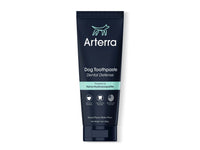
The nightly ritual matters just as much. A minute with a non-abrasive, fluoride-free nHA toothpaste rebuilds the enamel's defensive scaffold while your dog sleeps. If you have never seen the mechanism laid out, our Science of nHA pillar covers the biology in detail.

2. Feed the Cognitive Reserve
Once the inflammatory input is reduced, the second lever is nutritional support for the systems the brain depends on. This is the domain of the Canine Longevity Protocol. Cognition is not a standalone pillar. It is downstream of mitochondrial function, gut integrity, immune calibration, and cardiovascular perfusion. When any of those systems drift, cognition drifts with them.
This is why bioavailability matters so much. Most senior-support soft chews on the shelf list impressive-looking ingredients at sub-therapeutic doses, bound in a matrix that never reaches cellular circulation. The label is a marketing document. The bloodstream is the referee. Arterra's longevity formulation is built on the opposite premise... every milligram is dosed for measurable cellular impact across joint, gut, immune, cognition, and organ function.
3. Environmental Enrichment
Cognitive load is protective. Novel walks, scent work, food puzzles, and gentle new training keep the neural circuitry active. This is not a supplement replacement. It is a co-therapy, and it is free.
The 2026 Standard
The old standard was to react to cognitive decline once it was visible. The 2026 standard is to intervene on inflammatory inputs during the middle years, before the brain has spent down its reserve.
That reframe changes what "routine dental care" means. Brushing is no longer about cosmetic plaque. It is about protecting neural tissue five years upstream of the symptom. A dental chew is no longer a treat. It is a daily modulation of the ecosystem sitting six inches from the brain.
This is what we mean at Arterra when we say health is an investment in time. The intervention you make today buys the version of your dog that still recognizes you at 14.
Longevity Insights: Key Takeaways
- Canine Cognitive Dysfunction affects up to 68 percent of dogs aged 15 to 16 and is dramatically under-diagnosed.
- Periodontal pathogens, especially Porphyromonas gulae, drive systemic inflammation that compromises the blood-brain barrier.
- Persistent bad breath is a functional biomarker of subgingival dysbiosis, not a cosmetic issue.
- Reducing the oral inflammatory load through subgingival intervention is the highest-leverage cognitive protection available in the middle years.
- Bioavailable, therapeutically dosed longevity support amplifies the protective effect once the inflammatory input is under control.
A Final Word From the Lab Coat, and the Dog Dad
I lost sleep hearing what this owner was going through. Not because I could not help her lab. She adjusted the protocol and he stabilized for another good stretch of life. I lost sleep because I kept thinking about the years before the phone call, and how the entire industry had trained her to treat her dog's mouth as a hygiene problem instead of a longevity system.
The mouth is the front gate. What passes through it, in either direction, shapes how many summers you get.
You cannot buy your dog more years by wishing for them. You can build them, one nightly ritual at a time.
Experience the science of the oral-gut axis. Or optimize the systemic side with the Canine Longevity Protocol. Your dog's cognitive reserve is being spent right now. Decide what you want to spend it on.
Tags:
canine health,
cognitive dysfunction,
dog dementia,
longevity,
neuroinflammation,
oral-brain axis,
periodontal disease,
senior dog care