Small breed dogs (Chihuahuas, Yorkies, Toy Poodles, Maltese, Doodles, and most breeds under 20 pounds) develop periodontal disease at rates dramatically higher than large breeds... and lose teeth years earlier. The mechanism is anatomical: a small dog's jaw is scaled down proportionally, but tooth count and tooth size are not. That mismatch produces tooth crowding, retained baby teeth, and deep interproximal pockets where bacteria colonize beneath the gumline. Traditional brushing and abrasive dental chews cannot physically reach those pockets. Nano-Hydroxyapatite (nHA) at 20-80 nanometers can. This is the real reason your small dog needs a different dental protocol than a Labrador.
The Numbers Nobody Wants to Talk About
I'll say this plainly.
If you own a small breed dog, your dog is roughly two to three times more likely to lose teeth to periodontal disease than a large breed dog of the same age. That statistic comes out of large-scale veterinary insurance datasets and academic studies, and it has been consistent for decades. Small breeds also enter Stage 2 periodontal disease (attachment loss, bone loss beginning) years earlier than their large-breed counterparts.
The American Veterinary Medical Association has flagged periodontal disease as the most common clinical condition in adult dogs, with most animals showing signs by age three. For small breeds, that timeline compresses. By the time your Yorkie is five, the damage is often already structural.
And here's the part that will hit you if you own one of these dogs. Most small breed dental disease is invisible until it isn't. There is no "warning breath." There is no gradual visible tartar you notice while playing tug. Small breed periodontal disease progresses beneath the gumline, in the interproximal spaces between crowded teeth, hidden from view until a tooth is already mobile.
Then, one day at a routine cleaning, your vet says the sentence every small breed owner eventually hears... “We're going to need to extract several.”
Why Small Breed Dogs Have Worse Dental Disease
Three mechanical realities drive this, and understanding them changes how you protect against it.
1. The Jaw-to-Tooth Ratio Problem
Every domestic dog, from a 4-pound Chihuahua to a 180-pound Mastiff, has 42 permanent teeth. Same count. The teeth are scaled down in small breeds, but not proportionally to the jaw.
Think about what that means at the microscopic level. In a Labrador, a molar sits with several millimeters of gum and bone between it and the next tooth. Plenty of room for saliva to circulate. Plenty of clearance for a toothbrush bristle to sweep the surface. In a Toy Poodle, that same anatomical region is compressed into a fraction of the space. Teeth are literally touching. There is no interproximal room for a brush. There is no clearance for a scraping chew. Bacteria settle into the microscopic V-shaped pockets between adjacent crowns and nothing at the macro scale can reach them.
Crowding is the single biggest risk factor for early canine periodontal disease. And crowding is a small-breed problem by design.

2. Retained Deciduous Teeth
Puppies get 28 baby teeth (deciduous teeth) that normally exfoliate as the 42 permanent teeth erupt underneath. In small breeds, that exchange frequently fails. The baby tooth stubbornly refuses to fall out. The permanent tooth erupts alongside it. You end up with two teeth occupying a socket built for one.
This is called a persistent deciduous tooth, and it is dramatically more common in small breeds. Yorkies, Toy Poodles, Pomeranians, Malteses, Chihuahuas, and Shih Tzus lead the list. Every persistent deciduous tooth is a periodontal disaster waiting to happen. Food packs between the retained tooth and its permanent neighbor. Biofilm colonizes the gap. Gingivitis follows within months. And most owners never even notice their puppy has two rows of teeth in one spot until years later, when the collateral damage is already done.
3. Longer Lifespan, More Compounding Damage
Small dogs live longer. A Chihuahua's median lifespan is 15-17 years. A Great Dane's is 8-10. That gap seems like good news for the small breed owner, and in most ways it is. For the mouth, it isn't.
Periodontal disease is a compounding process. Every year of unchecked biofilm adds cumulative attachment loss, bone resorption, and inflammatory signaling into the bloodstream. A Great Dane's mouth gets about a decade of accumulated damage. A Chihuahua's mouth gets sixteen years of it, in a jaw that started at a compromised anatomical baseline.
More time under a worse starting condition. That's the actual math of the small breed dental crisis.
The Breeds Most at Risk
Every board-certified veterinary dentist keeps roughly the same mental list. If your dog is on it, this article is aimed directly at you.
-
Chihuahua — the archetype. Extreme jaw-to-tooth mismatch. High retained-deciduous rate.
-
Yorkshire Terrier — narrow rostrum, tight lower incisors, chronic gingivitis by age three is common.
-
Toy and Miniature Poodle — retained deciduous teeth are almost the default.
-
Maltese — small jaw, high inflammation baseline, notoriously bad breath from an early age.
-
Doodle mixes (Cavapoo, Cockapoo, Maltipoo, Yorkiepoo) — inherit the crowded-mouth genetics from the poodle side. This is now one of the largest at-risk populations in the U.S.
-
Dachshund — long body, small skull. Overlooked, and heavily affected.
-
Papillon, Pomeranian, Shih Tzu, Havanese — same anatomical pattern, same clinical trajectory.
-
Italian Greyhound — one of the most severely affected breeds in the entire species. Some IGs lose most of their teeth before age eight.
If you have a small breed rescue with unknown history, treat them as if they are already Stage 2. That assumption is right more often than it's wrong.
The Myth We Need to Kill: “Small Dog, Small Problem”
Here's the industry myth I want to debunk directly.
The prevailing assumption at the pet-store shelf is that a smaller dog needs a smaller version of the same product. Small dental chew. Small toothbrush. Small biscuit. The implication is that the problem itself is scaled down along with the animal.
It isn't. It's scaled up.
A smaller mouth with the same 42 teeth means each tooth is under more mechanical stress, in a more crowded environment, with less saliva volume to buffer acids, and a longer lifespan across which the damage compounds. A Chihuahua does not have a smaller dental problem than a Labrador. A Chihuahua has a bigger one.
And the "smaller version of the same product" approach fundamentally fails, because the products themselves were designed for macro-scale mechanical action. Scraping chews cannot reach interproximal spaces that a bristle already couldn't reach. Silica-abrasive pastes cannot enter subgingival pockets. The whole shelf is built around a mechanical model of dental care that never applied to small breed anatomy in the first place.
The solution isn't smaller. It's smaller particles. Nano scale, not toy scale.

Why Traditional Products Fail Small Mouths
Let's walk through the shelf and what each category actually does inside a small breed mouth.
Traditional abrasive dental chews. These are engineered around the physics of a large dog gripping a chew between molars and grinding down. In a Toy Poodle, the chew is too large to fit in the same grip, or too small to trigger meaningful chewing behavior. Either way, the abrasive "scraping" action never reaches the interproximal surfaces where small breed disease actually lives.
Enzymatic toothpastes. Enzymatic pastes (Virbac C.E.T., Petsmile, Vetoquinol) rely on a chemical reaction that dissolves organic film on the tooth surface. They clean. They don't rebuild. And in a crowded small breed mouth, they still can't physically enter the tight subgingival spaces where the disease is progressing.
Silica/abrasive toothpastes. These are more common in generic pet-store brands. They polish surface stains through mild abrasion, which over a 15-year Chihuahua lifespan actively wears the enamel thinner. Now you have a small breed mouth with the same crowding problem AND thinner enamel.
Water additives and breath sprays. These mask odor without addressing biofilm. In a small breed with disease progressing beneath the gumline, they buy you exactly nothing biologically.
The category has been optimized for a dental problem that small breed owners don't actually have.
What Nano-Hydroxyapatite Does Differently in a Small Mouth
This is where the mechanism finally matches the anatomy.
Nano-Hydroxyapatite particles are 20-80 nanometers. For scale, a single human hair is roughly 80,000 nanometers thick. nHA particles are three orders of magnitude smaller. They physically enter the microscopic tubules in the enamel surface, and they enter the tight interproximal spaces between crowded small breed teeth where no brush bristle can reach.
Once inside those spaces, nHA does three things at once. It occludes the dentin tubules where sensitivity and bacterial ingress begin. It deposits a biomimetic mineral scaffold that rebuilds lost enamel structure using the tooth's own material. And it buffers the acidic environment where bacterial metabolism drives demineralization.
In a large-breed mouth, this delivers meaningful protection. In a small-breed mouth, it does something even more important. It reaches the physical geometry that no other product in the category can reach.
Nano scale, for a nano-scale gap.

The Small Breed Dental Protocol
Here's what I actually run at home for small breed patients, and what I recommend for every Chihuahua, Yorkie, Poodle, Doodle, and toy breed owner who asks me.
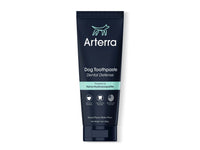
The nightly ritual. Sixty seconds of Arterra nHA Toothpaste, applied with a soft-bristle brush or finger brush, ideally right before bed. The overnight window is when saliva slows and the mouth is most vulnerable, and it's when the nHA scaffold does its most important work. The natural peanut butter flavor makes this survivable even for the small breeds that hate everything.
The passive layer. One Arterra Dental Chew per day, sized appropriately for your dog. The nHA continues delivering residual bio-activity in the saliva for hours after the chew is gone. The prebiotic support (banana and chicory root) starves the pathogenic oral bacteria while nourishing the beneficial species. This is the ambient protection layer that carries you through the daytime hours between brushings.
The professional layer. An annual dental exam with your veterinarian, with imaging under anesthesia if your dog is in a high-risk breed. nHA reduces the disease load, but it does not remove hardened calculus once it has formed. Do not skip the professional cleaning, and do not let anyone talk you into anesthesia-free scaling for a small breed dog. Both are compromises that don't serve your dog's long-term outcome.
Health is an investment in time.
For a small breed, that investment is more urgent than for any other dog in your life. You have more years to protect. You have more anatomical vulnerability to work against. And you have, for the first time, a mechanism at the right scale to actually do it.
Longevity Insights: Key Takeaways
-
Small breed dogs develop periodontal disease at 2-3x the rate of large breeds and lose teeth years earlier. The mechanism is anatomical, not behavioral.
-
Tooth count is fixed at 42. The jaw scales down with body size. Crowding is a small-breed problem by design.
-
Retained deciduous teeth are dramatically more common in small breeds. Every persistent baby tooth is a periodontal disaster waiting to happen.
-
Longer lifespan compounds the damage. A Chihuahua's mouth accumulates 60-70% more years of biofilm exposure than a Great Dane's.
-
The shelf category fails small mouths. Scraping chews and abrasive pastes are engineered for macro-scale mechanical action that never reaches the tight interproximal spaces where small breed disease progresses.
-
Nano-scale for nano-scale gaps. nHA particles at 20-80 nanometers physically reach the geometry no other product in the category can reach.
Experience the Science of nHA
If you own a small breed dog, this is the article I wish every pet-store shelf had a printout of. The category was not built for your dog. The mechanical model was designed for a Labrador. Your Chihuahua deserves better than a smaller version of the wrong product.
The Arterra nHA Toothpaste and Arterra Dental Chews are the first system in the U.S. pet-dental category engineered around the physical scale of the actual problem. Biomimetic. Non-abrasive. Safe if swallowed. Designed to reach the interproximal spaces and subgingival pockets no brush or scraping chew ever could.
Related reading:
Tags:
Dental Health