Yorkies are diagnosed with gum disease earlier and more often than almost any other breed. By age three, somewhere between 70-90% of Yorkies already have
If you own a Yorkie, the question is not whether gum disease will show up. It is how early you catch it, how much you can slow it down, and how many of your dog's teeth you can keep past age six.
Why I'm Writing This
Yorkies are the breed I hear the same heartbreaking story about, over and over. From customers, from the vets we work with. The dog is five, sometimes younger. It's a routine check-up. The vet looks in the mouth and says a version of, "we're going to need to pull several teeth."
Every owner is stunned. They brushed. They bought the chews. They did what they were told. It's unfortunate that it still wasn't enough.
None of that is your fault. The advice on the pet-store shelf was written for a big dog with plenty of room in its mouth. It was never designed for a four-pound animal that somehow has the same 42 teeth as a Great Dane, all crammed into a jaw a few inches wide.
What follows is what I would do if that were my dog, plus what the veterinary dental world actually recommends. This is not official medical advice. If your Yorkie has visible tartar buildup, red gums, or breath you can smell from across the room, the first move is a new dog toothpaste.
The Anatomy: A Great Dane's Mouth in a Teacup Body

Every dog, regardless of size, has 42 adult teeth. That number does not shrink with the dog. A Chihuahua and a Great Dane get the exact same count, and the individual teeth barely scale down at all, even though the jaw very much does.
Yorkies are the extreme end of that mismatch. Most adults weigh 4 to 7 pounds. The skull is short and the jaw is narrow. Those 42 teeth still have to fit in there somehow, so they end up rotated, tilted, and packed against each other tighter than in almost any other breed.
Here is what actually matters about that packing: the tiny gaps between the teeth, where gum disease grows and festers, get squeezed in so that no toothbrush bristle in the world will fit into them. Food gets wedged in. Bacteria in the saliva moves in and multiplies. That thin space between the tooth root and the gum line, the place where the real damage happens, becomes the microscopic battleground for the whole disease.
And in a Yorkie, that battleground is smaller than in just about any dog you are ever going to own.
This is not a case of you not trying hard enough. Owners who brush their Yorkie's teeth every single night for a decade still lose teeth. It's simply because the tools we have cannot reach where the disease is happening. If you have ever felt like you did everything right and your vet still gave you bad news, this is the reason.
The Puppy Teeth Problem
Every puppy loses baby teeth. There are 28 of them, and they are supposed to fall out between roughly three and seven months of age as the 42 adult teeth push up underneath.
Yorkies, more than almost any other breed, do not follow that plan. Baby teeth that just will not fall out on schedule are so common in this breed that vets almost expect it. The adult teeth come in anyway, on their own timeline. So for weeks or even months, your puppy is walking around with a partial double set of teeth stuffed into a jaw that was already the most crowded in the dog world.
The damage from those extra weeks does not go away when the baby teeth finally leave. The adult teeth grow into spaces that are already blocked. They rotate further than they should have. The final adult mouth ends up more crowded than it would have been if the baby teeth had cleared on time. And two months of a puppy trapping bacteria in a mouth too tight for any brush to reach can set up dental problems that do not show up until years later.
This is why a Yorkie puppy needs an oral exam earlier than most breed guides suggest. If baby teeth are still hanging around at six months, get them looked at. They almost always need to come out, and doing that early, before the adult teeth are locked into bad positions, is one of the very few things that genuinely changes the trajectory of the disease.
Yes, a Bad Mouth Affects the Rest of the Body. Here's What We Know.
I want to be careful here, because the "mouth-body connection" is one of the most oversold ideas in pet health.
Here is what we know for sure. Gum disease causes low-grade inflammation that just hangs around. When a dog with gum disease chews, bacteria from under the gum line get pushed into the bloodstream. There is a name for it: bacteremia. The AVMA lists gum disease as the most common health condition in adult dogs, and we are learning more every year about how it affects the rest of the body.
Yorkies happen to be predisposed to two conditions where that background inflammation matters more. The first is tracheal collapse, a weakness in the ring-shaped cartilage of the windpipe that is especially common in toy breeds, and where chronic inflammation is one of the things thought to make it worse. The second is a well-known tendency toward liver shunts and liver disease, where the liver has to work harder to clear inflammatory byproducts.
What we do not know yet, at the level of a proper clinical trial in dogs, is exactly how many extra good years daily dental care buys back on either of those. The mechanism makes sense. The trial evidence is thin, because those studies are enormously expensive and no one has funded them at scale.
What I take from that as a founder, and as someone who has spent a lot of time around small dogs, is this: we know oral inflammation is bad for a body that is already carrying two or three other things. We do not yet know exactly how many extra good months a nightly brushing routine gives you, but we do know it can help every dog live a healthier life.
This is not medical advice. If your Yorkie is coughing, breathing hard, or showing any sign of liver trouble, that is a vet visit, not a new toothpaste. Always consult your licensed veterinarian.
Where the Standard Advice Falls Short for This Breed
The generic dental routine for dogs goes something like this. Brush a few times a week. Give them a dental chew. Book a professional cleaning under anesthesia every year or two. For most big dogs with a normal-sized mouth, that is workable.
For a Yorkie, three things go wrong with it, and each one makes the others worse.
A few times a week is nowhere near often enough. In a crowded small-breed mouth, plaque hardens into tartar in about 24 to 72 hours. In a Yorkie, closer to 24. "Two or three times a week" leaves multi-day gaps where the disease is winning faster than you are pushing back. Daily brushing is a must for smaller dogs.
The tools cannot get to where the problem actually is. Toothbrush bristles will not fit into the tight gaps between crowded Yorkie teeth. Scraping-style chews polish the visible parts of the tooth and do almost nothing below the gum line. If your tools cannot reach the disease, the routine is a little performative.
Once every year or two is not often enough for professional care either. An 18 to 24 month cleaning schedule is fine for a lot of big breeds. It is NOT for a Yorkie. Given how fast the tartar builds up, how crowded the mouth is, and everything else this breed is prone to, most Yorkies do better on an annual professional check with dental X-rays, starting young. That is a conversation to have with your vet based on what they see in the mouth, not a rule to set from an article.
What Actually Works: The Nightly Ritual, Built for a Yorkie
Here is what the science and the veterinary dental world agree on for the smallest breeds.
1. A Nano-Hydroxyapatite Toothpaste, Every Night

Nano-Hydroxyapatite (nHA) at 20 to 80 nanometers is small enough to slip into the tight spaces between the teeth that a bristle cannot reach. Suspended in saliva, it drifts into those crowded pockets, settles onto the tooth surface, and does three useful things at once. It rebuilds the outer layer of enamel, plugs the tiny tubes in the tooth that get exposed when the gums pull back, and balances out the acidic conditions after your dog eats.
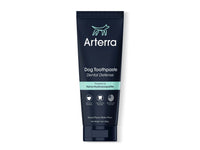
Particle size is the spec that matters. If a brand cannot tell you how small their particles are in nanometers, they do not really know what they are selling you. We built Arterra's nHA Toothpaste around 20 to 80 nm rod-shaped particles, specifically because that is the scale that reaches the anatomy of a crowded small-breed mouth.
There is no such thing as a "Yorkie-specific" formulation, because at that size the particle is already smaller than the space it needs to get into, even in the most cramped mouth out there.
2. A Real Dental Chew, Every Day
A dental chew is not a replacement for brushing. Think of it as a way to deliver good ingredients between brushings, and to keep bacteria from building up on the parts of the tooth the brush actually can reach.
Arterra's Dental Chews combine nHA with prebiotic fibers (sourced through banana flour and chicory root) that feed the healthy bacteria in your dog's mouth and gut, instead of dumping a load of starch onto the teeth. That distinction matters more than you would think.
Most "dental chews" on the shelf are basically extruded starch, which literally feeds the bacteria they claim to fight. That is what I call the Starch Trap, and it is one of the more expensive mistakes the whole pet dental aisle makes. It hits small-breed owners hardest, because the sugar residue ends up in the same tight compartment that is already trapping everything else.
3. Teach the Brush, Don't Fight for It
A Yorkie who fights the brush every night will win, because eventually you will give up. The most valuable skill in home dental care for a small dog is not brushing technique. It is teaching your dog to actually like the process.
Two-minute daily brushing sessions. Start by just lifting the lip with your finger, no brush at all. Then let them taste the toothpaste like it is a treat. Then introduce the brush. Reward every step. A Yorkie who happily lets you brush their teeth is worth more than any fancy product a fighting Yorkie will not tolerate. And a tip that helps a lot with small dogs specifically: sit them in your lap facing away from you, rather than reaching over their head. Coming at their face from above sets off a defensive reflex in most toy breeds.
4. Vet Dental Care, Starting Earlier Than You'd Expect
This is the step that is different for Yorkies, and it starts earlier than most guides tell you. Your Yorkie's first vet dental check should happen before all the baby teeth have finished falling out, ideally at the four to six month mark, so any stubborn ones can be caught and dealt with before they push the adult teeth out of place.
After that, most Yorkies do best with an annual professional dental check that includes X-rays. About two-thirds of what is going wrong in a small-breed mouth is happening below the gum line, where you cannot see it without imaging. The point is not to rack up cleanings for the sake of it. It is to catch problems at Stage 1 or 2, when they can still be reversed, instead of Stage 3 or 4, when the only answer is extraction.
What This Looks Like Over Your Dog's Life
If I brought home a Yorkie puppy today, here is roughly how I would think about the whole arc.
Birth to 6 months. The whole job is getting the puppy comfortable. Get them cheerfully accepting your finger on their gums, then a finger brush, then a soft toothbrush. Introduce the nHA toothpaste as a taste, like a treat, before you ever try to actually brush. First vet dental check by six months, mainly to see if any baby teeth are still hanging on. If they are, they almost certainly need to come out.
6 to 18 months. Nightly brushing becomes non-negotiable. Assume the adult mouth is more crowded than a normal-sized dog's and act accordingly. The first proper professional cleaning with X-rays usually falls in this window, ideally before the first birthday.
Years 1 to 4. The nightly routine, an annual professional check with X-rays, and a careful eye on the gum line. This is when most Yorkies who lose teeth at five or six are already building up hidden damage under the gums. You cannot see it from outside the mouth. It shows up clearly on a dental X-ray.
Year 4 and onwards. Assume gum disease is either already there or on its way. The nightly nHA routine is doing its most valuable work in these years, because it is the one tool that keeps working even as your dog ages and everything else gets a bit less effective. If your dog does need extractions later, that is not a failure of home care. It is often the right medical call. The point of the ritual is to reduce how many teeth end up coming out, and to push that conversation back by years.
Warning Signs Worth Watching For
Yorkies are stoic. They will walk around with serious gum disease and still eat, play, and act totally normal at home. A few things to keep an eye on, none of which replace a vet exam.
- Bad breath that has crossed the line from "dog breath" into something metallic, sweet, or genuinely foul.
- A little blood on a chew toy, or a pink tinge in the water bowl.
- Chewing on only one side of the mouth, or dropping food from one side.
- Visible tartar at the gum line, especially on the upper premolars. That is where Yorkies almost always show it first.
- A change in the way your dog's face looks around the eyes or muzzle, which can be a sign of discomfort a stoic little dog will not otherwise tell you about.
- Any new cough or change in breathing. In a Yorkie, tracheal collapse and inflammation often show up together, and that is a vet conversation, not a dental one.
If any of these show up, get to your vet, not Google or ChatGPT. What I can tell you from where I sit is that daily dental care is the floor, not the ceiling. It does not replace clinical care for the breed with the highest rate of gum disease of any dog on earth.
Final Thoughts
The Yorkshire Terrier is the breed the pet dental aisle was least designed for. The mouth is the most crowded. The disease shows up the earliest. The related health problems are the most stacked against them. And the standard advice, brush a few times a week, throw them a chew, book a cleaning every couple of years, was built for a completely different animal.
Daily brushing with nHA toothpaste is the key. Nano-Hydroxyapatite at 20 to 80 nanometers is one of the very few tools that reaches the space a bristle cannot. Vet dental care starts at that six-month check for lingering baby teeth and runs annually with X-rays from there. And the routine you build with your dog while they are young is what determines how many teeth are still there at age 8.
If you are a Yorkie parent, the nightly routine is not a nice-to-have. It is one of the very few real levers you have on a disease story that, for most Yorkies, is otherwise mostly written for you at birth.
Longevity Insights: Key Takeaways
-
Yorkshire Terriers have the highest documented rate of gum disease of any breed. Studies put it between 70% and 90% by age three. That is the baseline, not the risk case.
-
The Yorkie mouth is the most crowded in the dog world. 42 adult teeth crammed into a jaw a fraction of the size that number was designed for.
-
Retained baby teeth are a common breed problem. Yorkie puppy teeth that do not fall out on schedule push adult teeth into permanently worse positions. Get them checked by six months.
-
Toothbrushes and scraping chews cannot reach the tight spaces between the teeth where the disease actually grows in a small-breed mouth.
-
Nano-Hydroxyapatite at 20 to 80 nanometers is small enough to get in there. It rebuilds enamel, seals exposed tubules, and helps balance the acidic environment after eating. That's why it's the key ingredient in Arterra's toothpaste for dogs.
-
Start vet dental care at the six-month mark and move to an annual cleaning with X-rays. The disease lives under the gums, where you cannot see it without imaging.
This article is educational only and not medical advice. Always consult your licensed veterinarian for care specific to your dog.
Tags:
Dental Care,
Nano-Hydroxyapatite,
Periodontal Disease,
Small Breed,
Yorkshire Terrier