Dachshunds have one of the highest rates of gum disease of any dog breed. Big veterinary studies put them in the top three, right alongside Yorkies and Toy Poodles.
What throws most owners off is where their dog lands on that list. Most people think their Dachshund is safe from the small-breed dental crisis because the muzzle is long. The long muzzle is actually the reason the risk is so high.
Why I Wrote This
The Dachshund is the breed where what owners see and what vets find point in opposing directions. A Chihuahua owner walks in expecting a dental problem. A Yorkie owner walks in expecting a dental problem. A Dachshund owner walks in thinking their dog has a normal mouth, and then the vet lifts the lip and finds Stage 3 gum disease at age four.
What follows is what the veterinary dental research actually says about this breed, and what I do with that information as a founder who spends most of his days with his pups. I am not a vet. This is not medical advice. If your Dachshund has visible tartar, red gums, or breath you can smell from across the room, the first move is a vet exam, not a new toothpaste.
The Paradox: A Long Muzzle That Acts Like a Crowded Mouth

Every dog has 42 adult teeth. That number never changes. A Chihuahua and a Great Dane get the same number of teeth. What changes wildly is the size of the jaw those teeth have to fit into.
The Dachshund is the breed that most clearly breaks the "long muzzle equals healthy mouth" idea. Standard Dachshunds weigh 16 to 32 pounds. Miniature Doxies are 7 to 11 pounds. The muzzle looks long, but the lower jaw is narrow, and the individual teeth do not shrink to match the dog's small body or narrow jaw.
The result is a specific mouth shape that a big-breed dental plan was never built for. The premolars (the row of teeth that do most of the chewing work) are packed into a narrow row with steep walls between each tooth. The upper fourth premolar, the big one vets call the carnassial, sits where food and sticky bacterial film collect against the cheek side with almost no natural clearance. The lower first molar leans inward on many Dachshunds and creates a pocket under the gum that no toothbrush bristle can reach.
This is a different problem than what a Yorkshire Terrier experiences. Yorkies fail because everything is crushed together. Dachshunds fail because a long row of narrow teeth traps bacteria in a shape that looks fine from outside but is basically set up for gum disease to take hold.
Owners who lift the lip and see straight rows of long teeth reasonably assume the mouth is healthy. The disease is happening in the pocket where the gum meets the tooth root. You cannot see it without a probe and a dental x-ray.
What the Data Shows
The best data on which breeds get gum disease comes from pet insurance databases and vet school records. The exact numbers vary between studies, but the ranking is remarkably consistent. Dachshunds sit in the top three or four breeds in almost every large study published in the last twenty years.
A large study of primary-care vet records in the Journal of Small Animal Practice found Toy Poodles, Yorkies, Maltese, and Dachshunds sharing the top of the list. The American Veterinary Dental College, whose specialists handle the tough cases regular vets refer up, keeps identifying the same breeds in their published case series.
What the numbers do not show, and what matters just as much, is how young these dogs start showing the disease. In Dachshunds, vets are seeing it earlier than most owners expect. Stage 2 gum disease at age three, Stage 3 by five, is a common path in the breed, and it does not depend on how hard the owner works with the toothbrush. The anatomy sets the timeline.
A word of caution on the science. Prevalence data tells us the breed gets the disease. It does not, on its own, prove that any one thing an owner does changes the outcome across the whole population.
What the biology research adds is a good working model for why. When you put the anatomy, the bacterial biology, and the observed disease pattern together, the honest read is that this is a breed where the standard plan was built for the wrong dog, and a modified plan should help even if we cannot yet put an exact number on it.
The Second Layer: Back Problems Factor In
Dachshunds are the poster breed for a condition called IVDD (intervertebral disc disease), where the cushioning discs between the spine bones break down and can rupture. Somewhere between 19 and 24 percent of Dachshunds will have a serious IVDD episode at some point, according to the Dachshund Health UK studies that remain the go-to source on this. The gene that gives the breed its long back and short legs is the same gene that sets up the spinal discs to break down early.
This matters for dental care in two ways.
First, IVDD is an inflammatory condition. The disc breaks down, it herniates, and the body launches an inflammatory response. Chronic gum disease adds a steady, low-grade inflammatory load on top of a body that is already prone to inflammatory problems. The mechanical case for lowering one inflammatory input in a body already fighting another is strong. The controlled clinical trial that would prove exactly how much it helps does not yet exist in dogs. It probably will in the next decade.
Second, a Dachshund with active back problems often cannot be positioned normally for a dental cleaning. Regular cleanings that would otherwise happen on schedule get pushed back, cancelled, or done under compromised conditions because the dog cannot handle lying flat on its belly the way anesthesia requires. That means the at-home routine matters even more, because the professional cleanings are harder to keep on the calendar.
This is not medical advice. If your Dachshund is showing any signs of back pain, weakness in the back legs, or reluctance to jump, that is a same-day vet call, not a dental conversation. Always consult your licensed veterinarian.
What the "Old Standard" Gets Wrong for This Breed
The generic dental plan for adult dogs looks something like this. Brush a few times a week. Give a dental chew. Book a professional cleaning under anesthesia every year or two. For a healthy medium-sized dog with normal teeth, that plan works fine.
For a Dachshund, three things go wrong with it, and the failure is quieter than it is in a Yorkie because the outside of the mouth looks more reassuring.
Brushing a few times a week is not often enough. The sticky bacterial film on teeth hardens into tartar in about 24 to 72 hours in most dogs. In the narrow Dachshund mouth, normal chewing knocks less of that film loose, so it hardens on the faster end of that window. Two or three brushings a week leaves multi-day gaps where the disease is winning faster than the brushing is catching up. Daily is the floor, not the ceiling.
The tools do not reach where the disease actually is. Bristles cannot fit into the tight gaps between a Dachshund's premolars. Scraping-style chews polish the parts of the tooth you can see and do essentially nothing below the gum line, which is where the real disease is happening. If the tool cannot reach where the problem is, the tool is doing less than owners think. Owners who feel guilty about missing a night of brushing have been sold a story that the missed night was pulling more weight than it really was.
The professional cleaning schedule isn't right. An 18 to 24 month cleaning schedule is often fine for a healthy Labrador. It is the wrong schedule for a Dachshund. Given the anatomy, the pattern of disease progression, and the back problems, most Dachshunds do better with annual professional evaluations with dental x-rays, starting young. This is a conversation to have with your vet based on what they see, not a schedule to set from an article.
What Actually Works: A Nightly Dental Routine for Dachshunds

Here is what the biology research and veterinary dental literature agree on as a sensible plan for narrow-mouth breeds. I will explain what each step is doing, so you can adapt it to your dog rather than follow it blindly.
1. A Nano-Hydroxyapatite Toothpaste, Every Night
Nano-Hydroxyapatite (nHA for short) at 20 to 80 nanometers is small enough to reach the tight gaps between teeth that a bristle cannot enter. Suspended in your dog's saliva, it drifts into the narrow spaces between the premolars, lands on the tooth surfaces, and does three things at once. It rebuilds the outer enamel. It plugs the tiny tubes in the tooth (called dentin tubules) that open up as gums pull back. And it helps neutralize the acidic conditions that follow a meal.
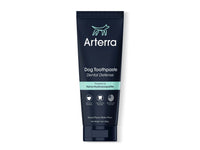
Particle size is the specification that matters most. If a brand cannot tell you the size range in nanometers, they do not know what they are selling you. We built Arterra's Remineralizing Toothpaste around 20 to 80 nm rod-shaped particles specifically because that is the size that reaches the tight spaces in a narrow small-breed mouth. There is no formula built just for Dachshunds, because at this particle size the ingredient is already smaller than the spaces it needs to get into.
2. A Functional Dental Chew, Every Day
A dental chew is not a replacement for brushing. It is a way to deliver working ingredients between brushings, and a way to disrupt the bacterial film on the tooth surfaces the toothbrush actually can reach.
Arterra's Dog Dental Chews combine nHA with prebiotic fibers (banana flour and chicory root) that feed the good bacteria in the gut instead of sitting in the mouth as a starch load. That distinction matters. Most "dental chews" on the shelf are extruded starch products that feed the very bacteria they claim to fight. We call this the Starch Trap, and it is one of the more costly mistakes in the pet dental aisle. It hits narrow-mouth breeds hardest, because the sugar residue lands right where the mouth is already slowest to clean itself.
3. How You Hold Your Dog Matters More Than You Think
A Dachshund with any history of back sensitivity should not be picked up and held up in the air to brush. The spine is not built for that position, and the dog will fight the routine, which is the one thing you cannot afford.
Sit on the floor. Put your dog in your lap, facing away from you, along the length of your thigh so the spine is supported and neutral. Approach the mouth from behind the head, not from the front. This works for two reasons. It gets past the defensive reaction most dogs have to a hand coming at their face. And it keeps your Dachshund's back in a position that will not turn a small disc problem into a big one.
If your dog has an active back issue, ask your vet whether daily brushing is even appropriate right now. Switch to a chew-based approach and a saliva-based rinse until the back problem has settled down.
4. Annual Professional Care With X-Rays, Starting Young
This is the step that is different for this breed, and it starts earlier than the general guides suggest. Most Dachshunds benefit from an annual professional dental exam with full-mouth dental x-rays starting by age two. The reason is how young the disease shows up. If Stage 2 gum disease is showing at three, you want the baseline x-ray at two so you can see the trend rather than just the endpoint.
About two-thirds of gum disease in a small-breed mouth is happening below the gum line, invisible without dental x-rays. This is not paranoia. It is what the anatomy calls for. The goal is not to rack up cleanings over a lifetime. The goal is to catch the disease at Stage 1 or 2, when it can still be reversed, rather than at Stage 3 or 4, when the answer is pulling teeth.
Dachshund Dental Care - Year by Year
If I adopted a Dachshund puppy today, here's how I'd think about their arc.
Months 0 to 6. Getting your puppy comfortable with the routine is the whole job at this stage. Get the puppy happily accepting a fingertip on its gums, then a finger brush, then a soft toothbrush. Introduce nHA toothpaste as a taste, not a treatment, before you ever try to brush for real. Learn the lap position for your specific dog's body now, while there is no back sensitivity to work around.
Months 6 to 24. Nightly brushing becomes a non-negotiable part of the day. The first adult-tooth professional cleaning with x-rays usually happens in this window. The real value of that first cleaning is the baseline it gives you for every visit after. Without a baseline x-ray, you are guessing about the trend forever.
Years 2 to 5. Nightly routine, annual professional exam with x-rays, careful attention to the tight gaps in the premolar row. This is the window when most Dachshunds who go on to lose teeth in their sixth or seventh year are already building up damage below the gum line. The tartar you can see on the tooth is the tip of the iceberg. The disease is happening under the gum.
Years 5 and beyond. Assume gum disease is either present or on the way. The nightly nHA routine is doing its most valuable work now, because it is the one tool that keeps working even as your dog ages and every other option becomes a little less effective. Pulling teeth, when it comes, is not a failure of home care. It is often the right call. The point of the routine is to reduce how many teeth need to come out and to push back the year when that conversation happens.
Don't Ignore the Signs
Dachshunds are tough about mouth pain. They will have advanced gum disease and still eat, play, and act normal at home. A few things worth watching for, none of which replace a vet exam.
- Bad breath that has crossed from "dog breath" into something metallic, sweet, or genuinely foul.
- Chewing only on one side of the mouth, or dropping food from that side.
- Visible tartar at the gum line on the upper premolars, which is where Dachshunds almost always show it first.
- A change in how your dog approaches food. Some Dachshunds with advanced gum pain will swallow kibble whole instead of chewing, because chewing hurts.
- Blood on a chew toy or a pink smear in the water bowl.
- Any new or worse reluctance to jump, hesitation on stairs, or weakness in the back legs. This is not a dental signal. It is an IVDD signal, and it is a same-day vet call.
If any of these show up, the right move is to consult a vet, not Google or AI search engines.
The Bottom Line
The Dachshund is the breed most owners assume is safe from the small-breed dental crisis because the muzzle is long. The data does not back that up. The anatomy is a long, narrow row of teeth with steep walls between each one, and the bacterial pocket that drives the disease is smaller and better hidden than an owner looking at the visible parts of the tooth would ever guess.
Daily brushing is essential. Nano-Hydroxyapatite at 20 to 80 nanometers is one of the few things that reaches the pocket a bristle cannot. Professional care with dental x-rays starts by age two and runs annually from there. How you position your dog matters more than it does for most breeds, both because of the spine and because a dog that fights the routine is a dog that will not have the routine for long.
If you own this breed, the daily dental routine is not a wellness aspiration. It is one of the few real levers you have on a disease path that, is otherwise, largely set for the breed at birth.
Longevity Insights: Key Takeaways
-
Dachshunds sit in the top four dog breeds for gum disease, right alongside Yorkies, Toy Poodles and Maltese. The long muzzle is not the protection owners assume it is.
-
The problem is a long, narrow row of teeth, not a crowded mouth. Different failure, same result. The disease progresses in a pocket that looks fine from outside.
-
Vets are seeing the disease younger than owners expect. Stage 2 at three, Stage 3 by five, is a common path. The anatomy sets the timeline.
-
IVDD makes it worse. Chronic gum inflammation adds load to a body already prone to inflammatory problems, and back issues often push back the professional cleanings that would otherwise catch disease early.
-
Daily nHA toothpaste and dental chews reach where the disease actually is. At 20 to 80 nanometers, the particles fit into the tight gaps between teeth that a bristle cannot. Pair with annual professional exams and x-rays starting at age two.
Tags:
Breed Health,
Dachshund,
Dental Health,
Nano-Hydroxyapatite,
Periodontal Disease,
Small Breed