A Chihuahua carries the same 42 adult teeth as a Labrador. In a mouth that weighs less than a can of soup.
That single fact is the whole story of Chihuahua dental care. If you have ever wondered why this breed loses teeth earlier and more often than almost any other, it is not bad luck and it is not something your dog did wrong. It is geometry. And once you understand it, the daily routine that works for a Chihuahua stops looking like a nice-to-have and starts looking like the one part of their care you cannot skip.
Why I Am Writing This
Chihuahuas are the breed that shows up most often in the "why did my dog lose all their teeth by age six" conversations I hear from other owners. And I hear it from people who brush, who buy the best dog food, who take their dogs to the vet regularly. It is not a story about neglect. It is a story about a routine that was designed for a 40 pound dog being applied to a 4 pound dog and quietly failing.
What follows is the version of the routine that is built for the anatomy your dog actually has. This is not medical advice. Your vet is the person who examines your Chihuahua and sets the schedule that matches what they see. What I can tell you is what the veterinary dental world has published about this breed, and what I would do if I brought a Chihuahua puppy home tomorrow.
The Data Nobody Puts on the Bag of Small-Breed Food
The American Veterinary Dental College and multiple published studies in the Journal of Veterinary Dentistry converge on the same picture. Toy breeds under 15 pounds carry the highest rates of periodontal disease of this size group. Chihuahuas sit at the top of that group, or very close to it, depending on which study you read.
Concretely, that looks like this.
Adult teeth arrive in a jaw that is one-third the size of the average dog. A Chihuahua weighs 3 to 6 pounds. Their skull is a scaled-down version of a much larger dog's, and the 42 teeth that come in were sized for closer to the original. There is no room for them to sit in a healthy neutral position. The teeth rotate, lean, and overlap. Every one of those points of contact is a place where the bristle of a toothbrush cannot fully reach, and where bacteria settle in.
Baby teeth that will not fall out are common in this breed. Very common. If a Chihuahua puppy is six months old and their canine baby teeth are still there, that is not a wait-and-see situation. In this breed it almost always means the adult tooth has come in beside the baby tooth, and both are now competing for the same slot. Two teeth in one socket creates a pocket that runs deep and is impossible to clean at home.
Plaque hardens into tartar in the same 24 to 72 hours it does for any dog, but in a Chihuahua mouth it does more damage faster. When teeth are already too close together, the tartar bridges between them and locks in the bacteria under the gumline. What you see on the outside of the tooth is a tiny fraction of what is happening below the gum, where the root sits.
By age three, most Chihuahuas have some degree of periodontal disease. By age six, a large portion of them have lost teeth to it. This is the pattern the specialist literature keeps reporting, and it holds even in homes where the owners are doing what they were told to do.
Why the Standard Small Breed Dental Routine Is Not Enough
The advice most Chihuahua owners get sounds sensible on paper. Brush a few times a week. Give them a dental chew. Book a professional cleaning under anesthesia every year or two. Done.
Three things go wrong with that routine in this breed.
Two or three brushings a week is a multi-day gap. Plaque calcifies into tartar in one to three days on a normal dog. In a mouth where teeth are already overlapping, the tartar bridges form faster and in more places at once. A Wednesday brush cannot undo what Sunday, Monday and Tuesday allowed to happen. In a Chihuahua, daily is the floor, not the ceiling.
Most "dental chews" are wrong for this mouth. A hard, large doggy dental chew is a choking risk for a 4 pound dog with a small airway. And the majority of the soft dental chews on the shelf are essentially extruded starch shaped to look like a treat. Starch is exactly what the bacteria in the mouth ferment for energy. In a Chihuahua mouth, that residue lands in the geometry that is already the slowest to clear, which means you are feeding the disease you were trying to prevent.
Waiting 18-24 months between professional cleanings ensures a healthy mouth. In this breed, that interval is often too long. By the time an owner notices bad breath or a wobbly tooth, the disease is well past the point where a cleaning alone will fix it. What was going to be a routine cleaning becomes a cleaning plus multiple extractions, which is a much bigger surgery, a longer anesthetic, and a much bigger bill.
The Nightly Ritual, Built for a Chihuahua

Here is what the science and the veterinary dental world agree on for a dog this size.
1. Brush With Nano-Hydroxyapatite Toothpaste, Every Night
Nano-Hydroxyapatite, or nHA, is a tiny version of the same mineral that already makes up the outer layer of a tooth. At 20 to 80 nanometers, the particles are small enough to slip into the tight gaps where two Chihuahua teeth overlap, the space a bristle cannot enter. Once they are in there, suspended in saliva, they do three useful things at once. They rebuild the outer layer of enamel. They plug the tiny tubes in the tooth that get exposed when the gums start to pull back. And they help balance out the acidic conditions in the mouth after your dog eats.
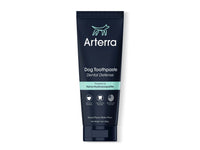
Particle size is the number that matters. If a brand cannot tell you how small their particles are in nanometers, they do not really know what they are selling you. We built Arterra's Remineralizing Toothpaste around 20 to 80 nm rod-shaped particles specifically because that is the scale that reaches the anatomy of a very small mouth.
2. A Real Dental Chew, Sized For Their Mouth, Every Day
A dental chew is not a replacement for brushing. Think of it as a way to deliver good ingredients between brushings, and to keep bacteria from building up on the parts of the tooth the brush actually can reach.
Two things matter for a Chihuahua. First, it has to be sized and textured for a very small mouth. Big dental chews are a choking risk in this breed and can crack teeth outright.
Second, the chew has to not be a starch bomb. Arterra's Dental Chews combine nHA with prebiotic fibers that feed the good bacteria in your dog's mouth and gut, instead of dumping a load of starch onto the teeth. In a Chihuahua mouth, that difference compounds fast, because the sugar residue from a starchy chew lands exactly in the spaces that are already the slowest to clear.
3. Brushing Technique That Actually Reaches This Breed's Teeth
Standard brushing advice is a small circular motion with a soft-bristle brush. In a Chihuahua mouth, add two modifications.
Spend most of your time on the upper premolars and molars in the back of the mouth. Those are the teeth most commonly rotated in this breed, and they are where the most hidden disease develops. To reach a rotated tooth, angle the brush along the way the tooth actually sits, not the textbook diagram. Feel the tooth with your finger first if you are not sure of the orientation.
Second, do not fight your dog's face. A Chihuahua does not have much jaw strength, but they are stoic about mouth pain and can freeze up or nip if you clamp the muzzle shut. Lift the lip and brush with the mouth relaxed and slightly open. That takes practice for both of you. It is easier if you start when they are a puppy, but it can be built at any age with patience and treats.
4. Vet Dental Care On A Custom Schedule, With X-rays
This is the step that is genuinely different for this breed, and it is the step where I am most cautious about giving general advice. Because Chihuahuas develop disease faster than the average dog, most veterinary dentists recommend starting professional cleanings earlier than the generic eighteen to twenty-four month timeline, and often more frequently.
Dental X-rays at every professional visit are also disproportionately important in this breed, because a Chihuahua's teeth can look reasonably healthy on the surface while there is significant bone loss underneath. The X-ray is how you catch that early, when a tooth can still be saved.
The right interval for your Chihuahua is a conversation with your vet, based on what they see in the mouth and on the X-rays. It is not a schedule you set at home.
What This Looks Like Over Your Chihuahua's Life
If I brought home a Chihuahua puppy today, here is roughly how I would think about the whole arc.
Birth to 6 months. The whole job is getting the puppy comfortable with your hand near their mouth. Get them cheerfully accepting your finger on their gums, then a finger brush, then a soft toothbrush. Introduce the nHA toothpaste as a taste first, like a treat, before you ever try to actually brush. Learn to lift the lip without setting off a defensive reaction. That patience in the first six months is what buys you the next thirteen years of easy brushing.
6 months. First vet dental exam. The specific thing you are looking for at this age is baby teeth that have not fallen out. Any baby canine still in place at six months in a Chihuahua almost always needs to come out, and doing that extraction early prevents the adult tooth from locking permanently into a wrong position. This is often done at the same time as a spay or neuter, which means only one anesthetic event instead of two.
Years 1 to 3. The nightly ritual, and professional check-ins with X-rays at the interval your vet sets. This is the window when most Chihuahuas who go on to lose teeth are already building up hidden damage. You cannot see it from outside the mouth. It shows up clearly on an X-ray.
Year 3 and onwards. Assume gum disease and the related complications are either already there or on their way. The nightly ritual is doing its most valuable work in these years. If extraction becomes necessary, that is not a failure. In this breed, planned removal of a chronically problematic tooth is often the intervention that produces the biggest quality-of-life improvement, because it takes out a source of ongoing pain and inflammation.
Warning Signs Worth Watching For
Chihuahuas are stoic about mouth pain, and their small size means they can hide problems for a long time before you notice. A few things worth watching for.
- Bad breath that has crossed from "dog breath" to something metallic, sweet, or genuinely foul.
- New reluctance to chew, or dropping food from one side of the mouth.
- Visible tartar bridging between adjacent teeth, or gum recession, especially on the upper premolars in the back of the mouth.
- A tooth that looks slightly loose, or that moves when your dog eats.
- A little blood on a chew toy, or a pink tinge in the water bowl.
- Any swelling of the muzzle, gum, or under the eye. In a Chihuahua, this is a same-week vet conversation. A tooth root abscess in this breed can drain through the skin below the eye and needs treatment quickly.
If any of these show up, the right move is your vet, not Google or ChatGPT.
Final Thoughts
The Chihuahua is the breed the standard dental routine was least designed for. Same 42 teeth as every other dog, in a jaw that is one-third the size, with a strong tendency to hold onto baby teeth and a shorter window before periodontal disease sets in. What comes out of that is a dog that needs a routine tuned for the anatomy they actually have.
Daily brushing is essential. Nano-Hydroxyapatite at 20 to 80 nanometers is one of the very few tools that reaches the pockets a bristle cannot. Brushing technique needs to account for teeth that are rotated and overlapping, which the textbook does not. Professional care starts earlier and runs on a per-dog schedule set with your vet, based on dental X-rays and what the mouth is actually showing.
If you own a Chihuahua, the daily ritual is not a wellness aspiration. It is one of the small handful of levers you have on a disease story that, at the breed level, was set the day their teeth started coming in.
This is not medical advice. Always consult a licensed veterinarian about your dog's dental care, especially for a breed as prone to complications as the Chihuahua.
Longevity Insights: Key Takeaways
-
42 teeth in a 4-pound jaw is the whole story. Same tooth count as a Labrador, one-third the space to hold them, which produces rotated teeth, overlapping teeth, and pockets no bristle can fully reach.
-
Retained baby teeth are common and matter. Any baby canine still in place at six months in a Chihuahua almost always needs to come out, before the adult tooth locks permanently into a wrong position.
-
Daily is the floor, not the ceiling. In this breed, two or three brushings a week is a multi-day gap that plaque and tartar walk right through. Every night, with nHA toothpaste at 20 to 80 nanometers, is the standard the anatomy demands.
-
Chew sizing matters as much as chew composition. Big hard chews are a choking risk in a 4-pound dog. Starchy chews feed the exact bacteria they claim to fight. Look for chews sized for a small mouth, with real ingredients and no starch-bomb formulation.
-
Vet cleanings start earlier and run on a per-dog cadence. Chihuahuas often need their first professional cleaning by six to twelve months and shorter intervals than the generic 18-to-24 month advice, always with dental X-rays.
-
Home care is what keeps professional care from becoming emergency care. The nightly ritual is what makes the difference between a routine cleaning and a cleaning plus five extractions.
Tags:
Chihuahua,
Dental Health,
Periodontal Disease,
Small Breeds