French Bulldogs, Pugs, and English Bulldogs have the same number of teeth as every other dog breed. What they don't have is a jaw designed to hold them.
Centuries of breeding for a short, flat muzzle has left produced a mouth that vet dentists describe with words like rotated, impacted, and displaced. That is not aesthetic language. It is the clinical vocabulary for teeth that have been pushed out of their intended positions because there was nowhere else for them to go.
Why I'm Writing This
The brachycephalic dental story is the one where the standard advice fails most quietly. Owners of Frenchies, Pugs and English Bulldogs already know their breed is high-maintenance. They have to budget time and money for breathing issues, skin fold care, the occasional heat-stress emergency. What most of them do not know is that the same skull compression that causes those problems is doing quiet, ongoing damage to the teeth from puppyhood.
What follows is what the veterinary dental world says about these breeds. This is not official medical advice. Brachycephalic dogs also carry anesthetic risks that make dental care a genuinely more complicated conversation than it is for most breeds, so pet parents of these breeds should go to the vet regularly.
The Geometry Problem: A Full-Size Mouth in a Compressed Skull

After they lose their puppy teeth, every dog gets 42 adult teeth. Selective breeding has, over roughly 150 years, aggressively shortened the muzzle of the brachycephalic breeds without proportionally shrinking the number or size of the teeth that need to fit into it. The premolars and molars in a Pug are not miniature. They are, tooth for tooth, close to what a similarly weighted normal-muzzled dog would carry. What has changed is the length of the jaw they have to occupy.
The result is a specific and predictable set of dental problems. The clinical literature is unusually consistent on that fact. Studies from vet dental referral practices in the US, UK, and continental Europe converge on the same pattern in the brachycephalic breeds.
Rotated premolars. The upper third premolar, most commonly, twists on its long axis because the neighbouring teeth have squeezed the space it was meant to erupt into. Rotation exposes root surfaces that were not designed to be exposed, and creates hidden pockets under the gum line that a toothbrush bristle was never designed to enter.
Impacted or unerupted teeth. Some premolars fail to come in at all. They stay lodged in the jaw, sometimes visible on a dental X-ray as a bony bump with a fluid-filled sac around it. Those sacs, called dentigerous cysts, are diagnosed in brachycephalic breeds at rates far above the general dog population. Left alone, they can quietly eat away at jaw bone over years.
Retained baby teeth. Like the toy breeds, brachycephalic dogs disproportionately hold onto baby teeth past the point they should have fallen out. In a Frenchie or Pug puppy, this is a signal, not a curiosity. It usually means the adult tooth has come in at a position it should not be in, and both teeth are now competing for the same space.
Malocclusion. The most defining feature of the brachycephalic bite is that it is undershot by design. The lower jaw juts out past the upper. What breed standards frame as "characteristic," the veterinary dental literature frames as a malocclusion that concentrates uneven wear and pressure across the mouth. Teeth wear down where they should not. Others do not wear at all where they should.
Add it all up, and the pockets where bacteria collects in a brachycephalic mouth are bigger, more numerous, and in stranger shapes than in any other body type of dog. There are more places for the disease to hide, and fewer natural ways to disrupt it.
The Second Layer: The Anesthetic Question That Governs Everything Else
Every conversation about dental care in a brachycephalic dog runs into the same immovable clinical fact. Professional dental cleaning is done under general anesthesia. General anesthesia in a dog with Brachycephalic Obstructive Airway Syndrome (BOAS) is a much more complex event than it is in a normal-muzzled dog.
The ACVIM statement on BOAS is that anesthesia can be done safely in these breeds, but it requires a team that knows what it is doing, the right pre-anesthetic checks, and modified recovery protocols. The most dangerous window is right around waking up.
This changes how to think about home care in a specific and important way. The nightly dental routine is disproportionately valuable to these breeds, because it can reduce the number of trips to the vet your dog needs under anesthesia in a lifetime. Every anesthetic event that gets pushed back by a year, or avoided entirely because there was nothing serious to fix, is a real reduction in the cumulative risk your dog carries.
This is not medical advice. If your Frenchie, Pug or English Bulldog has any breathing noise beyond what is typical for the breed, or if surgical BOAS correction has been raised as an option, that conversation takes priority over any dental question. Always consult a licensed veterinarian.
Where Brachycephalic Dental Care Falls Short
The generic dental routine for adult dogs goes something like this. Brush a few times a week. Give them some kind of dental chew. Book a professional cleaning under anesthesia every year or two.
For a brachycephalic breed, three things go wrong with it.
Not brushing enough. The number of pockets where bacteria can hide in a brachycephalic mouth is higher than in any other body type. Two or three brushings a week leaves multi-day windows in which the disease is progressing across a mouth that has more places for it to progress. Daily is the floor, not the ceiling. In this group, daily is closer to non-negotiable than in any other.
Standard brushing technique doesn't reach the affected teeth. A soft-bristle toothbrush moved in a small circular motion is the textbook advice, and it works for a mouth with roughly upright teeth. When a premolar has twisted 30 or 60 degrees on its long axis, the exposed surface is at an angle a bristle does not naturally address. Owners who brush diligently and still find advanced disease on the rotated teeth are not brushing wrong. They are brushing an anatomy the textbook did not account for.
The professional-cleaning interval has different rules compared to other breeds. In a normal-muzzled dog, the interval is set by how fast disease progresses. In a brachycephalic dog, it is set by the balance between how fast the disease progresses and how much anesthetic risk your dog can safely accumulate. That balance is a per-dog conversation with your vet, informed by how severe the BOAS is, how the heart looks, and how much disease is showing on dental X-rays. The generic 18-to-24-month schedule is neither a floor nor a ceiling. It is not the right way to think about it at all.
Preventative Care Works: The Nightly Ritual, Built for a Brachycephalic Dog Breeds

Here is what the science and the veterinary dental world agree on for this group.
1. Brush with Nano-Hydroxyapatite Toothpaste, Every Night
Nano-Hydroxyapatite (nHA) at 20 to 80 nanometers is small enough to slip into pockets that a bristle cannot reach. This matters more in a brachycephalic mouth than in almost any other. Suspended in saliva, the particles drift into the spaces around rotated premolars and impacted teeth, settle onto the tooth surface, and do three useful things at once. They rebuild the outer layer of enamel. They plug the tiny tubes in the tooth that get exposed when the gums pull back. And they balance out the acidic conditions after your dog eats.
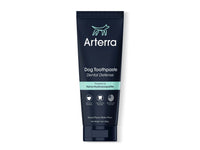
Particle size is the spec that matters. If a brand cannot tell you how small their particles are in nanometers, they do not really know what they are selling you. We built Arterra's Remineralizing Toothpaste around 20 to 80 nm rod-shaped particles, specifically because that is the scale that reaches the anatomy of a compressed skull.
2. A Real Dental Chew, Every Day
A dental chew is not a replacement for brushing. Think of it as a way to deliver beneficial ingredients between brushings, and to keep bacteria from building up on the parts of the tooth the brush actually can reach.
Two specific things matter in this breed group.
First, the chew has to be sized and textured for a mouth that is not going to grind it down like a large breed pup. Big, hard dental chews are the wrong tool for a Pug and can become a choking risk in a brachycephalic dog that already has trouble breathing during exertion. Second, the chew has to not be a starch bomb.
Arterra's Dental Chews combine nHA with prebiotic fibers that feed the healthy bacteria in your dog's mouth and gut, instead of dumping a load of starch onto the teeth. Most "doggy dental chews" on the shelf are basically extruded starch, which literally feeds the bacteria they claim to fight. In a brachycephalic mouth, the sugar residue lands in geometry that is already the slowest to clear, and the compounding effect is worse than in most breeds.
3. Brushing Technique That Actually Reaches the Rotated Teeth
The standard advice is a small circular motion with a soft-bristle brush. In a brachycephalic mouth, add two modifications.
First, spend disproportionate time on the third and fourth upper premolars. These are the teeth most commonly rotated in the breed group, and they are where the most hidden disease will be developing. The way to reach a rotated tooth is to angle the brush along the long axis of the tooth as it actually sits, not as a textbook diagram says it should sit. Feel the tooth with your finger first to understand its real orientation.
Second, do not fight the dog's face. Brachycephalic dogs already have to work harder to breathe than other breeds. If you clamp the muzzle shut during brushing, you are compromising the airway of an animal that has less airway to start with. Lift the lip and brush with the mouth relaxed and slightly open. That takes practice for both of you, and it starts in puppyhood if you can.
4. Vet Dental Care on a Custom Schedule, With X-rays
This is the step that is genuinely different for this group, and it is the step where I am most cautious about giving general advice. The right interval for a Frenchie, Pug or English Bulldog professional cleaning is set by a conversation between three factors. What the current dental X-rays show. What the current BOAS assessment shows. And what the pre-anesthetic bloodwork and heart exam show.
For most of these dogs, the answer is more frequent than the generic 18-to-24-month interval, and starts younger, typically by age two, with dental X-rays at every visit specifically to catch cysts around unerupted teeth. But it is a per-dog answer, and it is not one an article can set. This is the section where your vet is not a rubber stamp on a schedule you set at home. It is the section where they run the schedule.
What This Looks Like Over Your Dog's Life
If I brought home a Frenchie or Pug puppy today, here is roughly how I would think about the whole arc.
Birth to 6 months. The whole job is getting the puppy comfortable. Get them cheerfully accepting your finger on their gums, then a finger brush, then a soft toothbrush. Introduce the nHA toothpaste as a taste, like a treat, before you ever try to actually brush. Learn to lift the lip without setting off a defensive reaction. Pay attention to which puppies breathe hard during even light play. That is early BOAS information that will shape every future anesthetic conversation.
6 to 12 months. First vet dental exam should happen by the six-month mark, mainly to check for baby teeth that have not fallen out yet. Any that are still there at six months almost always need to come out, and doing that extraction early prevents adult teeth from settling permanently into wrong positions. First full professional cleaning with X-rays usually follows soon after. In a brachycephalic dog, that first X-ray is especially valuable because it catches unerupted teeth and any early cysts before they become surgical cases.
Years 1 to 4. The nightly ritual, and professional check-ins with X-rays on the schedule your vet sets based on your individual dog's BOAS status. This is the window when most brachycephalic dogs who go on to lose teeth are already building up hidden damage on their rotated premolars. You cannot see it from outside the mouth. It shows up clearly on an X-ray.
Year 4 and onwards. Assume gum disease and the related complications are either already there or on their way. The nightly ritual is doing its most valuable work in these years, because it is the tool that keeps working even as the anesthetic schedule becomes more constrained by age and other health conditions. If extraction becomes necessary, that is not a failure. In brachycephalic breeds, planned removal of a chronically problematic rotated premolar is often the intervention that produces the biggest quality-of-life improvement, because it takes out a source of ongoing pain and inflammation.
Warning Signs Worth Watching For
Brachycephalic dogs are stoic about mouth pain in the same way most dogs are, and they show additional signs that overlap with breathing problems, which makes it harder to sort out what is going on. A few things worth watching for.
- Bad breath that has crossed from "dog breath" to something metallic, sweet, or genuinely foul.
- New reluctance to chew, or dropping food from one side of the mouth.
- Visible tartar or gum recession on the upper third or fourth premolars, which is where this group almost always shows disease first.
- Any visible swelling of the muzzle or lower jaw. In a brachycephalic dog, this is a same-week vet conversation. Dental cysts and jaw bone problems can present exactly this way.
- New or worse breathing noise, or new snoring. Not a dental signal on its own, but often a signal that BOAS is progressing and that any future anesthetic conversation needs a fresh assessment.
- A little blood on a chew toy, or a pink tinge in the water bowl.
If any of these show up, the right move is your vet, not Google or ChatGPT.
Final Thoughts
The brachycephalic breeds are the ones the standard dental routine was least designed for. The skull is compressed. The mouth was not. What you end up with is rotated teeth, impacted teeth, cyst risk, and a set of pockets that no toothbrush was designed to enter. Layered on top is an anesthetic conversation that governs how often professional cleanings can happen, which makes the at-home ritual disproportionately valuable in this group.
Daily brushing is essential. Nano-Hydroxyapatite (nHA) at 20 to 80 nanometers is one of the very few tools that reaches the pockets a bristle cannot. Brushing technique needs to account for teeth that are twisted on their long axis, which the textbook does not. Professional care runs on a per-dog schedule set with your vet, based on dental X-rays and BOAS status together, not a generic timeline.
If you own one of these breeds, the daily ritual is not a wellness aspiration. It is one of the small handful of levers you have on a disease story that, at the population level, was set by the skull the breed inherited.
Longevity Insights: Key Takeaways
-
42 teeth in a short jaw produces predictable problems. Rotated premolars, impacted teeth, dentigerous cysts and retained baby teeth are documented at rates far above the general dog population in Frenchies, Pugs and English Bulldogs.
-
The undershot bite is an issue, not just character. It concentrates uneven wear and creates pockets a bristle cannot reach.
-
BOAS changes the professional-cleaning scenario. Anesthesia is safe in this group with an experienced team, but the balance between disease-driven cleaning frequency and cumulative anesthetic risk is a per-dog conversation with your vet.
-
The at-home brushing ritual is extremely valuable because it reduces the number of anesthetic events your dog needs over a lifetime.
-
Standard brushing technique needs to be adapted. Rotated teeth sit at angles a textbook diagram does not describe. Spend disproportionate time on the third and fourth upper premolars, and never clamp the muzzle shut on a dog that already struggles to breathe.
-
Nano-Hydroxyapatite at 20 to 80 nanometers is small enough to reach the pockets around rotated and impacted teeth. That is why it is the key ingredient in Arterra's Remineralizing Toothpaste for dogs.
Tags:
Brachycephalic,
Breed Health,
Dental Health,
English Bulldog,
French Bulldog,
Nano-Hydroxyapatite,
Periodontal Disease,
Pug