Almost every dog owner I know has had the same conversation with their vet. The one where the estimate for a dental cleaning comes in around $1,200, and there is a long pause on both sides of the exam room.
What follows is usually one of two moves. Sticker shock, followed by a decision to wait another year. Or a nod, the card comes out, and the question of how to make this cost less painful next time never really gets answered.
Both moves miss the same thing. The bill for a vet dental cleaning is not the price of the cleaning. It is the price of everything that has been happening in your dog's mouth for the years leading up to it, and the price of the anesthetic event that has to happen in order to fix it. The way to bring that number down is not to skip the visit. It is to make sure that when the visit happens, there is less for the vet to have to do.
Why I Am Writing This
I wrote this because most owners I know feel a little manipulated by the price of dog dental cleanings. It is not clear what the money is buying, the estimates are wide, and there is no context on why one dog needs a $600 cleaning and another dog the same breed and age needs a $2,400 one.
The short answer is that there is no such thing as a standard dog dental cleaning. There are five or six line items that make up the bill, and which of them apply to your dog depends on the state of the mouth on the day of the visit. That is the piece nobody explains.
What follows is the honest breakdown. Not to talk anyone out of taking their dog to the vet. Skipping professional cleanings entirely is not the answer either. But once you can see what you are actually paying for, the case for a real home routine goes from nice-to-have to absolutely essential.
What You Can Expect on a Vet Dental Bill
A professional dog dental cleaning is a surgical procedure. It is done under general anesthesia, because the vet has to clean under the gumline, take X-rays, and, in many cases, do extractions. None of that is possible on an awake dog.
The bill is built out of these components. Ranges are wide because prices vary by region, by clinic, and by the size and health of your dog. The numbers below are rough US ballpark figures from published clinic price guides and the AAHA Dental Care Guidelines conversation. Your clinic will differ.
Pre-anesthetic bloodwork. $75 to $200. Standard before any anesthetic event. Screens for kidney and liver function, and for anything else that would change the anesthetic plan.
General anesthesia and monitoring. $200 to $600. The single largest line item on most bills. Covers the drugs, the intubation, the IV fluids, and the technician who is monitoring your dog's vitals for the whole procedure. Cost scales with your dog's size and any underlying health issues that require modifications.
Full-mouth dental X-rays. $75 to $200. Non-negotiable in modern veterinary dentistry. The American Veterinary Dental College position is that roughly 60 percent of dental pathology is under the gumline and invisible without imaging. A cleaning done without X-rays is guessing.
Scaling, polishing, and cleaning above and below the gumline. $150 to $400. The cleaning itself. Ultrasonic scaling of tartar off the crown of every tooth, then hand-scaling under the gumline in every pocket, then polishing to smooth the surface so plaque takes longer to re-adhere.
Extractions, if needed. $10 to $150 per tooth, sometimes much more for complex surgical extractions of large multi-rooted teeth. This is where a $700 estimate becomes a $2,000 bill. Extraction cost depends entirely on what the X-rays show. A single loose incisor is cheap. A rotted upper premolar that has to be surgically sectioned and removed root by root is not.
Antibiotics, pain management, and follow-up. $30 to $150. Post-op medications and, in some cases, a recheck visit.
Add it up. A healthy adult dog with clean pre-op X-rays, no extractions, and no complications runs roughly $500 to $900. A dog with moderate periodontal disease and a handful of extractions runs $1,000 to $1,800. A dog with advanced disease that needs multiple surgical extractions and possibly a referral to a board-certified veterinary dentist can run north of $3,000 to $4,000.
The bill is not really about the cleaning. It is about which of those items apply to your dog on the day. And that is where the daily ritual either saves you money or does not.
Where The Ritual At Home Actually Changes The Bill

The daily ritual at home does not reduce the cost of the anesthesia, the bloodwork, or the X-rays. Those are fixed. What it changes is the size of the cleaning line item and, more importantly, whether extractions appear on the bill at all.
Here is how each part of the home routine ties back to a specific number on that estimate.
Daily brushing with Nano-Hydroxyapatite (nHA) toothpaste changes what the vet finds on the crown of the tooth. With dog teeth, plaque calcifies into tartar in 24 to 72 hours. Daily brushing disrupts that cycle before the tartar can lock in. Every gram of tartar that is not there on the day of the cleaning is less time under anesthesia, less scaling to do, and less inflammation in the gums. In a mouth that has been brushed daily for years, the cleaning line item is often on the low end of the range.
The nHA in the toothpaste specifically changes what happens under the gumline. nHA at 20 to 80 nanometers is small enough to slip into the pocket where the gum meets the tooth root. Once there, it does three things at once. It rebuilds the outer layer of enamel. It plugs the tiny tubes in the tooth that get exposed when the gums start to pull back. And it helps balance out the acidic conditions that let bacteria thrive. That is the mechanism that reduces the chance of a tooth going from healthy to unsalvageable in the years between vet visits. And the number on the estimate that gets reduced is the extraction line, which is the one that can 10x the bill.

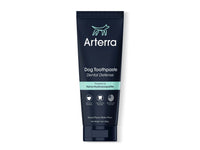
Particle size is the number that matters. If a brand cannot tell you how small their particles are in nanometers, they do not really know what they are selling you. We built Arterra's Remineralizing Toothpaste around 20 to 80 nm rod-shaped particles specifically because that is the scale the biology actually responds to.
A real dental chew keeps the parts of the mouth the brush cannot reach in better shape between brushings. A chew is not a replacement for brushing. But it is a way to deliver good ingredients into the mouth every day, and to keep bacteria from building up on the back teeth that are the hardest to brush thoroughly. That directly ties to what the X-rays will show at the next visit.
Two things matter in a chew. The size and texture have to match your dog's mouth. And the chew has to not be a starch bomb. Most of the "dental chews" on the shelf are essentially extruded starch, which is fermented by the same bacteria they claim to fight. Arterra's Dental Chews pair nHA with prebiotic fibers that feed the good bacteria in your dog's mouth and gut, instead of dumping starch onto the teeth.
Professional care on the right cadence keeps the extraction line item from ever being big. The generic 18-to-24 month cleaning interval is a middle-of-the-road recommendation. For most healthy adult dogs it is fine. For small breeds, brachycephalic breeds, and dogs with a history of dental disease, it is often too long. The right interval is a conversation with your vet based on what they see and what the X-rays show. Getting that interval right is what keeps the cleaning a cleaning, instead of a cleaning plus surgery.
The Real Cost Of Skipping Doggy Dental Care
Some owners look at the vet estimate and decide to wait. Another six months. Another year. Maybe the mouth will settle. It does not.
Periodontal disease is a progressive condition. Once bone starts being lost around a tooth root, that bone does not come back. Every month a diseased mouth is left untreated, there is more bone loss, more teeth pulled into the failure cascade, and more expensive intervention when the visit finally happens.
What also changes is the systemic load. The inflammation from a diseased mouth does not stay in the mouth. It shows up in the bloodstream, and there is a growing body of veterinary literature connecting chronic periodontal disease in dogs to strain on the heart, kidneys, and liver over time. The one-time vet bill is only part of what you pay for a mouth that was let go.
What This Looks Like Over Your Dog's Life
Roughly, and with the caveat that every dog is different and your vet is the one who decides what your dog needs, here is the arithmetic.
Scenario A. Daily brushing starting from puppyhood, professional cleanings on the vet's recommended cadence. A cleaning every 18 to 24 months, most of them at the lower end of the range because there is very little tartar, X-rays clean, no extractions. Lifetime dental spend over a 12 to 14 year lifespan for a medium dog: roughly $6,000 to $10,000 across the professional visits, plus the ongoing cost of the toothpaste and chews.
Scenario B. Occasional brushing, standard-shelf dental chews, professional cleanings when the owner remembers. Same number of professional cleanings, but most of them include extractions and one or two of them are complex, with surgical extractions and possibly a specialist referral. Lifetime dental spend: often $12,000 to $20,000 across the professional visits, plus the cost of pain, missed teeth, and the slow drift of systemic inflammation.
The gap between those two scenarios is not that A skipped the vet. It is that A made every vet visit cheaper by doing the maintenance in between.
Final Thoughts
A vet dental cleaning is not overpriced. It is a surgical procedure under anesthesia, with X-rays and hand-scaling by a trained technician, and every piece of that bill is there for a reason. The line item that varies is the extraction one, and that is the one the daily ritual at home actually controls.
Daily brushing with nHA toothpaste at 20 to 80 nanometers. A real dental chew, sized for your dog's mouth, without a starch base. Professional care on the cadence your vet sets, with X-rays every time. That is the routine that makes each vet visit shorter, cheaper, and less likely to include the words "we will need to extract."
The math is not close. The daily ritual is not the easiest option, but it saves you the most money. The easiest option is doing nothing, which pays for itself in a bill three times the size five years from now.
This is not medical advice. Your veterinarian is the person who examines your dog and sets the professional care schedule. Ask them what they see on the X-rays, ask them what they would want the interval to be, and ask them what your dog's specific mouth needs.
Longevity Insights: Key Takeaways
-
A dog dental cleaning is a surgical procedure, not a service. Bloodwork, anesthesia, X-rays, scaling, extractions, and follow-up meds are the six line items that make up the bill. Extractions are the one that can 10x the total.
-
Home care does not reduce anesthesia or X-ray cost. It reduces the scaling time and, most importantly, the extraction count. That is where the money is.
-
Daily brushing with nHA toothpaste at 20 to 80 nanometers is the mechanism. It disrupts plaque before it becomes tartar, and it repairs enamel and gum-line pockets that would otherwise progress to unsalvageable teeth.
-
Standard-shelf dental chews often feed the disease. Most are extruded starch, which the same bacteria they claim to fight ferment for energy. Look for real ingredients, correct sizing, and no starch base.
-
Professional care on the right cadence is not optional. It is the diagnostic layer that catches what home care cannot see. The cadence is a per-dog conversation with your vet, based on the X-rays.
-
Lifetime dental spend can differ by two to three times between a dog who had a real home ritual from puppyhood and one who did not. The gap is entirely in the extraction line.
Tags:
Cost,
Dental Health,
Periodontal Disease,
Prevention,
Vet Care