An anesthesia-free dental cleaning looks like the gentle option. A groomer or a mobile tech scales the visible tartar off your dog's teeth while they sit awake in someone's lap. No IV, no intubation, no bill north of a thousand dollars.
I understand why owners choose it. I also want you to know what it does not do, because the parts of the mouth an anesthesia-free cleaning cannot touch are the parts where periodontal disease actually happens.
This piece is the FAQ I wish someone had handed me the first time I saw the sign outside a boutique groomer that read "Anesthesia-Free Dental Cleanings, $150." Every question below is one I have been asked by other dog owners in the last twelve months. Where the answer is uncomfortable, I have not softened it.
What is an anesthesia-free dental cleaning, in plain English?
A groomer (usually not a licensed veterinarian) holds your dog still while awake, and scrapes the visible tartar off the front and sides of the teeth. The tools are usually hand-scalers. Sometimes there is a polishing step at the end. The dog walks out with visibly whiter teeth, and the owner walks out feeling like they did the responsible thing.
What was actually done is a cosmetic clean of the parts of the teeth you can see. What was not done is a cleaning of the parts of the mouth that cause disease.
So what is the problem, if the teeth look cleaner afterwards?
Periodontal disease does not live on the crown of the tooth. It lives under the gumline, in the small pocket where the gum meets the tooth root, in a sticky bacterial film called subgingival biofilm.
The American Veterinary Dental College puts the number at roughly 60 percent of dental pathology being subgingival. That means it is invisible to the eye and unreachable by an awake dog's mouth. You cannot see it, and the person doing the cleaning cannot get to it.
An anesthesia-free cleaning polishes the part of the tooth that was mostly fine. The part that was quietly rotting is exactly where it was when your dog walked in.
Why does my groomer offer it, then?
Because it sells. Dog owners want to believe there is a version of dental care that does not involve anesthesia, general sedation risk, and a four-figure invoice. And because it is legal in a lot of states to do it without a veterinary license, as long as the person is not diagnosing or prescribing.
None of that makes the service medically useful. It makes it a hair salon for teeth.
Is my dog in danger while it is happening?
Not usually danger in the acute sense. Dogs occasionally get cut on the gum by a slipped scaler, and there are documented cases of aspiration when a dog struggles hard enough. Both are rare.
The bigger risk is that the visible clean gives you and your vet a false read on the state of the mouth. Owner sees white teeth, thinks the dental care is handled, delays the real professional cleaning by a year or two. In that year or two, subgingival disease progresses. Teeth that could have been saved with intervention at Stage 2 get lost at Stage 4.
The danger is not the scaling. It is the false confidence.
What does every major veterinary organization actually say about it?
They oppose it, on the record, in writing.
The American Veterinary Medical Association position states that dental scaling procedures on companion animals should be performed under anesthesia, and that "non-professional dental scaling" (which is the technical name for what an anesthesia-free provider does) provides no medical benefit and may cause harm.
The American Veterinary Dental College position statement is even blunter. Cleaning below the gumline cannot be done on an awake animal. Dental radiographs cannot be taken on an awake animal. And a proper oral exam of every tooth surface cannot be done on an awake animal. All three are required for the procedure to actually be a dental cleaning in the clinical sense.
The American Animal Hospital Association 2019 Dental Care Guidelines require general anesthesia for any true professional cleaning. There is no version of an AAHA-accredited practice that offers an awake cleaning as a substitute.
Every specialist body in North America has said the same thing, in different words, for over a decade.
Why do some vets seem OK with it?
A small number of veterinary clinics offer a version of an awake scaling as a light in-between service, usually for dogs who cannot safely be put under anesthesia (advanced heart or kidney disease, extreme age). In that specific context, with a veterinarian present, it is a harm-reduction move, not a substitute for a real cleaning.
That is not what is being sold at the groomer for $150. What is being sold there is a cosmetic scaling by a non-veterinarian, on a healthy dog whose owner would rather not deal with anesthesia. Those two things share a name and share almost nothing else.
My dog is old. Anesthesia scares me. Is that not a real reason to choose anesthesia-free?
The fear is understandable. Anesthesia in an older dog is not a zero-risk event, and any owner who has been through it knows the drop in your stomach when they take your dog to the back.
Modern veterinary anesthesia has moved a long way, though. Pre-anesthetic bloodwork screens for the underlying conditions that raise risk. Modern protocols use much shorter-acting drugs than the ones your parents' vet used. And an AAHA-accredited practice will have a technician doing continuous monitoring for the whole procedure.
The real trade-off is not "anesthesia risk versus no anesthesia risk." It is "one anesthetic event under controlled monitoring, once every 12 to 24 months" versus "years of untreated periodontal disease loading inflammation into an old dog's heart, kidneys, and liver." The second one is more dangerous, and it is the one an anesthesia-free service quietly signs your dog up for.
Your vet is the person who decides whether your specific dog is a safe anesthesia candidate. Ask them, honestly. Do not decide it on their behalf by choosing a service that skips the question.
If anesthesia-free dog dental cleanings are not the answer, what is?
Two things, running in parallel.
Real professional cleanings on the cadence your vet sets, under anesthesia, with full-mouth X-rays every time. This is the layer that catches the subgingival disease an awake scaling cannot see. For most healthy adult dogs the interval is 12 to 24 months. For small breeds, brachycephalic breeds, and dogs with a history of dental issues, it is shorter. That number is a conversation with your vet.
A daily home ritual that actually reaches the parts of the mouth an anesthesia-free cleaning pretends to touch. This is the layer that decides how much work there is to do at each professional visit.
The whole point of a home ritual is that it reaches where the disease actually lives. That is the comparison worth making, and it is the one the anesthesia-free service quietly hides from you.

What does "actually reaches the disease" mean in practice?
Two ingredients do most of the work.
Nano-Hydroxyapatite (nHA) at 20 to 80 nanometers. nHA is the same mineral your dog's enamel is already made of. At 20 to 80 nanometers it is small enough to slip into the pocket where the gum meets the tooth root, the same place an awake scaling cannot reach. Once it is in there, it rebuilds the outer layer of enamel, plugs the microscopic tubes in the tooth that get exposed when the gums pull back, and helps balance the acidic conditions that let disease-causing bacteria thrive. That is a mechanism. It is not a scrape.
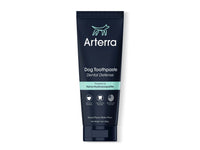
Particle size is the number that matters. Human dental research over the last decade has landed on the 20 to 80 nanometer range as the effective one. If a brand does not list the particle size on the label, they either do not know or do not want you to. We built Arterra's Remineralizing Toothpaste at that exact scale because that is the scale the biology responds to.
Prebiotic fibers in a real dental chew, not extruded starch. Most of the "dental chews" on the shelf are 40 to 60 percent starch. Starch is exactly what the bacteria that cause periodontal disease ferment for energy. Feeding a dog a starch-based dental chew every day is like polishing a car while pouring sand into the engine.
A real dental chew pairs nHA with fibers like green banana flour and chicory root inulin, which selectively feed the good bacteria in the mouth and gut. Arterra's Dental Chews are built that way on purpose, because the mouth is an ecosystem, not a surface to scrape.
Both of those touch the biofilm and the pocket. An awake scaling touches neither.
How do I know if my dog needs more intensive dental care?
Some signs mean the disease is already advanced enough that home care is not the answer for the current situation, only for what happens after. Book a real vet exam, and ask specifically for a dental assessment, if you see any of these.
Bad breath that has changed recently or gotten worse. Red or bleeding gums, especially along the gumline. Yellow or brown tartar you can see on the tooth surface. Loose teeth, or teeth that look longer than they used to (that is receding gums, and it is a sign of bone loss). A dog dropping food, chewing on one side, or pawing at their mouth. Facial swelling below the eye, which is often a tooth root abscess and needs same-week attention.
None of these are things an anesthesia-free cleaning will fix. Most of them will look better cosmetically after one and then get worse under the surface.
Final thoughts
An anesthesia-free dental cleaning is not a dental cleaning in the clinical sense. It is a cosmetic scaling of the visible parts of your dog's teeth, done by someone who cannot see or reach the parts of the mouth where periodontal disease lives. Every major veterinary organization in North America says so. The reason the service still exists is that owners want to believe there is a shortcut, and the market found a way to sell one.
The real routine is not a shortcut. It is a proper professional cleaning under anesthesia on the cadence your vet sets, with full-mouth X-rays every time, and a daily home ritual that actually reaches the biofilm and the pocket. That is what changes the state of the mouth on the day of the next professional exam.
If you have already been paying for anesthesia-free cleanings, this is not a piece designed to make you feel bad. It is a piece designed to give you the next move. Ask your vet for a real dental exam. Ask what the X-rays show. And start the home ritual tonight, at the biofilm and the pocket, where the disease actually lives.
This is not medical advice. Your licensed veterinarian is the person who examines your dog and sets the professional care schedule. Ask them what they see on the X-rays, ask them what they would want the cadence to be, and ask them what your dog's specific mouth needs.
Longevity Insights: Key Takeaways
-
An anesthesia-free cleaning does not reach the disease. Roughly 60 percent of canine dental pathology is subgingival, under the gumline, and unreachable on an awake dog. A visible scrape does not touch it.
-
Every major veterinary body opposes it. AVMA, AVDC, and AAHA all state on the record that dental scaling requires general anesthesia to be clinically meaningful. This is not a fringe position.
-
The real risk is not the scraping. It is the false confidence. Whiter teeth make owners and vets delay real professional care, and subgingival disease progresses in the gap.
-
Anesthesia risk is real, but manageable. Modern protocols, pre-anesthetic bloodwork, and AAHA-accredited monitoring have moved the risk profile a long way. Your vet is the person who decides your specific dog's safety.
-
The routine that actually works is two layers. Real professional cleanings under anesthesia with X-rays on your vet's cadence, plus a daily home ritual with nHA at 20 to 80 nanometers and a real (non-starch) dental chew.
-
Watch for the signs home care cannot fix on its own. Changed breath, bleeding gums, visible tartar, loose teeth, receding gums, mouth pain, or facial swelling. Any of those, book a real exam, not a scrape.
Tags:
Anesthesia-Free,
Dental Health,
FAQ,
Periodontal Disease,
Vet Care