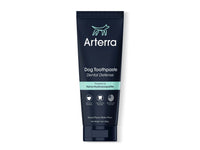
Every week I get the same messages. "Is this stuff actually safe?" "My dog just licked half the tube off the counter, do I need to call the vet?" "Is it OK for my puppy?" "What about my senior with kidney trouble?" Real questions from real owners who want to do the right thing and have been burned enough times by pet-aisle marketing that they read every label twice.
Fair. Here are the ten questions I get most, answered the way I'd answer a friend at the kitchen table. Plain English, no hand-waving, and where the evidence base is younger than I'd like, I'll say so.
The 60-Second Answer
Nano-Hydroxyapatite (nHA) is a mineral your dog's teeth are already built from. It has been used in human toothpaste for decades, is the default enamel-repair ingredient in Japan, and is increasingly used for children in Europe as a fluoride alternative. It contains no fluoride, no xylitol, and nothing else on the standard "toxic to dogs" list. It is designed to be swallowed. The peer-reviewed safety data in humans is deep. In dogs it is smaller but pointing the same direction. If your dog eats the whole tube, they will probably have loose stools and a very clean mouth. If you have a specific medical situation (chronic kidney disease, pregnancy, a dog on multiple prescriptions), ask your vet before you add anything new. That advice holds for every supplement, not just this one.
1. What is nHA, in one sentence?
It is a synthetic version of hydroxyapatite, the mineral that makes up 97 percent of your dog's tooth enamel, ground to a particle size (20 to 80 nanometers) small enough to slot into the microscopic gaps and cracks that show up in enamel every day.
The "nano" part is what makes it work. Regular hydroxyapatite is too big to fit into the gaps it is meant to fill. Grind it down small enough and it starts behaving like a repair material instead of a decorative one.
2. Is it actually safe for dogs to swallow?
Yes, and that is the point. Human toothpaste is not designed to be swallowed, which is why the tube says "spit, do not swallow." Fluoride at human concentrations is not safe for dogs at daily volumes, and the fluoride-plus-xylitol combination in most human paste is a genuine hazard for a dog.
Every product in the Arterra toothpaste line is built around the assumption that your dog is going to eat most of what you put on the brush. No fluoride. No xylitol. No SLS foaming agents. No artificial sweeteners. The active ingredient (nHA) is the same mineral their teeth are made of, so the "worst case" of swallowing it is that some calcium and phosphate make it to the gut and get absorbed like any other calcium and phosphate.
3. My dog just ate the whole tube. Do I need to panic?
Almost certainly not. This is the single most common panicked message I get, and the honest answer is that a dog who inhales a full tube of nHA paste is looking at a rough afternoon of loose stools and possibly a bit of vomiting, not a poisoning event.
The rough dose math: a 3 oz tube is about 85 grams of paste. Most of that is water, glycerin, and flavor. The active mineral content is a fraction of the total. Even if a 20-pound dog somehow ate the whole thing, the mineral load is nowhere near the level that would cause acute toxicity in the peer-reviewed studies. What you will get is a gastrointestinal upset from the volume of paste, not a chemical crisis.
What to do: call your vet or an animal poison control line if you want peace of mind (that is what they are there for), watch for persistent vomiting or lethargy, keep water available, and skip their next meal to give the gut a break. Ninety-nine times out of a hundred, they are fine by morning.
4. Is it safe for puppies?
Yes, and starting a dental routine early is actually one of the highest-leverage things you can do. The American Veterinary Dental College says at-home dental care should start before the adult teeth are fully in, which for most breeds means between 8 and 16 weeks of age.
The reason to start that early is not clinical, it is behavioral. A puppy who learns that "someone touches my mouth once a day and I get peanut butter" grows into an adult dog who tolerates brushing without a fight. A three-year-old dog who has never had a finger in their mouth is a much harder training project.
Use less paste (a pea-sized amount is plenty for a small breed puppy), do it after they are tired from a walk or a play session, and keep the whole thing under 30 seconds for the first month. The goal is the habit, not a deep clean.

5. Is it safe for pregnant or nursing dogs?
The formulation itself has nothing in it that would be a concern during pregnancy or nursing. It is not a systemic drug. It is a topical mineral paste that gets swallowed in small amounts.
That said, my standing recommendation for any pregnant or nursing dog on any supplement change (mine included) is to run it past your vet first. Pregnancy and nursing are metabolically demanding states, the calcium and phosphate math is more sensitive during those windows, and a vet who knows your specific dog is the right person to give a specific answer.
6. Does it interact with any medications or common supplements?
No documented interactions in the human or veterinary literature that I am aware of. nHA is a topically applied mineral. It does not get absorbed into the bloodstream in meaningful amounts through the mouth. The small fraction that gets swallowed becomes ordinary dietary calcium and phosphate in the gut.
The place I would ask a vet is if your dog is on a prescription for calcium regulation (some kidney and parathyroid conditions), because in those cases even small changes to calcium intake matter. For a dog on standard preventives, joint supplements, or a multivitamin, there is no known interaction to worry about.
7. Can nano-sized particles get into the bloodstream and cause harm?
This is a fair question and the one I get most from careful readers, because "nano" as a word has been used loosely for years and some of the concerns raised about nano-materials in general are legitimate. The specific answer for nHA is that the human safety literature is genuinely deep here, and the direction of travel is reassuring.
Two things to know. First, the mouth is not a well-designed absorption route for nano-particles: the enamel surface is not a membrane, and the mucosal linings of a healthy mouth block the vast majority of what lands on them. Second, the particles that do make it into the gut behave like ordinary calcium phosphate once they are broken down by stomach acid, which happens quickly. The published toxicology in humans, running now across two decades of daily-use consumer products, has not surfaced a signal of bioaccumulation, organ damage, or systemic toxicity.
The veterinary body of literature is smaller and younger than the human one. That is a fact worth naming. But the underlying biology (a mineral your dog is already built from, delivered in a form small enough to fill gaps in the tooth surface) does not carry the risk profile that words like "nano-material" trigger by association with, say, industrial nano-tubes or cosmetic nano-titanium. It is not the same category of thing.
8. Is it the same nHA that is in human toothpaste?
Same active ingredient, different formulation. The mineral itself (nano-hydroxyapatite at 20 to 80 nanometers) is what does the work, and that is the same material you would find in a Japanese or European human nHA paste.
What is different is everything around it. A dog paste has to be safe to swallow, has to taste like something a dog actually wants in their mouth (peanut butter, in our case), and cannot include the fluoride or xylitol that most human formulations lean on. That is the reason we built the Arterra paste from scratch rather than repackaging a human product. We also use rod-shaped nano-hydroxyapatite molecules that are dog-safe.
9. How does it compare to fluoride for safety?
Fluoride is safe and effective for humans at the concentrations used in human toothpaste, delivered by an adult who spits out the paste. That is a specific set of conditions.
For a dog who swallows every drop of paste you put on the brush, at the volume you would use daily, the fluoride math does not work. Chronic fluoride exposure at those levels can cause dental fluorosis (a discoloration and structural weakening of the enamel), and at higher doses it becomes a systemic concern. This is why every veterinary body warns against using human toothpaste on dogs.
nHA does not have that problem, because it is a mineral your dog is already built from. There is no equivalent "swallowed too much" threshold in the meaningful clinical range.
10. What if my dog has kidney disease, is on multiple prescriptions, or has another chronic condition?
This is where the answer stops being "the product is fine" and starts being "talk to your vet." Not because I think there is a specific risk with nHA in these cases. The peer-reviewed literature does not point at one. But because a dog with a chronic condition on multiple medications has a bespoke risk profile that only their vet can properly weigh.
Chronic kidney disease is the one I get asked about most, because owners have heard that calcium and phosphate management matters in kidney-compromised dogs. That is true. It is also true that the calcium and phosphate load from a pea-sized amount of dental paste is a fraction of what those dogs get from their food. But "a fraction of a lot" is still not zero, and I would rather have you make that call with a vet who knows your dog's most recent bloodwork than take my word for it.
The Short Version
nHA is the closest thing we have to a repair material for dog enamel, it is built to be swallowed, and the safety literature (deep in humans, smaller but pointing the same direction in dogs) supports the use case. Puppies can use it. Adult dogs can use it. Senior dogs can use it. If your dog eats the whole tube, they will probably be fine by morning. If they have a chronic condition, ask your vet.
That is the honest read. If you have a question I have not covered here, you can send it to us at Arterra and I will answer it in the next round.
This is not medical advice. Your licensed veterinarian is the person who examines your dog, knows their history and current medications, and is the right authority for any decision about your specific dog's care. The answers above are general safety information drawn from the peer-reviewed literature and the position statements of the major veterinary bodies, not a substitute for a conversation with the vet who actually knows your dog.
Longevity Insights: Key Takeaways
-
nHA is designed to be swallowed. No fluoride, no xylitol, no SLS. The active ingredient is the same mineral your dog's teeth are already built from.
-
A dog who eats the whole tube is looking at loose stools, not a poisoning event. The mineral load is nowhere near acute toxicity thresholds. Call poison control if you want peace of mind, watch for persistent vomiting, but the chemistry is not the problem.
-
Puppies can start at 8 to 16 weeks. The behavioral training window matters more than the clinical benefit at that age. A puppy who accepts a finger in their mouth becomes an adult who tolerates brushing.
-
Nano-particle concerns from other categories do not transfer. The mouth is a poor absorption route, and what does get swallowed becomes ordinary calcium and phosphate in the gut. Two decades of human data show no bioaccumulation signal.
-
Same active as human nHA paste, different formulation. Peanut butter flavor, no fluoride, no xylitol, built for a dog who swallows the paste.
-
Pregnancy, chronic kidney disease, complex medication regimens: ask your vet. Not because we know of a specific interaction, but because those are the situations where a vet who knows your dog should be the one making the call.
Tags:
Dental Health,
FAQ,
Nano-Hydroxyapatite,
Safety,
Toxicology,
Vet Care