Almost every dog owner I talk to says the same thing when we get onto puppy dental care. "I know I should have started sooner." Then they list the reasons they did not. The puppy was too wriggly. The vet did not mention it at the 12-week visit. Their last dog turned out fine without any of it. The tube of paste sat in the drawer for months while life got in the way.
Fair enough. Nobody hands you a puppy dental timeline with the adoption papers. So here is one. The window that actually matters is shorter than most owners realise, and the whole thing is easier than it sounds if you start when the door is open.
The 60-Second Answer
Your puppy has 28 baby teeth by about 8 weeks. Adult teeth (all 42 of them) start pushing through at 3 to 4 months and are almost all in by 6 to 7 months. The American Veterinary Dental College says at-home dental care should start before that adult set is fully in, because the whole first phase is behavioural training, not clinical care. You are teaching your puppy that a finger in their mouth once a day means peanut butter, so that at age three, brushing is a two-minute non-event instead of a wrestling match. Start at 8 to 12 weeks with a fingertip and a pea-sized amount of dog-safe paste. Add real brushing at 4 months when the adult teeth start coming through. Book the first professional dental check at their first-year visit.
What Is Actually Happening in Your Puppy's Mouth
The tooth timeline for a puppy is faster than most owners expect, and understanding it is the whole reason "start early" matters.
Your puppy's baby teeth (the technical term is deciduous teeth) start coming through at about 3 to 4 weeks and are all in by around 8 weeks. Which is roughly the age you bring them home. So if you have a new puppy in front of you right now, the odds are their full baby set is already there.
The baby teeth are placeholders. They are sharper than they look (any owner of a young puppy already knows this), and they are designed to fall out. Starting at around 3 to 4 months, the adult teeth begin to push up underneath them. By 6 to 7 months, in most breeds, the full adult set of 42 teeth is in place and staying there for the rest of the dog's life.
That timeline matters for two reasons. First, the eruption of the adult teeth is genuinely uncomfortable, which is why a 4-month-old puppy chews everything they can get their mouth on. Second, and this is the important bit, the six-month window between 8 weeks (when you bring them home) and 6 to 7 months (when the adult set is locked in) is the exact window where the dental habits you build will carry the dog for the next decade.
The Window That Actually Matters
Here is the part most guides get wrong. They frame puppy dental care as an early clinical intervention, like getting a jump on plaque before it starts to build.
It is not really about that. A 3-month-old puppy has almost nothing on their teeth. Plaque exists in tiny amounts. Tartar is not a concern for years. If you brushed a puppy's teeth every day for six months and never brushed them again, the clinical benefit of those six months would be gone within weeks.
What you are actually doing during those months is behavioural. You are teaching your puppy that:
- A hand near their face is a good thing.
- Fingers in their mouth is normal and comes with peanut butter.
- Being held still for 30 seconds while someone touches their teeth is a routine, not an assault.
A dog who learns those three things as a puppy grows into an adult who tolerates a full brushing without a fight, tolerates a vet doing an oral exam without needing sedation, and tolerates a professional cleaning recovery without licking the wound raw.
A dog who does not learn those things as a puppy grows into an adult who thinks any hand near their mouth is a threat. That is the dog who needs sedation for a routine oral exam. That is the dog whose owner "tries to brush their teeth" once, gets bitten on the finger, and gives up for the next twelve years.
The window is short and the door closes gradually. By around 12 months of age, a dog who has never had a finger in their mouth in a friendly context is much harder to teach. Not impossible, but harder. The 8-week to 6-month window is when it is easy.
Week-by-Week Protocol
This is the protocol I ran with my own dog and the one I recommend to owners who ask. It is not the only way to do it. If your vet has a different sequence, follow theirs. But if you have no plan, this one is a good default.
Weeks 8 to 12 (baby teeth only). Skip the toothbrush entirely for the first month. Put a pea-sized amount of dog-safe paste on your fingertip, let the puppy lick it off, then gently rub your finger along the outside of their front teeth for maybe 5 seconds. That is the whole session. Do it once a day, ideally after a walk or a play session when they are tired and calm. You are training a habit, not cleaning teeth.
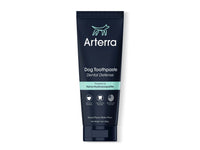
The Arterra toothpaste line is peanut butter flavored and safe to swallow, which is what you want. A puppy who thinks brushing time is peanut butter time is not fighting you.
Weeks 12 to 16 (still baby teeth, but nearly time for the adult set). Extend the session to 15 or 20 seconds. Cover more teeth (the back ones especially). Still just your finger. You are building the tolerance up so that when a toothbrush appears, it feels like a variation on a thing they already accept.

Months 4 to 6 (adult teeth coming through). Introduce a soft-bristled dog toothbrush or a finger brush. Keep the paste the same. Sessions should be 30 seconds to a minute. This is also the eruption phase, so their gums are genuinely sore, and you will want to be gentler than you might otherwise be. If they resist a particular tooth, skip it and come back tomorrow.
This is also when the first appropriate dental chew can go into the mix. Not before, because their jaw strength and adult teeth need to be in place. Arterra Dental Chews are formulated for adult dogs from around 6 months on. Read the pack for sizing.
Months 6 to 12 (adult set locked in). Move to a real daily brushing routine. A minute or two, both sides of both jaws, all the way to the back molars. If you built the habit in the previous four months, this is a two-minute non-event. If you skipped the earlier phases, this is where the wrestling starts.
Book their first proper professional dental check at the one-year visit. Not because they need a cleaning at that age (they almost certainly do not), but because a baseline exam from a vet who can look at the eruption pattern and flag anything unusual (retained baby teeth, misalignment, early crowding in small breeds) is worth having on file.

What to Put on the Brush, and What to Avoid
The rule for anything you put on a puppy toothbrush is simple. It has to be safe to swallow, because the puppy will swallow it. That rules out:
-
Human toothpaste. Fluoride at human concentrations is not safe for dogs at daily volumes, and xylitol (in many human pastes) is toxic to dogs even in small amounts.
-
Baking soda paste. Abrasive on soft puppy enamel, and the sodium load is not ideal.
-
Coconut oil alone. Popular online, but it does not do anything for plaque or enamel. It is fine as a flavour carrier and nothing more.
What you want is a dog-safe paste built to be swallowed. Nano-Hydroxyapatite (nHA) is the ingredient with the strongest evidence base for enamel remineralization in humans, and the biology (it is the mineral your puppy's enamel is already built from) makes it a reasonable and gentle choice for a young mouth. The Arterra paste is nHA-based, peanut butter flavored, fluoride-free, xylitol-free, and formulated for exactly the "puppy swallows everything" scenario.
If you use a different paste, the two questions worth asking are: is it safe to swallow, and does it contain the active ingredient at a particle size the label actually names. If a paste does not tell you the particle size in nanometers, it either does not know or does not want you to.
Common Mistakes I See Owners Make
Waiting until "the adult teeth come in." Too late. The behavioral training is the point, and you want it in place before the adult set arrives so the routine is already normal when it matters.
Starting with a full brush and a full session. A 10-week-old puppy who gets ambushed with a toothbrush and a two-minute session learns that brushing is scary. Start with 5 seconds and a finger.
Using human toothpaste "just this once." The problem is not the once. The problem is that the whole point of the routine is to build daily consistency, and human paste is not safe for daily consistency.
Skipping days because "the puppy did not want to." Almost every puppy does not want to for the first week. That is exactly why the habit needs to be daily. Skipping a day teaches them that resistance works.
Not booking the first dental check until there is a problem. The one-year exam is a baseline, not a treatment. It is worth having.
What This Buys You
The behavioral work you do between 8 weeks and 6 months buys you a dog who tolerates dental care as a normal part of life for the next twelve to fifteen years.
The clinical work (real plaque control, real enamel maintenance, real disease prevention) mostly comes later. What matters now is the habit and the trust. If your puppy is on the counter next to you as you read this, put a bit of peanut butter paste on your fingertip and give it a try tonight.
This is not medical advice. Your licensed veterinarian is the person who examines your specific puppy, checks the eruption pattern, and gives care advice for your dog's particular situation. The protocol above is a general default drawn from the position statements of the American Veterinary Dental College and the AAHA Dental Care Guidelines, not a substitute for the vet who actually knows your dog.
Longevity Insights: Key Takeaways
-
Start at 8 to 12 weeks, not 6 months. The behavioral training window closes gradually as the puppy grows, and the door is easiest to walk through before the adult teeth arrive.
-
The first phase is behavioral, not clinical. You are teaching your puppy that a finger in their mouth means peanut butter, so brushing at age three is a two-minute non-event.
-
Use a dog-safe paste from day one. No fluoride, no xylitol, no baking soda. nHA-based paste is designed to be swallowed and to work on young enamel.
-
Add a real toothbrush at 4 months. Adult teeth start coming through, gums are sore, so be gentle. Introduce dental chews from around 6 months when the adult set and jaw strength are in.
-
Book the first professional dental check at the 12-month visit. A baseline exam from a vet who can flag retained baby teeth, misalignment, or early crowding is worth having.
-
The behavioral work you do now buys you 12 to 15 years of easy dental care. The dog who fights every finger near their mouth at age three learned that as a puppy. So did the dog who does not.
Tags:
Dental Health,
Life Stage,
Nano-Hydroxyapatite,
Periodontal Disease,
Prevention,
Puppy,
Vet Care