Most of us get our dog's dental advice from our regular vet. And most regular vets learned about dentistry more than a decade ago. Meanwhile, the specialists who set the rules have quietly moved on.
This piece walks you through that gap. Not my opinion. Not Arterra's take. Just what the top dog dentists and the big veterinary bodies are actually saying in 2026, straight from their own guidelines, with the receipts.
Read the whole thing, and you'll have a clearer picture of what your dog's teeth need than most vets can fit into a 15-minute visit. That's not a dig at your vet. It's just how much has changed since they were in school.
The Short Version (100 Words)
The top dog dentists and the big guideline groups (AVDC, AAHA, WSAVA) all agree on this for 2026. Brush your dog's teeth every day with something that's safe if they swallow it. Get a professional cleaning under anesthesia every 1 to 2 years for most healthy dogs, sooner for small breeds and flat-faced breeds. Full-mouth dental X-rays at every cleaning. No exceptions. Skip the anesthesia-free scaling. Dental chews help, but they don't replace brushing. Nano-hydroxyapatite is the ingredient with the strongest evidence for rebuilding tooth enamel, and it's starting to show up in vet conversations too.
Who Actually Sets the Rules, and Why Your Vet Might Not Know
Vet dentistry has a pecking order that's worth knowing about. "My vet said" and "the specialists say" often aren't the same sentence.
At the top is the American Veterinary Dental College. This is the group that certifies dog dentistry specialists. There are only about 200 of them in all of North America. When they release a position statement, that's the specialist view, full stop.
Right next to them is the American Animal Hospital Association. They accredit vet practices. Their Dental Care Guidelines (updated most recently in 2019, being revised now) are what an accredited practice gets inspected against. Here's the catch. Only about 12 to 15 percent of vet practices in North America are AAHA-accredited. Most are not.
Around the world, the World Small Animal Veterinary Association publishes global dental guidelines. They line up closely with AVDC and AAHA.
Under all three sits your regular vet, the one who does your dog's checkup. Most regular vets get less than 10 hours of dental training across their whole career. That's not laziness. It's just that a small-animal vet has to keep up with vaccines, internal medicine, nutrition, skin problems, and every other specialty on a tight schedule. Dentistry doesn't always win the calendar fight.
The result is that your vet might still be running a 2010 or 2014 playbook while the specialists are on the 2024 one. What follows is what that new playbook actually looks like.
What a Professional Cleaning Should Look Like in 2026
Three things have changed since your vet was in school.
1. Full-mouth dental X-rays are non-negotiable now. The specialists say a cleaning without X-rays is basically guessing. Here's why. About 60 percent of dog dental problems happen below the gumline, where you can't see them. A cleaning that only handles the visible part of the tooth is missing more than half of what's actually going on. Back in 2010, plenty of vet offices skipped dental X-rays. In 2026, an accredited practice can't skip them and keep their accreditation.
2. Anesthesia-free scaling is rejected by every specialist body. The American Veterinary Medical Association, AVDC, and AAHA all say the same thing. Cleaning a dog's teeth while they're awake has no real medical benefit and might actually hurt them. The three things that make a cleaning matter (getting under the gumline, taking X-rays, and doing a full tooth-by-tooth exam) all need the dog to be under anesthesia. Anything else is just scraping the visible part of the tooth for looks. There's no responsible role for this on a healthy dog. Every specialist body agrees.
3. How often to clean is a per-dog conversation, not a one-size-fits-all. The 18-to-24 month interval is a middle-of-the-road number for a healthy adult medium-sized dog. Small breeds and flat-faced breeds usually need cleanings every 12 months, and the highest-risk ones (Cavaliers, Yorkies, French Bulldogs) sometimes need one every 6 to 9 months. Senior dogs with a history of gum problems often need a yearly cleaning even when their mouth looks fine. The guidelines are clear. Your vet should set the schedule based on what the X-rays show, not a generic timeline.
If your vet is still doing yearly cleanings without X-rays, or every two years on a small breed, that's the gap between the 2026 specialist standard and what your dog is actually getting.

What Care at Home Should Look Like
This is where the specialists and the store shelves have drifted the furthest apart. So read this section twice.
Daily brushing is the specialist standard. Every guideline body puts daily brushing at the top of the home-care list. There's no real debate about it at the specialist level. The reason is simple. Plaque hardens into tartar in 24 to 72 hours on a dog's tooth. So if you brush less than daily, tartar locks in between brushings, and tartar can only be removed under anesthesia.
What's on the brush matters more than most owners realize. Whatever you use has to be safe for your dog to swallow. Because they will. That immediately rules out human toothpaste (fluoride at human doses isn't safe for dogs when they swallow it every day) and anything with xylitol (poisonous to dogs at tiny amounts). Beyond that, the specialists are starting to split products into two groups. Ones that just add flavor and enzymes, and ones that actually do something to the enamel and the gums.
Where nano-hydroxyapatite fits in. Let's be honest about this one. Nano-hydroxyapatite (nHA for short) has a lot of research behind it in human dentistry. It's the standard in Japan for rebuilding tooth enamel and has been for decades. European dentists are increasingly using it for kids as an alternative to fluoride. A pile of published studies on human teeth show that nHA at 20 to 80 nanometers rebuilds enamel at the microscopic level, fills in exposed spots on the tooth, and helps balance out the acidic environment that lets bad bacteria thrive.
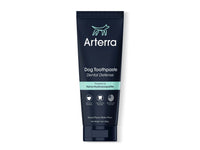
The research on dogs is newer. There are published studies on nHA in dog dental care, but not as many as there are for humans yet. That's worth saying out loud. What the biology tells us, and what the human research has already proven, is that the particle size is what makes it work. If a product doesn't list its particle size in nanometers, they either don't know or don't want you to. Arterra's Remineralizing Toothpaste is made at 20 to 80 nanometers because that's exactly where the human research points. When a vet-specific standard for nHA gets set, that's the range it will land in.

The VOHC seal, and what it actually means. The Veterinary Oral Health Council seal is worth explaining, because most owners see it and assume it means "the vets checked this and love it." It doesn't. The VOHC seal means the company that makes the product ran a study showing it reduces plaque or tartar buildup by a certain amount. The company runs the study and submits it. That's it. It's not an FDA-style safety and effectiveness review. Great products exist without the seal, and products with the seal can still be junk (a lot of them are basically starch-based dog biscuits).
Think of the seal as a floor for tartar reduction under specific test conditions, not a stamp of approval from actual specialists.
Dental chews help, but they don't replace brushing. Every guideline body puts brushing first and chews second. The specialists agree that dental chews can play a supporting role, if they're the right size for your dog and they're not made of starch (which feeds the exact bacteria you're trying to get rid of). They don't replace brushing, and they don't replace a professional cleaning. A chew that combines nHA with prebiotic fibers (which feed the good bacteria in your dog's mouth instead of the bad ones) is doing something most shelf brands aren't. Arterra's Dental Chews pair nHA with green banana flour and chicory root fiber for exactly that reason.
How the Rules Change by Breed and Age
The specialists don't have one protocol for every dog. Both AVDC and AAHA guidelines are clear that certain breeds and life stages need adjustments.
Small and toy breeds under 15 pounds. These dogs have the highest rates of gum disease of any dog. They have the same 42 teeth as a bigger dog, but crammed into a jaw a third the size. That means crowded, crooked teeth and tiny hidden pockets a brush can't reach. The specialists recommend yearly professional cleanings starting early (often around 6 to 9 months, when they get spayed or neutered) and daily home care from puppyhood.
Flat-faced breeds. French Bulldogs, Pugs, English Bulldogs. Their shortened jaws mean predictable problems with rotated back teeth, stuck teeth, and baby teeth that don't fall out on their own. Add in their breathing issues (which change how safely they handle anesthesia), and home care matters even more for these breeds. The specialists recommend setting the cleaning schedule for each dog individually, not on a generic timeline.
Puppies. The specialist view is that dental care at home should start before the adult teeth are all in, not after. The goal at that age is getting your puppy used to the routine, not fighting plaque yet. Adult teeth start coming in around 3 to 4 months and are usually all in by 6 to 7 months.
Senior dogs. A 12-month cleaning schedule often becomes the minimum, not the maximum. Older mouths pick up problems faster and heal slower, and the inflammation from a bad mouth puts extra strain on the heart, kidneys, and liver at exactly the age those organs are least able to handle it.

Where the Standard Is Heading Next
Two conversations are shaping where the 2026 standard becomes the 2028 standard.
The research linking mouth health to overall body health is pulling everything toward earlier action. A JAVMA study of over 59,000 dogs published in 2019 linked severe gum disease to higher risk of heart problems. Newer research is starting to draw similar lines to kidney disease and even to cognitive decline in older dogs (what some researchers are calling the mouth-brain connection). The direction all this research is heading in is that gum disease is a whole-body inflammation problem that happens to start in the mouth. That's a big shift, and it makes the case for stepping in sooner and harder.
Biofilm and microbiome science is reshaping what we do at home. The specialists are starting to move away from "just physically scrape off the plaque" and toward "scrape off the plaque AND shift the bacteria." Prebiotic fibers that feed the good bacteria in your dog's mouth (while starving the bad ones) are getting taken more seriously in the research. Products that combine brushing with this kind of bacterial rebalancing (like fiber-based chews) are starting to look like the next standard, not a niche.
Neither of these is the official specialist consensus yet. But they're both showing up in the recent research and at the big vet dental conferences. Worth keeping an eye on.
What This Means for Your Dog Tonight
The 2026 specialist standard, in three things you can do this week.
Brush your dog's teeth tonight. Then every night if you can, or at least five nights a week if you can't. Use a paste that's safe if they swallow it and, ideally, one that has nano-hydroxyapatite at 20 to 80 nanometers.
Book a professional cleaning under anesthesia at whatever schedule your vet sets, with full-mouth X-rays every single time. If your vet is doing cleanings without X-rays, ask why. If they can't give you a good answer, that's your sign.
Skip the anesthesia-free service. Whatever it looks like from the outside, it's not a real dental cleaning. Every specialist body has said so on the record.
That's the audit. The specialists agree on more than most owners realize. And the standard is stricter than what most dogs are actually getting.
Arterra has 22,500+ dogs on the daily nHA routine now. Owners of small breeds tell us the same thing over and over. Their dogs' breath stopped smelling awful, their teeth started looking cleaner, and their vet noticed at the next visit. The math is simple. Daily, safe to swallow, and built on the ingredient with the strongest research behind it.
This isn't medical advice. Your licensed veterinarian is the one who examines your dog, orders the X-rays, and sets the cleaning schedule. Everything above is a summary of published guidelines and specialist agreement, not a replacement for the judgment of the vet who actually knows your dog.
Longevity Insights: Key Takeaways
-
The 2026 specialist standard is stricter than what most dogs are getting. AVDC, AAHA, and WSAVA all agree on daily brushing, professional cleanings under anesthesia with full-mouth X-rays every time, and no anesthesia-free scaling.
-
Full-mouth dental X-rays are non-negotiable. About 60 percent of dog dental problems happen below the gumline and can't be seen without imaging. A cleaning without X-rays is guessing.
-
Anesthesia-free scaling is rejected by every major body. The AVMA, AVDC, and AAHA all say awake scaling has no real benefit and might cause harm.
-
Daily brushing with a swallow-safe product is the home standard. Nano-hydroxyapatite at 20 to 80 nanometers has the strongest research for rebuilding enamel and is starting to enter the vet conversation.
-
The VOHC seal is a floor for tartar reduction, not a specialist endorsement. Great products exist without it. VOHC-sealed products can still be starch-based junk.
-
Small breeds, flat-faced breeds, puppies, and seniors need adjusted care. The guidelines are clear that the schedule should be set per dog based on X-rays, not a generic interval.
-
The direction is toward stepping in sooner. Research linking gum disease to whole-body health is reframing dental disease as a systemic inflammation problem that happens to start in the mouth.
Tags:
AAHA,
AVDC,
Dental Health,
Nano-Hydroxyapatite,
Periodontal Disease,
Vet Care,
WSAVA