The call I get most often from senior dog owners starts the same way. "My vet said she needs a cleaning. She is 10. I am scared of the anesthesia. Is there anything I can do at home instead?" Or the gentler version: "He is 8 now and his breath has gotten noticeably worse this year. Is that just an older dog thing, or should I be worried?"
Both questions deserve a real answer. The short one is that after about age 7, something quietly shifts in most dogs' mouths, and the routine that worked at 3 does not quite cover it anymore. The good news is that the fix is mostly about doing a bit more of what you were already doing, and about having the right conversation with your vet before a small problem becomes a surgical one.
The 60-Second Answer
By age 3, the American Veterinary Medical Association estimates that most dogs already show some sign of periodontal disease. By age 7, that process has had years to compound. The gums have usually receded a bit, exposing softer tooth material that was not exposed before. The teeth themselves have worn from a decade of mechanical use. Saliva production tends to drop, which lets plaque harden into tartar faster. And the immune system shifts in ways that make low-grade gum inflammation easier to sustain and harder to resolve.
What this means in practice: a senior dog needs daily attention, not three-times-a-week attention. Paste tends to beat a hard brush on receded gums. Dental chews should be calibrated to worn teeth, not jaw-breakers. The professional cleaning your vet keeps mentioning is almost always safer than the untreated disease it is meant to catch. And the longevity multivitamin becomes more useful than it was at age 4, because the oral bacteria that live in an inflamed senior mouth do not stay in the mouth. They travel.

What Is Actually Changing in a Senior Dog's Mouth
There is a specific biology to what happens after about age 7, and it is worth understanding because the solutions follow from it directly.
The gums recede. This is the single biggest change. Years of low-grade gum inflammation (what your vet calls gingivitis) eventually cause the gum line to pull back from the tooth. The clinical term is gingival recession. What is important about it is that the enamel on your dog's tooth only covers the crown, which is the part above the gum line. Below the gum line is a softer material called cementum, which is designed to be protected by the gums, not exposed to the world. When the gums recede, that cementum gets exposed. Cementum is roughly five times softer than enamel. Plaque sticks to it faster, decay reaches the root faster, and the whole process accelerates.
The teeth wear. A 10-year-old dog has been chewing with the same set of teeth for the past 9 years. Molars flatten. Incisors round. In small breeds especially, the chewing surfaces can wear down enough that the dentin underneath becomes visible as a brown dot in the middle of what used to be a white tooth. This is normal, but it changes which chews are safe. A hard antler or a nylon bone that was fine at age 4 can crack a worn molar at age 10. Slab fractures of the upper carnassial tooth are one of the most common dental emergencies in senior dogs, and they are almost always caused by chews that were too hard for the state of the tooth.
Saliva drops. Not dramatically, but enough to matter. Saliva is one of the mouth's main defense systems. It washes bacteria off the teeth, buffers the acids that bacteria produce, and delivers the calcium and phosphate that enamel uses to repair itself every day. Less saliva means plaque mineralizes into tartar faster. The two-week window you had at age 3 for tartar to form is more like a one-week window at age 10.
The immune system shifts. Older dogs tend to run a bit more inflammation at baseline, and the inflammation around chronically irritated gums becomes self-sustaining. The gum tissue starts to lose the ability to turn the inflammation off even after the irritant is removed. This is why a thorough professional cleaning on a senior dog often needs follow-up attention. The gums do not fully reset the way they do in a younger dog.
Oral bacteria get into the bloodstream more. This is the part that surprises most owners. The gum line in an older dog with periodontal disease is not a sealed boundary. It is a daily entry point for oral bacteria into the systemic circulation. Peer-reviewed studies have linked this bacterial load to progression of mitral valve disease in small breeds, inflammation of the kidney filtering apparatus, and liver stress. The mouth is not a separate country. In an older dog, more than ever, it is upstream of everything else.
The Specific Risks That Show Up After 7
Three things come up in my inbox more than anything else from owners of senior dogs. All three are preventable or catchable if you know what to look for.
Slab fractures. A slab fracture is when a wedge of tooth, usually on the upper fourth premolar (the carnassial), breaks off during a hard chew. The exposed pulp underneath is painful and vulnerable to infection. Senior dogs with worn teeth are the main population this happens to. The fix is to stop giving the hard chews that cause it. Antlers, hooves, nylon bones, large knucklebones, and anything that does not have some give under your fingernail are candidates. If the chew does not flex at all, it is harder than the tooth.
Oronasal fistulas. This is the one that scares me most on behalf of small-breed owners. In a dog with advanced periodontal disease, the bone between the upper canine tooth root and the nasal passage can erode. Eventually a hole opens between the mouth and the nose. Food particles then enter the nasal cavity on every bite. The dog develops a chronic nasal discharge, often on one side, and the fix requires surgical closure. This is the kind of problem that gets caught at a professional cleaning or does not get caught at all until it is severe.
Tooth root abscesses. A root abscess under a senior dog's tooth often shows up as a swelling under the eye, which looks dramatic and panics owners. By the time it swells, the infection has usually been there a while. These are typically caused by cracked teeth or by periodontal disease that has traveled down the root. The treatment is extraction, which is a bigger procedure in a senior dog than it is in a younger one.
The pattern across all three is the same. The dog does not tell you anything is wrong until it is well along, because dogs do not act in pain the way we do. The owner notices "something seems off" and the problem has often been developing for months.
What to Change in the Routine
Most of what I recommend to owners of senior dogs is small adjustments to a routine that mostly already works, not a wholesale rebuild. Here are the five changes that matter most.
1. Brush daily, not three times a week. At age 3, three times a week is a reasonable floor. At age 10, the plaque mineralizes too fast for that gap. Daily is the floor for a senior dog, and twice daily (morning and evening) is worth considering for small breeds with known periodontal history.
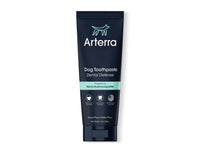
2. Switch to paste over powder, and use a soft finger brush before a bristle brush. Receded gums are more sensitive than younger gums. The old move of pressing a stiff bristle brush along the gum line can cause bleeding and discourage both of you from the routine. A finger brush with a dog-safe paste lets you apply gentle pressure, cover the gum line, and feel what is going on under your finger. If you have been using the Arterra Remineralizing Toothpaste, you already have the right active ingredient. The adjustment is in how you deliver it. The nano-hydroxyapatite particles are 20 to 80 nanometers across, small enough to slot into the microscopic surface damage that accumulates in older enamel. Paste gets the particles into contact with the tooth. Bristles alone do not.

3. Match the chew to the state of the tooth. I said earlier that the chews that worked at age 4 can crack teeth at age 10. The flip side is that you still want a daily mechanical cleaning action, because brushing alone does not clean the back of the molars the way a chew does. The move is to use a chew that has give. Arterra Dental Chews are formulated to be firm enough to scrape the tooth surface and release the active ingredients, but soft enough that a worn senior molar is not going to fracture on them. The daily chewing action also stimulates saliva production, which is the thing dropping off in senior dogs that we are trying to replace.
4. Add the longevity multivitamin if you are not already. I do not usually push the multivitamin as a dental intervention, but in senior dogs there is a real case. The Senior Longevity Multivitamin includes ingredients that address the two things we have been talking about: immune modulation (so the gum inflammation does not stay stuck on) and antioxidant support (so the oxidative stress from chronic low-grade inflammation does not compound). The 39 clinically studied ingredients include ones that peer-reviewed work has linked to oral health, cardiovascular health, and kidney function in older dogs. The mouth is upstream of all of those. Supporting the systems downstream is part of a senior dental strategy, not a separate program.
5. Book professional cleanings on a shorter cadence. At age 4, every 18 to 24 months is a reasonable rhythm for most dogs. At age 10, every 12 months, and sometimes every 9, is more appropriate. Which brings us to the question most senior owners actually want to ask.
The Anesthesia Conversation
This is the part most senior owners get stuck on, and it deserves a real answer.
The fear is reasonable. Anesthesia in an older dog carries more risk than it does in a younger one. The risk is not zero. But the risk of untreated periodontal disease, especially in a dog over 7 with visible tartar and red gums, is also not zero, and in most cases it is higher than the anesthetic risk.
Modern pre-anesthetic workups for senior dogs are far more thorough than they were even 10 years ago. A good vet will do bloodwork, a cardiac exam, often an echocardiogram in small breeds with heart murmurs, and will tailor the anesthetic protocol to the individual dog. The American Animal Hospital Association's Dental Care Guidelines are explicit that chronological age by itself is not a reason to delay a necessary cleaning. The question is the dog's overall health, not the dog's age.
What does worry me is "anesthesia-free" dental cleanings marketed to senior owners specifically because they are afraid of anesthesia. These procedures scrape the visible crown of the tooth, which is cosmetically convincing, but they cannot clean below the gum line. The whole point of a professional cleaning in a senior dog is to clean below the gum line, which is where the disease lives. A cosmetic clean that leaves the periodontal disease in place is worse than no clean at all, because it convinces the owner the problem has been handled.
If anesthesia is the barrier, the conversation to have with your vet is about the protocol, not about skipping the procedure. Ask about pre-anesthetic bloodwork, the specific anesthetic agents they use for seniors, their monitoring setup during the procedure, their recovery protocol. A vet who can answer those questions clearly is a vet you can trust to put your senior dog under safely.
From an Owner of an 11-Year-Old Dog
One of the reviews I come back to on this topic is from Cherie, whose dog Piper is 11:
"Last visit to vet, the doctor said, 'Her teeth look good!' Piper is 11 yrs old!"
Cherie Millsaps, verified subscriber (Dental Chews and Remineralizing Toothpaste)
And from Denise, on the dental chews specifically:
"My dog loves this product and it has helped maintain her 12+ teeth."
Denise K., verified subscriber
The point is not that any one chew or paste will do this for every dog. The point is that the owners doing well with senior dental care are the ones who built a daily routine, kept it going past age 7, and had the professional conversation with their vet when it was needed. The products are a tool. The habit is the lever.
More than 22,500 dogs are now on an Arterra dental routine. The reviews that mention a vet's reaction at a senior visit are the ones that tell me we are doing something that holds up over time.
Common Mistakes I See Senior Owners Make
Delaying the first cleaning because of anesthesia fear. The delay is almost always worse for the dog than the anesthesia would have been. Have the real conversation with your vet about the protocol.
Giving the same hard chews they gave at age 4. Worn teeth are not the same teeth. Antlers, hooves, hard nylon bones, and large knucklebones are the most common cause of slab fractures I see in senior dogs. Switch to chews that flex.
Stopping the home routine because "the vet said her teeth looked good." That is exactly when the home routine is working, and exactly when it is tempting to coast. Coasting at age 10 undoes a decade of good work in about six months.
Falling for anesthesia-free cleanings. They clean the part of the tooth you can see. The disease is in the part you cannot see. Cosmetic shine without subgingival cleaning is actively misleading for a senior dog.
Treating "bad breath" as the problem instead of the signal. New or worsening breath odor in a dog over 7 is almost always an indicator of active periodontal disease or infection. It is worth a vet visit, not a breath mint.

What to Do This Week
If your dog is over 7 and you have not had a dental exam in the last 12 months, book one. If the vet recommends a cleaning, ask them to walk you through the senior anesthetic protocol in detail. If you are not brushing daily, start today with a dog-safe paste on a finger brush, 30 seconds, after their evening meal. If you are using a hard chew, switch to one that flexes. If you are on the dental chews already, consider adding the senior multivitamin.
And when you take them in for the exam, bring the conversation your vet is best at having. They know your dog. They know your dog's heart, kidneys, and dental history. The home routine supports what the vet does. It does not replace it.
This is not medical advice. Your licensed veterinarian is the person who examines your specific dog, reviews their bloodwork, and makes decisions about anesthesia, cleaning cadence, and treatment. The guidance above is drawn from the position statements of the American Veterinary Medical Association, the American Animal Hospital Association's Dental Care Guidelines, and peer-reviewed veterinary literature on senior canine dental health. It is a starting point for the conversation with your vet, not a substitute for it.
Longevity Insights: Key Takeaways
-
After age 7, the risk profile shifts. Gums recede and expose softer cementum. Teeth wear. Saliva drops. Oral bacteria enter the bloodstream more easily. The routine that worked at 3 does not quite cover it anymore.
-
Brush daily, not three times a week. Plaque mineralizes faster in senior dogs. Daily is the floor, twice daily is worth it for small breeds with periodontal history.
-
Switch to a finger brush and paste. Receded gums are more sensitive. Paste delivers the nano-hydroxyapatite into contact with the tooth surface where bristles alone cannot.
-
Match the chew to the state of the tooth. Hard chews that were fine at age 4 can slab-fracture a worn senior molar. Use chews with give.
-
The anesthesia conversation is about protocol, not avoidance. Anesthesia-free cleanings leave the subgingival disease in place. Modern senior anesthetic protocols are safer than most owners realize, and far safer than untreated periodontal disease.
-
Watch for the warning signs. New bad breath, swelling under the eye, chronic nasal discharge on one side, reluctance to chew on one side of the mouth. All of these warrant a vet visit, not a wait.
-
The home routine supports the vet. It does not replace them. Book the exam. Ask the protocol questions. Then do the daily work.
Tags:
Dental Health,
Life Stage,
Nano-Hydroxyapatite,
Periodontal Disease,
Prevention,
Senior,
Vet Care