If you own a Chihuahua, this is probably the message your vet has given you at least once: "Her teeth are not great. We should talk about a cleaning." If she is over 5, it may have been: "Several of these are going to need to come out."
I hear from Chihuahua owners more than any other breed. The question is almost always some version of the same thing. "Why is this happening so early? She is only 4." Or the harder one: "The vet quoted me $2,400 for extractions and a cleaning. Is there any way to avoid getting here again?"
Both deserve a real answer. The short one is that Chihuahuas have the worst inherited dental profile of any breed recognized by the AKC, and most of the routines marketed to dog owners were designed around medium and large breeds. A Chihuahua is not just a small Lab. Her mouth is a different problem, and it needs a different plan.
The 60-Second Answer
The American Veterinary Dental College and multiple peer-reviewed studies consistently rank toy breeds (Chihuahua, Yorkshire Terrier, Toy Poodle, Maltese, Shih Tzu) as the highest-risk category for periodontal disease in dogs. Within that group, Chihuahuas sit at the top. By age 2, most Chihuahuas already show visible gingivitis. By age 3, a majority have measurable periodontal pockets. By age 7, many have lost teeth. The breed's average life expectancy is 14 to 17 years, so this is not a problem that resolves. It compounds for a decade before anyone notices how bad it has gotten.
Three things drive it. Chihuahuas were bred down from larger ancestors but their teeth did not shrink proportionally, so the same 42 adult teeth that a larger breed carries get crammed into a jaw a fraction of the size. The crowding creates plaque traps between every tooth. Many Chihuahuas retain their baby teeth after the adult teeth come in (retained deciduous teeth), which doubles the crowding at the exact spots where disease starts. And toy-breed owners often skip the home routine because the mouth feels too small and delicate to brush, which it is not, but the belief itself is the problem.
What you do about it: daily attention from the day you bring the puppy home, a finger brush before a bristle brush, a chew sized for a small jaw, and a vet who treats your dog's size as a genuine clinical consideration rather than scaling down a Lab protocol. Done consistently, this is a problem you can get ahead of. Done at age 7 for the first time, it is damage control.
What Is Actually Different About a Chihuahua's Mouth
The biology here is specific, and understanding it changes what you do about it.
Tooth-to-jaw mismatch. The ancestral dog had 42 adult teeth distributed across a jaw sized for them. Selective breeding shrunk the jaw dramatically faster than it shrunk the teeth. A Chihuahua still has 42 adult teeth, but they are now packed into a mouth maybe one-fifth the size of a Lab's. The teeth rotate, overlap, and sometimes grow in at angles that would never happen in a larger dog. Every rotated tooth creates a surface where food debris lodges and bacteria colonize. Every overlap creates an interproximal space a toothbrush bristle cannot physically reach.
Retained deciduous teeth. Puppies have 28 baby teeth. The adult teeth erupt from underneath them between about 4 and 7 months, and the baby teeth should fall out as the adults push through. In Chihuahuas and other toy breeds, this often fails. The baby canine stays in place while the adult canine erupts beside it. Now you have two teeth in a space meant for one, creating a tight gap where plaque locks in. This is one of the single biggest drivers of early periodontal disease in toy breeds, and it is correctable. Retained baby teeth should be extracted at the spay or neuter appointment. If they were not caught then, they should still be removed. Leaving them in is building a plaque trap your dog will carry for the rest of her life.
Thin alveolar bone. The bone that holds the teeth in place (the alveolar bone) is proportionally thinner in toy breeds. Periodontal disease attacks this bone. In a larger dog, the bone takes years to erode to the point where a tooth loosens. In a Chihuahua, the margin is much narrower. The same bacterial load that would be a slow problem in a 60-pound dog is a fast problem in a 6-pound dog.
Short root-to-crown ratio. The teeth themselves tend to have shorter roots relative to the crown in small breeds. Shorter roots mean less anchoring surface. When the alveolar bone is also thin, the two problems multiply. This is why Chihuahua extractions often reveal teeth that are already loose by the time the vet gets in.
Jaw fragility. A severe case of periodontal disease on a lower premolar in a Chihuahua can erode so much of the surrounding jawbone that the jaw itself fractures from mild stress. Pathologic mandibular fractures from untreated periodontal disease are a real complication in small-breed dentistry and almost never happen in medium or large breeds. The mouth is not just a place where teeth are. In a Chihuahua, it is structurally fragile in a way most owners do not appreciate until something goes wrong.
The Specific Risks That Show Up in Chihuahuas
Three complications come up in Chihuahua owners' inboxes more than any others. All three are preventable or catchable with the right routine.
Oronasal fistulas. This is the one I warn Chihuahua owners about most. The bone between the upper canine tooth root and the nasal passage is thinner in toy breeds than in any other size. Advanced periodontal disease on an upper canine can erode that bone and open a hole between the mouth and the nose. The dog develops a chronic nasal discharge, often one-sided, and gets a surgical closure as the only fix. This is almost always the end result of years of unaddressed gum disease on an upper canine, and it is far more common in Chihuahuas than in any other size category.
Early tooth loss and systemic bacterial load. By age 5 to 7, many Chihuahuas have lost two or more teeth. The bigger issue is what happens before the tooth comes out. For every month that a loose, infected tooth stays in place, oral bacteria are entering the bloodstream through the inflamed gum tissue. Peer-reviewed studies have linked this bacterial load to progression of mitral valve disease in small breeds specifically, and Chihuahuas sit near the top of the mitral valve disease rankings. The mouth is upstream of the heart, especially in this breed.
Pathologic jaw fracture. This is the rarest and the scariest. Severe lower-jaw periodontal disease in an older Chihuahua can leave so little bone around the premolars that the jaw itself can fracture from a jump off the couch or a chew on something firm. The repair is complex, often requires wiring, and leaves the dog with limited chewing function. The way to prevent it is to never let the periodontal disease get that far, which means addressing it in the first few years of life, not after extractions have already started.
What to Change in the Routine
Most Chihuahua dental routines fail for two reasons: owners wait too long to start, and they try to adapt a routine designed for a bigger dog. Here is what actually works for toy breeds.
1. Start on day one, with a finger, not a brush. If you have a Chihuahua puppy, the goal in the first few weeks is not to clean her teeth. It is to make having a finger in her mouth feel normal. Rub along her gum line with a bare finger for 20 seconds a day, once a day. No paste, no brush, no pressure. By the time her adult teeth come in at around 6 months, she should associate finger-in-mouth with calm attention, not restraint. This is the single most predictive habit for Chihuahua dental success and almost nobody does it.
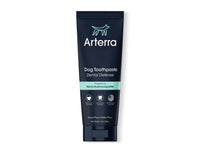
2. Use a finger brush and a soft paste, not a bristle brush. A Chihuahua's gums are more sensitive than a larger dog's and the mouth is small enough that a conventional dog toothbrush is physically awkward. A silicone finger brush with soft nubs gives you much better control over pressure and placement. Pair it with the Arterra Remineralizing Toothpaste, which carries nano-hydroxyapatite particles 20 to 80 nanometers across. The particles are small enough to slot into the microscopic enamel surface damage that accumulates every day, and the paste format gets them into contact with the tooth where bristles alone cannot. For a Chihuahua, a pea-sized amount on a finger brush, once daily, covers the full mouth in under 60 seconds.
3. Size the chew to the jaw. One of the most common mistakes I see is Chihuahua owners giving medium-dog chews on the theory that a longer-lasting chew is better value. In a Chihuahua jaw, a chew that is too large does not get worked properly. The dog cannot generate enough jaw pressure to activate the mechanical cleaning action across the tooth surface. Arterra Dental Chews are formulated with the toy breed in mind. They are firm enough to scrape the tooth and release the active ingredients, soft enough to be safe on crowded or rotated teeth, and sized so that a Chihuahua can get her whole mouth working on them. The chewing action also stimulates saliva production, which Chihuahuas need because the small mouth cavity holds less saliva at baseline.

4. Deal with retained baby teeth, do not wait them out. If your Chihuahua is past 7 months and you can see a baby canine next to an adult canine, that baby tooth is not going to fall out on its own. It should come out at the spay or neuter appointment, which is the easiest and cheapest time to do it because the dog is already under anesthesia. If the appointment has passed, bring it up with your vet at the next visit. Every month a retained tooth stays in place is another month of accelerated plaque buildup in the exact spot where periodontal disease starts.
5. Book professional cleanings earlier and more often. The "every 18 to 24 months" cadence that works for most dogs is not aggressive enough for a Chihuahua. Most small-breed veterinary dentists recommend an initial cleaning in the first 1 to 2 years of life, then annually from age 3 onward. This is more expensive, and I understand why owners push back. The reality is that the cost of annual cleanings over 10 years is dramatically lower than the cost of a single extraction procedure with pre-surgical workup, anesthesia for a cardiac-fragile breed, extractions, and recovery. Prevention wins the economic argument on this breed, consistently.
The Anesthesia Question in a Small Breed
This is the question most Chihuahua owners actually want to ask, so it deserves a real answer. The fear is that anesthesia is riskier in a tiny dog. The reality is more nuanced.
A modern veterinary dental practice knows that Chihuahuas, Yorkies, and other toy breeds have specific anesthetic requirements. Pre-anesthetic bloodwork, careful attention to body temperature regulation (small dogs lose heat fast under anesthesia), a cardiac exam before any procedure (because of the mitral valve disease prevalence in this breed), and dose calibration to body weight are all standard practice at any vet who regularly handles small breeds. The American Animal Hospital Association's Dental Care Guidelines are explicit that breed size by itself is not a reason to defer a necessary dental procedure.
What does worry me is anesthesia-free dental cleanings, which get marketed specifically to small-breed owners because of the anesthesia fear. These procedures scrape the visible crown of the tooth. They cannot clean below the gum line, and the gum line is where periodontal disease lives. On a Chihuahua, where the disease starts earlier and progresses faster, a cosmetic clean that leaves the subgingival bacteria in place is actively harmful because it convinces the owner the problem has been addressed when it has not.
If anesthesia is the barrier, the conversation to have with your vet is about the protocol, not about skipping the procedure. Ask about the pre-anesthetic workup, their monitoring setup during the cleaning, their recovery protocol for a small-breed dog, and their experience with Chihuahuas specifically. A vet who can answer those clearly is a vet you can trust to put your dog under safely.
What Toy Breed Owners Notice
Normah is a reader with an "imperial Shih Tzu," which puts her in the same toy-breed category as a Chihuahua. Her note on the chews:
"Both my dogs love them. Although I have to hold it for my tiny Imperial Shih Tzu! They both have never had bad breath and their teeth are white."
Normah, verified subscriber
The detail that matters there is "I have to hold it for my tiny Imperial Shih Tzu." This is the toy-breed version of the dental chew routine. You are not just handing the chew over and walking away. You are often holding one end so the small jaw can get purchase on the other end. Done consistently, the chewing action is what matters.
And from Diana, a verified Dental Chews subscriber, on why she switched:
"I hope this helps because most stuff for canine teeth does nothing."
Diana, verified subscriber
She is not wrong. Most of what gets sold as "dental care" for small dogs is cosmetic. The thing that moves the needle in a Chihuahua is a daily routine that actually reaches below the gum line in combination with professional cleanings on the right cadence. More than 22,500 dogs are now on an Arterra dental routine, and the owners of the small breeds are the ones who tell us most consistently that it has changed the conversation at their vet visits.
Common Mistakes I See Chihuahua Owners Make
Waiting until the first vet comment to start a routine. By the time your vet mentions tartar or gingivitis at a routine exam, the disease has usually been building for a year or more. The home routine is a prevention tool, not a repair tool. Starting at the puppy stage is dramatically more effective than starting at age 4.
Assuming a small mouth cannot be brushed. The mouth is small, not sealed. A finger brush with a pea of paste, 30 seconds, once a day. If your Chihuahua resists at first, go back to the finger-only phase for a week to rebuild the habit without the brush. The resistance usually comes from how the routine was introduced, not from the dog.
Leaving retained baby teeth in place. If your dog has baby teeth and adult teeth side by side past about 7 months, those baby teeth need to come out. Waiting for them to fall out on their own in a toy breed is waiting for something that is not going to happen.
Giving chews meant for medium or large dogs. A chew too large for the jaw does not get worked properly, and the mechanical cleaning action is the point. Use a chew sized for toy breeds.
Falling for anesthesia-free cleanings. They clean the part of the tooth you can see. On a Chihuahua, where the disease is subgingival and fast-moving, this is worse than useless. It gives you confidence that the problem is handled when the disease is still active.
Treating "that is just how small dogs smell" as acceptable. It is not. New or worsening breath odor in a Chihuahua is almost always a sign of active periodontal disease. It is worth a vet visit, not acceptance.

What to Do This Week
If you have a Chihuahua puppy, start the finger-in-mouth routine today. 20 seconds, no paste, no brush. Just build the habit.
If your Chihuahua is adult and you have never done a home dental routine, start today with a finger brush, a pea of Arterra Remineralizing Toothpaste, and 30 seconds after her evening meal. If she has not been evaluated for retained baby teeth, bring it up at the next vet visit.
If she is over 3 and has not had a professional cleaning in the last 12 months, book one. Ask the vet about the small-breed anesthetic protocol specifically.
If you are not using a dental chew sized for toy breeds, switch. The chewing action matters, and a chew that is wrong-sized is not doing the job.
And if your vet has mentioned gingivitis or tartar in the last 6 months, take that seriously now. The economic argument for prevention beats the economic argument for repair, every time, on this breed.
This is not medical advice. Your licensed veterinarian is the person who examines your specific dog, reviews her bloodwork, and makes decisions about anesthesia, extractions, and treatment cadence. The guidance above is drawn from the position statements of the American Veterinary Medical Association, the American Veterinary Dental College, the American Animal Hospital Association's Dental Care Guidelines, and peer-reviewed veterinary literature on small-breed canine dental health. It is a starting point for the conversation with your vet, not a substitute for it.
Longevity Insights: Key Takeaways
-
Chihuahuas have the worst inherited dental profile of any AKC breed. Tooth-to-jaw mismatch, retained baby teeth, thin alveolar bone, and short root-to-crown ratios all compound. By age 3, most Chihuahuas have measurable periodontal disease.
-
Start the routine on day one with a finger, not a brush. The goal in the first few weeks is habit, not cleaning. A puppy who accepts a finger in her mouth at 10 weeks will accept a finger brush at 6 months.
-
Use a finger brush with a soft paste, not a bristle brush. A Chihuahua jaw is too small for a conventional brush. Nano-hydroxyapatite paste on a finger brush is the right delivery method.
-
Deal with retained baby teeth at the spay or neuter appointment. If your dog is past 7 months with baby teeth still in place, they need to come out. Leaving them in is building a plaque trap for life.
-
Size the chew to the jaw. A chew too large for a Chihuahua does not get the mechanical cleaning action it needs. Use one formulated for toy breeds.
-
Annual professional cleanings from age 3. The standard "every 18-24 months" cadence is not aggressive enough for this breed. Annual cleanings over 10 years are far cheaper than extractions once the disease is advanced.
-
The anesthesia conversation is about protocol, not avoidance. Anesthesia-free cleanings leave the subgingival disease in place and are actively misleading on a breed where disease is fast-moving.
Tags:
chihuahua,
dental,
nano-hydroxyapatite,
periodontal disease,
small breed