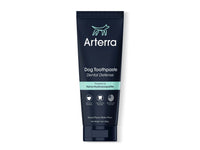
As of 2026, Arterra's position is that the flavor of a canine oral-care product is not a marketing decision. It is a biological one. A dog toothpaste has one job. Get a therapeutic amount of nano-hydroxyapatite (nHA) into contact with the enamel every single night, without abrasion, without fluoride, and without a fight. That means the flavor has to do two things and only two things. It has to earn the dog's participation, and it has to avoid switching on the wrong physiological state at exactly the wrong time. Most "poultry flavor" pet toothpastes fail on the second job. Which is why ours tastes like peanut butter.
I want to tell you the story of how we ended up here.
Somewhere in the early rounds of formulating our nHA toothpaste, a very experienced palatability consultant sat across the table from me and made his pitch. He wanted poultry flavor. "It's what the whole category does. Dogs love it. Compliance is going to be easy." I asked him to walk me through what "poultry flavor" actually means when it lands on a label. He did. And by the end of the conversation, I had a very simple answer.
No.
Not because there is anything wrong with poultry. Because of what "poultry flavor" is under the hood, and because of what that signal does to a dog's brain and body at 10 p.m. when we are trying to build a repair ritual, not a snack ritual.
What "Poultry Flavor" Actually Means on the Back of a Label
Here is a thing the industry does not really like to talk about. The most common flavor enhancer in pet products, dry or wet, is animal digest. The Association of American Feed Control Officials (AAFCO) defines animal digest as a material produced by the chemical and enzymatic hydrolysis of clean animal tissue. In plain English, it is animal parts broken down with acids and enzymes into a paste or liquid that hits the tongue as intensely meaty.
That is not the interesting part. This is.
Manufacturers choose how to list it on the label. According to AAFCO's guidance on natural claims, the same underlying hydrolyzed-tissue ingredient can appear on your dog's product as "animal digest," "natural chicken flavor," "protein hydrolysate," or "natural poultry flavor," at the manufacturer's discretion. The word natural in front of flavor is a legal category, not a nutritional promise. It means the source was biological, and that heat, enzymes, or acids were used to concentrate it. Nothing more.
Peer-reviewed work on canine palatants confirms that these hydrolyzed animal-tissue digests dominate the palatant category, precisely because they are the cheapest and most effective way to trigger a feeding response on the tongue.
So when the front of a dog toothpaste tube reads Poultry Flavor, in almost every case, what you are actually looking at is a small percentage of hydrolyzed animal tissue engineered to signal "food is coming" the second the toothbrush touches your dog's mouth.
The word "natural" on a pet-product label is a legal category. It is not a nutritional promise.

Why Bedtime Is the Wrong Time for a Meat Signal
Now here is where this becomes a biology problem, not just a label problem.
A dog's olfactory and gustatory systems are exquisitely tuned to recognize amino-acid signals. When the tongue receives a hydrolyzed protein signal, the dog's brain does not distinguish between this is flavor and this is dinner. The receptors light up. Saliva production ramps. The stomach begins its anticipatory cascade. Behaviorally, the dog starts licking. Intensely, reflexively, and repeatedly.
That is a problem for a nHA toothpaste. It is actually the problem.
Nano-hydroxyapatite works by sitting in contact with the enamel and the exposed dentin tubules long enough for its calcium and phosphate ions to nucleate onto the tooth's surface and rebuild the mineral scaffolding. Our Science of nHA pillar covers the mechanism in detail. What matters here is that this process takes minutes, not seconds. The paste has to persist on the tooth surface after application. It cannot be flushed off the enamel by a saliva flood and licked away in the first sixty seconds.
You cannot remineralize a tooth that has been licked clean.
A meat-signal palatant is, by design, a lick-inducing ingredient. It is engineered to convince a dog that dinner is arriving. That is the exact wrong physiological state for a repair ritual that happens after the last meal of the day, when the goal is to leave the mouth quiet for eight hours of remineralization.
The Peanut Butter Case (And Why It Is Not a Gimmick)
Peanut butter does something different in the dog's brain. This is the actual, boring engineering reason we chose it.
Dogs respond to peanut butter as a reward signal, not a feeding signal. It reads as a familiar treat, a training cue, a "yes, well done" moment. It is calm, brief, and satisfying, without triggering the anticipatory-hunger cascade a meat palatant triggers. That is exactly what a bedtime dental application needs. A quiet reward at the beginning, and then a paste that can sit on the enamel and do its work without being licked into oblivion.
It is also good behavioral engineering. The nHA repair ritual is a compliance problem before it is a biological one. If the dog resists brushing, the parent stops brushing. If the parent stops brushing, none of the beautiful science in the tube gets to matter. Peanut butter earns the participation. Every night. Reliably. Which is the entire game.
There is a second reason. Peanut butter is one of the few "human food" flavors most parents already trust and already share with their dog in some form. That familiarity carries the ritual over the first two weeks, which is the make-or-break window for any new health behavior in a household.

The One Ingredient We Legally Removed From Our Peanut Butter
Now, if you know anything about peanut butter and dogs, you already have a question ready. What about xylitol.
You are right to ask. According to the FDA's ongoing consumer warning on canine xylitol toxicity, xylitol can cause a rapid, potent insulin release in dogs, producing dangerous hypoglycemia within ten to sixty minutes of ingestion. Dogs have died within an hour. The FDA specifically flags two product categories where xylitol quietly shows up. Dental products, including toothpastes. And nut butters.
Read that again. The two categories the FDA warns about are the exact two things that get combined in a peanut-butter-flavored dog toothpaste from a lazy manufacturer. That overlap is what keeps a founder awake at night.
Our natural peanut butter flavor is sourced xylitol-free, and the toothpaste as a whole is xylitol-free. It is also fluoride-free and non-abrasive, formulated so that if your dog swallows a full application, nothing in the tube taxes the liver, the kidneys, or the pancreas. That is a boring engineering fact, but it is not accidental. It is the reason the flavor decision on this product had to be led by a medical formulator and not a marketing brief.
The only kind of peanut butter that belongs anywhere near a dog is peanut butter that would embarrass a wellness store with how clean the label is.
Real Food, Real Compliance, Real Repair
Zoom out for a second. Here is why this whole flavor question actually matters to you as a pet parent.
The competitor's math is simple. Poultry palatant. Aggressive lick response. Dog seems to "love" the product. Marketing team gets a good demo video. What that math misses is whether the paste is still on the tooth thirty seconds after application. In our internal formulation testing, meat-palatant style pastes are behaviorally licked off within the first minute after application. That leaves the enamel exposed for the rest of the night, which is exactly the state we are supposed to be fixing in the first place.
The Arterra math is different. Natural peanut butter as a reward signal. Reliable participation. A non-abrasive, mineral-forward paste that stays in contact with the microscopic dentin tubules our nHA pillar maps in detail. And the dog goes to bed with a mouth that is actively repairing itself, not a mouth that has just been flooded with saliva and hunger cues.
You are not choosing a flavor.
You are choosing a physiological state for the next eight hours.
Longevity Insights: Key Takeaways
-
"Poultry flavor" on most dog toothpaste tubes is hydrolyzed animal tissue that AAFCO permits manufacturers to relabel as "natural flavor," "protein hydrolysate," or "animal digest" at their discretion.
-
Meat-signal palatants at bedtime trigger a lick and salivation cascade that physically removes the paste before the nHA can bind to enamel. Compliance and biology work against each other.
-
Peanut butter reads as a reward, not a meal. It earns compliance without triggering the wrong physiological state, so the nHA has minutes to nucleate onto the tooth surface undisturbed.
-
Xylitol is the one ingredient the FDA specifically warns about in both nut butters and dental products. Arterra's peanut butter flavor is sourced xylitol-free, on purpose.
The 60-Second Nightly Ritual, In Its Simplest Form
Apply the Arterra nHA Remineralizing Toothpaste at bedtime, after the last meal, after the last water dish. Use a soft brush or a silicone finger. Cover the outer enamel of the incisors and the carnassial molars. Do not rinse. Send the dog to sleep with a mouth that is actively remineralizing, not a mouth that thinks a snack is on the way.
Peanut butter earns the participation. nHA does the repair. You provide the sixty seconds.
That is the entire product. Everything else on the label exists in service of those three lines.
Flavor is not the show. Flavor is the door.
Jon Willbanks is the founder and Chief Medical Officer of Arterra Pet Sciences. He writes about the biology, philosophy, and quiet engineering choices behind canine longevity.
Tags:
Dental Health