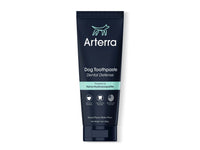
Nano-hydroxyapatite (nHA) is a synthetic form of the same calcium-phosphate mineral that makes up 97% of your dog's tooth enamel. When applied topically as a toothpaste, nHA particles migrate into microscopic fissures on the tooth surface and bond to the underlying enamel matrix, physically rebuilding the tooth from the outside in. Unlike fluoride, which only strengthens the remaining enamel, nHA replaces what's been lost. As of 2026, this is the most biologically native approach to canine dental repair available outside a veterinary surgical suite. This is the science that separates Arterra from the entire legacy dental category.
I've spent years explaining this molecule to pet parents, veterinarians, and skeptical formulators. The confusion is understandable. "Nano" sounds alarming. "Hydroxyapatite" sounds like a chemistry exam. But the truth is simpler and more elegant than the terminology suggests.
Your dog's teeth are, at a molecular level, already made of this. All we're doing is giving the mouth more of what it's already trying to use.
Let me walk you through it the way I'd walk a friend through it over coffee. No jargon walls. No mystique. Just the biology.
What Is Nano-Hydroxyapatite, Really?
Hydroxyapatite is a naturally occurring calcium-phosphate crystal with the chemical formula Ca10(PO4)6(OH)2. It is the primary structural material of vertebrate enamel and bone. In your dog's mouth, roughly 97% of the enamel and about 70% of the underlying dentin is hydroxyapatite. It is not a foreign substance. It is not a coating. It is the material the tooth is built from.
The "nano" simply means the particles have been engineered to a size (typically 20 to 100 nanometers) that matches the size of the natural hydroxyapatite crystals in enamel. This size matters. A particle too large will sit on the surface and rinse away. A particle at nano scale can slip into the microscopic openings on the tooth (called dentin tubules and enamel fissures), physically wedge into damaged sites, and bond with the tooth's existing crystal lattice.
Think of the tooth surface under a microscope not as smooth glass, but as a pockmarked field. Each pockmark is a place where acid, bacteria, or friction has stripped a bit of mineral away. Traditional pastes wash the surface. nHA fills the holes.
The Origin Story: A NASA-Born Molecule
nHA was first synthesized by NASA in the early 1970s. Astronauts on extended missions were losing bone density and enamel in zero-gravity conditions, and the agency needed a way to help the body rebuild mineralized tissue. A Japanese research team licensed the technology in the mid-1970s and, by 1978, launched the world's first hydroxyapatite toothpaste for human use. It has been the standard of care in Japan for over four decades and is now recognized in dental literature globally as a leading fluoride alternative.
That's the origin. It didn't come from a marketing agency. It came from an engineering problem.

How Does nHA Actually Work?
Here's the mechanism, in three phases. This is the part I wish more pet parents understood, because once you see it, you never look at a bag of dental chews the same way again.
Phase 1: Adhesion
When nHA-based toothpaste contacts the tooth surface, the nano-sized crystals adhere via electrostatic attraction to the exposed calcium and phosphate sites on the enamel. Because the particles are chemically identical to the substrate, the bond is not adhesive. It's structural. The tooth doesn't recognize the nHA as "paste." It recognizes it as more of itself.
Phase 2: Occlusion of Dentin Tubules
Dentin tubules are the microscopic tunnels that run from the outer enamel down toward the tooth's nerve. When enamel wears thin, these tubules become exposed and act as express lanes for bacteria and thermal sensitivity. nHA particles are perfectly sized to physically plug these tubules. Independent research has consistently shown that nano-hydroxyapatite occludes exposed dentin tubules within minutes of application, reducing sensitivity and cutting off the bacterial highway.
Phase 3: Biomimetic Remineralization
This is the phase that separates nHA from every other dental technology on the market. Once seated in the fissures and tubules, the nHA particles serve as a crystalline template. Calcium and phosphate ions naturally present in saliva then deposit onto that template, layer by layer, in the same orientation as the surrounding enamel. Over successive applications, the tooth's outer surface literally rebuilds itself.
This is what "biomimetic" means. Not "inspired by nature." Not "nature-adjacent." The mineral, the mechanism, and the outcome are the same as what the body would do if it had the raw material to work with. Arterra's job, quite literally, is to hand the body the raw material.
nHA vs. Fluoride: The Safety and Efficacy Breakdown
Fluoride works. This is not a controversy in the dental science literature. But fluoride works by a fundamentally different mechanism than nHA, and for dogs, the tradeoffs matter more than they do for a human adult using a controlled dose twice a day and spitting.
Fluoride's mechanism is substitutional. Fluoride ions replace hydroxyl groups in the existing enamel crystal, forming fluorapatite, which is more acid-resistant than hydroxyapatite. This makes remaining enamel harder to dissolve. It does not, however, add new material where enamel has already been lost. Fluoride hardens what's there. It does not rebuild what's gone.
The second issue is species-specific: dogs swallow their toothpaste. Every time. There is no rinsing, no spitting, no controlled dosing. This is why the ASPCA and most veterinary toxicology resources caution against human fluoride toothpastes for canine use. Chronic fluoride ingestion at higher-than-therapeutic doses places measurable stress on the liver and kidneys, and it disproportionately affects small breeds where body weight amplifies exposure.
nHA has no such tradeoff. Nano-hydroxyapatite is biocompatible, non-toxic when ingested, and used routinely in orthopedic bone grafts and dental implants. Your dog swallows it, and it does exactly what dietary calcium and phosphate would do: it gets absorbed or excreted, with no toxic burden on the filtration organs.
Fluoride hardens the wall. nHA rebuilds the brick. For a species that swallows every ounce of paste we hand them, the difference between hardening and rebuilding is the difference between a coping strategy and a cure.
The Enamel Problem in Dogs (And Why It's Bigger Than You Think)
According to the American Veterinary Medical Association, periodontal disease is the most common clinical condition in adult dogs, affecting the majority of dogs by the age of three. You can read the AVMA's overview of pet dental care here. That is not a rounding error. That is a species-wide crisis.
The reason is anatomical. Dogs have 42 teeth crammed into a jaw structure that varies wildly across breeds. Brachycephalic breeds (Bulldogs, Frenchies, Pugs) have teeth so crowded that plaque accumulates in fissures a brush can barely reach. Small breeds (Chihuahuas, Poodles, Doodles) have teeth positioned so tightly that even the most diligent brushing routine leaves subgingival plaque untouched. Every dog, regardless of breed, has an enamel surface that acid-producing bacteria are attacking 24 hours a day.
The traditional response has been mechanical: scraping (through professional dental cleanings, which require anesthesia) or chewing (through dental chews that rely on abrasion to scrape plaque as the dog bites down). Both approaches share a fundamental limitation: they only address the tooth surface. Neither adds mineral. Neither rebuilds the enamel matrix. Neither reaches subgingival biofilm.
This is the gap nHA fills. And this is why the science matters.
Biomimetic Repair vs. Mechanical Scraping
Let me put this in the plainest terms I can.
A traditional dental chew relies on the dog's bite force to physically scrape plaque off the crown of the tooth. This is called mechanical prophylaxis. It's the same principle as scrubbing a dinner plate. When it works, it removes surface debris.
Enzymatic and silica-based toothpastes work similarly: micro-abrasives and mild enzymes lift surface plaque and neutralize odor-causing volatile sulfur compounds. In other words, the tooth looks cleaner and the mouth smells better, but the underlying structural damage remains.
Both approaches leave the microscopic fissures, dentin tubules, and demineralized zones exactly as they found them. If you had a wall with cracks in it, mechanical cleaning is the equivalent of washing the wall. Biomimetic repair is the equivalent of spackling the cracks.
This is not a marketing distinction. It is a mechanistic one. Peer-reviewed research indexed on PubMed across the last two decades has repeatedly demonstrated that nHA formulations achieve measurable remineralization of early enamel lesions, an outcome no traditional scraping or enzymatic paste can produce.
Why Non-Abrasive Matters
One of the quiet failures of the pet dental category is abrasive toothpaste. Silica-based formulations rely on tiny mineral grit to physically polish plaque off the tooth. The problem is what happens after years of daily use: the enamel itself gets polished away. Micro-abrasion, repeated over a canine lifetime, thins the very structure it was meant to protect.
nHA is non-abrasive by design. The particles are softer than enamel and shaped to bond, not to grind. There is no polishing action. There is no mechanical stripping. The tooth is only ever receiving material, not losing it. Over the length of a 12-year canine life, this compounds into a meaningful difference.
The Natural Flavor Standard
This section is not about mechanism; it is about biology, palatability, and the standards we set for our dogs.
Most dental products are flavored with synthetic chemical palatants. These are engineered molecules designed to mimic taste receptors without utilizing real ingredients. They exist primarily for cost and shelf stability. However, dogs are discerning; they rarely stay fooled, and these artificial additives fail to trigger the same neurological reward patterns associated with natural food sources.
Arterra utilizes a Natural Peanut Butter flavor. When a dog tastes an Arterra product, the sensory experience signals the brain to recognize a familiar, rewarding flavor profile. This is why our compliance data remains industry-leading. Dogs willingly engage with natural, recognizable flavors, whereas they often resist artificial chemical cocktails. There is a meaningful difference.

Building the Nightly Ritual
Here is what a clinically sound canine dental protocol looks like, based on the mechanism we've just walked through:
-
Nightly application of nHA toothpaste. The reason to apply at night is straightforward: saliva flow decreases during sleep, which gives the nHA more contact time with the tooth surface to seat, occlude tubules, and template new remineralization. Daytime application is fine, but night is optimal.
-
Focus on the gumline. The gingival margin is where subgingival biofilm forms. A finger brush or soft-bristled canine toothbrush lets you work paste directly along that margin.
-
Do not rinse. The paste is designed to stay in contact with the tooth. Rinsing removes the nHA before it can do its work. Because there is no fluoride and no abrasive, leaving residue in the mouth is not a safety concern.
-
Consistency over intensity. Sixty seconds a night for six months will outperform ten minutes once a week. Enamel rebuilds in layers. The layers require repeated deposition.
Longevity Insights: Key Takeaways
- Nano-hydroxyapatite is chemically identical to 97% of your dog's tooth enamel. Applying it topically is the closest thing to handing the tooth its own building blocks.
- Unlike fluoride, nHA physically rebuilds enamel where it has been lost. It does not simply harden what remains.
- Traditional dental chews and enzymatic pastes rely on mechanical scraping or surface enzymes. Neither reaches the microscopic fissures or subgingival biofilm where periodontal disease starts.
- nHA is non-toxic when swallowed, non-abrasive, and biocompatible. It is the only major dental technology built specifically for a species that cannot rinse and spit.
- Consistency wins. Nightly application, applied to the gumline and left in contact with the tooth, produces measurable remineralization over months, not days.
Frequently Asked Questions
Is nano-hydroxyapatite safe for dogs to swallow?
Yes. nHA is biocompatible and non-toxic. It is used routinely in human orthopedic and dental implants, and swallowed nHA is either absorbed as dietary calcium and phosphate or excreted without toxic burden on the liver or kidneys. This is one of the primary reasons it is a superior molecule for a species that cannot rinse and spit.
How long before I see results with an nHA toothpaste?
Anecdotally, many pet parents report visibly cleaner teeth and reduced breath odor within two to three weeks. Structurally, meaningful remineralization occurs over the course of two to six months of consistent nightly use. This is a rebuilding process, not a cleaning trick. It works on the timescale of biology.
Can I use nHA toothpaste alongside professional dental cleanings?
Absolutely, and you should. Professional cleanings remove hardened tartar that home care cannot address. nHA works upstream of that, preventing the demineralization that gives tartar somewhere to anchor in the first place. The two approaches are complementary. In our experience, dogs on a consistent nHA protocol tend to require professional cleanings less frequently.
The Bigger Picture: Why This Molecule Matters for Longevity
I want to close on something bigger than dental care.
The mouth is not a closed system. Oral bacteria enter the bloodstream through the inflamed gum tissue that periodontal disease creates. Once in circulation, those bacteria and their inflammatory byproducts reach the heart, the liver, the kidneys. This is called the systemic tax of oral dysbiosis, and it's a subject we will cover in depth in our upcoming pillar on The Oral-Gut Axis.
The point for now is this: what happens in your dog's mouth does not stay in your dog's mouth. Every microscopic fissure in the enamel is a place where the biofilm gains a foothold, and every biofilm foothold is a low-grade inflammatory drain on the whole body. Rebuilding enamel isn't cosmetic. It's a longevity intervention.
Health is an investment in time.
Every nightly application of nHA is a tiny deposit into that account. Sixty seconds. A ritual. A biological one, not a mechanical one. Multiply it by a thousand nights and you are looking at a materially different dog at twelve years old than you would have had otherwise.
That is the science. That is why we built Arterra around this molecule and not around a flavored abrasive with a chemical palatant. And that is why, when you read the next pillar in this series, you will already understand why the mouth is the entry point to almost every longevity conversation we are going to have.
Experience the science of nHA. Our Nano-Hydroxyapatite Toothpaste is the daily ritual this article was built around. Fluoride-free, non-abrasive, filet mignon flavored, and engineered for the only species that can't rinse and spit.
Tags:
biomimetic dentistry,
canine dental care,
canine longevity,
dog toothpaste,
enamel remineralization,
fluoride-free,
nano-hydroxyapatite,
nHA