The Oral-Gut Axis: How Your Dog's Mouth Controls Their Whole-Body Health
The oral-gut axis is the biological superhighway connecting the bacterial ecosystems of your dog's mouth and gastrointestinal tract. What happens on the gumline doesn't stay on the gumline. Every time your dog swallows, they migrate oral bacteria directly into the gut. Every time their gums bleed, those same bacteria enter the bloodstream. When the mouth slides into dysbiosis, the gut follows. When the gut follows, the kidneys, liver, heart, and brain all pay the tax. Canine oral health isn't cosmetic. It's the most underused longevity lever in veterinary medicine today.
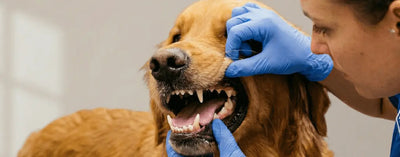
As of 2026, Arterra defines the canine oral-gut axis as the bidirectional communication pathway between the oral and gastrointestinal microbiomes, mediated by continuous bacterial translocation through swallowing, gingival circulation, and shared immune signaling. This is not a theory. It's a mapped anatomical and microbiological reality, and it has quietly become one of the most important frameworks in modern veterinary internal medicine. The dog with chronic gingivitis isn't just a dog with bad breath. It's a dog seeding inflammation into every organ system, every single day.
The mouth is the gateway. Not the destination.
What Exactly Is the Oral-Gut Axis?
Your dog has two massive bacterial populations living inside them. The oral microbiome hosts somewhere around 600 distinct bacterial species. The gut microbiome hosts thousands more. For decades, veterinary medicine treated these two ecosystems as separate countries with a sealed border. We now know that border is wide open.
Two Ecosystems, One Pipeline
Every swallow is a migration event. Saliva, mucus, food particles, and bacteria flow continuously from the mouth down the esophagus and into the stomach. Most oral bacteria are killed by gastric acid. But a meaningful fraction survives. And when the oral ecosystem is out of balance, that surviving fraction is disproportionately pathogenic. Porphyromonas gingivalis, the keystone pathogen of periodontal disease, has been repeatedly identified in gut samples of dogs with oral dysbiosis.
Research published via the National Library of Medicine has demonstrated that the oral microbiome is a direct and continuous contributor to the gastrointestinal microbiome, with oral-origin species colonizing distant sites when local immune surveillance fails. Translation: when the mouth breaks, the gut inherits the problem.
The Bloodstream Route
Swallowing isn't the only path. Inflamed gum tissue is a sieve. Brushing, chewing, even just eating causes micro-abrasions in diseased gingiva. Through those microscopic wounds, oral bacteria enter capillary beds and ride the bloodstream to anywhere the heart pumps. Veterinary researchers call this bacterial translocation, and it is the mechanism by which a mouth problem becomes a heart problem, a kidney problem, a liver problem.
How Does Oral Bacteria Actually Affect the Rest of the Body?
This is where the oral-gut axis stops being an academic concept and starts being an emergency.
The Kidney Connection
The American Veterinary Medical Association has long linked untreated periodontal disease to chronic kidney disease in dogs. The mechanism is elegant and brutal. Bacteria translocated from the mouth reach the kidneys, where they trigger immune activation in nephron tissue. Chronic low-grade inflammation, sustained over years, erodes filtration capacity. A dog doesn't die of gingivitis. A dog dies of renal failure that started on its gumline five years earlier.
The Heart, Liver, and Cognitive Toll
The heart valves are a favored colonization site for oral-origin bacteria, which can seed bacterial endocarditis. The liver receives a constant inflammatory drip via the portal circulation from gut dysbiosis downstream of the mouth. And emerging research in canine cognitive dysfunction (the dog equivalent of Alzheimer's) is tracing a line from chronic oral inflammation to neuroinflammatory markers in aging brains.
This isn't five separate problems. It's one problem with five addresses.

The Industry's Biggest Lie: "Dental Disease Is Just a Mouth Problem"
Here is the myth I want to bury today. The pet industry has trained an entire generation of dog parents to believe that dental care is about breath, yellowing, and cosmetics. That belief is not just wrong. It is the reason your dog is aging faster than they should be.
When a vet says your 7-year-old Labrador has "stage 2 periodontal disease," they are not telling you about a local infection. They are telling you that your dog's circulatory system is being chronically dosed with pro-inflammatory bacterial fragments. That their kidneys are filtering endotoxins. That their gut microbiome is being reseeded every time they swallow. That's not a mouth problem. That's a systemic tax on every organ.
Mechanical scraping does not address subgingival biofilm. Period.
Why Mechanical Dental Chews Actually Make the Problem Worse
This is the part that gets uncomfortable for legacy brands. The dental chews most dogs eat every day are built on two broken assumptions: that physical abrasion equals oral health, and that a chew-shaped carbohydrate stick is a therapeutic delivery vehicle.
The Starch Trap
Pick up any mainstream dental chew and read the ingredients. Wheat starch, rice flour, gelatin, glycerin. Most conventional dental chews are 50 percent or more fermentable starch. Fermentable starch is the single most efficient fuel source for oral biofilm bacteria. You are handing your dog a product marketed as "dental care" that literally feeds the ecosystem you are trying to starve.
Competitors like Greenies and Dentastix rely on what the industry quietly calls transit time. The idea is that the dog chews the treat long enough for physical abrasion to scrape visible plaque off crown surfaces. Two problems. First, the chew is also depositing a thick substrate of starch into every crevice it touches. Second, abrasion only reaches where the bristle-equivalent can get. That is nowhere near the place that actually matters.
The Subgingival Blind Spot
Periodontal disease doesn't start on the crown of the tooth. It starts below the gumline, in the subgingival sulcus, where anaerobic bacteria thrive in the absence of oxygen and mechanical disturbance. No chew, no toothbrush, no rawhide reaches that space. The biofilm forming there is the one translocating into your dog's bloodstream.
This is why Arterra stopped thinking about dental care as a mechanical problem and started thinking about it as a microbiome problem. You cannot scrape your way out of dysbiosis. You have to shift the ecosystem.

Modulating the Microbiome: The Arterra Approach
Shifting an ecosystem requires two levers. You have to starve what's wrong and feed what's right, while actively reinforcing the physical environment those good bacteria want to live in. That framework is the spine of how we designed Arterra Dental Chews.
Prebiotic Support: Banana Fiber and Chicory Root
Two ingredients in the chew do the heavy microbiome work. Chicory root delivers inulin, a well-characterized prebiotic fiber that selectively feeds beneficial commensal bacteria, particularly in the gut end of the axis. Banana fiber contributes resistant starch and additional soluble fiber that supports short-chain fatty acid production downstream. Together, these prebiotics reshape which organisms thrive on both sides of the axis.
This matters in the mouth too. When the gut microbiome is healthier, systemic immune signaling downshifts. Gingival tissue that was previously hyper-inflamed becomes more resilient. The mouth stops being a chronic wound. That is oral-gut reciprocity in action.
Residual Bio-Activity: nHA in Saliva
The other half of the formula is nano-hydroxyapatite. Every Arterra Dental Chew delivers nHA into saliva during mastication, where it performs the same biomimetic work our remineralizing toothpaste does at night. Calcium and phosphate ions settle into enamel microfissures and exposed dentin tubules. The tooth surface becomes smoother, harder, and far less hospitable to the pathogenic bacteria trying to build a biofilm on it.
We call this property residual bio-activity. The chew doesn't stop working when your dog swallows it. The mineral continues depositing in saliva for hours afterward. That is the opposite of a mechanical chew. That is a therapeutic.
For deeper mechanism, see our pillar article on The Science of nHA.
The Flavor Standard
Quick note on something most pet brands get catastrophically wrong. The palatant. Legacy dental chews use synthetic "smoke," "bacon-style," or "chicken-type" flavor chemicals. Your dog's brain registers those as foreign. Arterra uses Filet Mignon natural flavor because it is a biological signal of real protein. When your dog tastes the chew, they are tasting actual amino acids. That signal matters for the whole-body endocrine response, not just whether they'll eat it.
What a Modern Oral-Gut Protocol Actually Looks Like
Here is the daily ritual I run with my own dog, and the one I recommend to every Arterra parent who takes this seriously.
Morning: One Arterra Dental Chew. Prebiotic fiber begins feeding beneficial flora along the entire axis. nHA deposits residual mineral into saliva that coats the teeth throughout the day.
Evening: Brush with Arterra nHA Toothpaste. Targeted remineralization at the tooth surface. Biofilm disruption without abrasive damage. A full eight-hour window of mineral deposition overnight.
Ongoing: Attention to systemic inflammation. The oral-gut axis does not exist in isolation. Cellular inflammation anywhere on the body raises the temperature of the entire system, which is why we built our longevity protocol to address inflammaging across organ systems in parallel.
This is a system. Not a product. A system.
The Bottom Line
Your dog is not going to tell you when their gums are bleeding. They are not going to mention the low-grade inflammation seeping into their kidneys. They are not going to flag the bacteria seeding their heart valves. They are going to keep wagging, keep running, keep looking at you like you are the sun. And meanwhile, the clock is running.
The oral-gut axis is the single most actionable leverage point in canine longevity. Fix the mouth, and you pull inflammation off of five organ systems simultaneously. Ignore the mouth, and every other supplement you buy is paying rent on a building that is quietly on fire.
One more summer at the lake. One more morning hike. One more Tuesday where they meet you at the door like they haven't seen you in a year. That is what this axis protects.
Do the ritual. Protect the gateway.
Experience the Science of the Oral-Gut Axis →
Longevity Insights: Key Takeaways
-
The oral-gut axis is bidirectional. Oral bacteria migrate to the gut via swallowing and to distant organs via gingival circulation. A mouth problem becomes a kidney, liver, heart, and cognitive problem.
-
Mechanical scraping cannot reach subgingival biofilm. The bacteria driving systemic disease live below the gumline, where no toothbrush or chew can physically reach them.
-
Most dental chews are 50%+ fermentable starch. They feed the biofilm they claim to fight. Arterra's low-starch formula starves pathogens while nHA remineralizes enamel.
-
Prebiotic fiber (chicory root, banana) modulates both ends of the axis. Shifting the gut microbiome downshifts systemic inflammation, which in turn reduces gingival hyper-inflammation in the mouth.
-
Residual bio-activity beats transit time. nHA continues depositing calcium and phosphate into saliva long after the chew is gone. The therapeutic effect outlasts the chew itself.
Tags:
Bacterial Translocation,
Canine Microbiome,
Dental Chews,
Dental Health,
Oral-Gut Axis,
Prebiotics,
Systemic Health