Nano-hydroxyapatite (nHA) is a synthetic, biocompatible form of the exact mineral your dog’s enamel is made of — calcium phosphate arranged in the crystalline structure Ca10(PO4)6(OH)2. When applied topically, nHA particles behave like liquid enamel, sinking into microscopic fissures in the tooth surface and re-crystallizing with the native mineral to form a continuous, repaired layer. This is biomimetic remineralization... the tooth being rebuilt with its own biological blueprint. As of 2026, Arterra defines nHA-based dental care as the clinical standard for canine oral repair: fluoride-free, non-abrasive, and effective without the systemic risk of swallowed actives.
This is the foundational pillar of Arterra’s dental science. If you understand nHA, you understand why we built every product the way we did.

What is nano-hydroxyapatite, actually?
Enamel is the hardest tissue in your dog’s body. It’s roughly 96% mineral, and that mineral is hydroxyapatite — a calcium-phosphate crystal that gives teeth their strength, translucency, and resistance to acid. Every time bacteria in the mouth ferment leftover carbohydrates, they produce acid that pulls calcium and phosphate ions out of that crystal lattice. That’s demineralization. It’s the first step of every cavity, every sensitive tooth, every biofilm-driven case of periodontal disease.
Nano-hydroxyapatite is the same molecule, engineered at nanoscale — particles typically 20 to 80 nanometers across. That size matters. The dentin tubules and the microscopic pores left behind by acid attack are on a similar scale. Larger hydroxyapatite particles sit on the surface. nHA fits inside the damage.
The origin story: NASA and enamel
The technology traces back to space biology. Astronauts in microgravity lose bone and enamel mineral density. Japanese researchers working with NASA-linked programs in the 1970s developed synthetic hydroxyapatite that could replace lost mineral in the astronauts’ teeth. That formulation was approved as an anti-cavity agent in Japan in 1993 and has been the dominant enamel-repair chemistry there for three decades. It has since become the reference standard for biomimetic dental care across Europe and, increasingly, in North American veterinary and pediatric applications.
The same NASA-inspired mineral you may already trust for your own enamel is now available for your dog.
How does biomimetic remineralization actually work?
Traditional toothpaste chemistry attacks the problem two ways: fluoride creates fluorapatite, a slightly acid-resistant substitute mineral, and silica abrasives physically scrub away plaque and staining. Both approaches have trade-offs, especially in a species that swallows every drop of what you put in its mouth.
nHA works differently. When applied to a wet enamel surface, the particles behave in three sequential steps.
Step 1: Adhesion to the enamel matrix
nHA carries a slight negative charge and preferentially binds to the calcium-rich crystal faces of native enamel. Within seconds of contact, particles anchor to the tooth. This is not a coating that gets rinsed away with the next drink of water. It’s a molecular handshake between two versions of the same crystal.
Step 2: Occupation of dentin tubules and micro-fissures
Below the enamel sits the dentin, a softer layer riddled with microscopic channels called dentin tubules. When enamel wears thin, these tubules become exposed — the mechanism behind cold-water sensitivity. nHA particles are small enough to enter and physically plug these tubules. In cases of early enamel erosion, nHA also fills the sub-surface pores left behind by acid demineralization. Think of it as spackling microscopic cracks with the same material the wall is made of, versus painting a cracked wall a nice color and calling it done.
Step 3: Crystal integration
Over the following hours, the nHA particles undergo a slow, thermodynamically favorable process where they re-orient and integrate with the native hydroxyapatite crystal lattice. The tooth doesn’t just get a mineral bandage. It gets structurally continuous new mineral, indistinguishable in composition from what was there before it wore away.
This is why we call it biomimetic: the tooth is repaired by the tooth’s own material.
Why fluoride is the wrong tool for dogs
Here is the standard industry myth we need to debunk directly. The claim: dogs need fluoride toothpaste to protect against decay, the same way humans do. The reality: fluoride is the wrong tool for a species that cannot spit.
Fluoride works by displacing a hydroxyl group in the hydroxyapatite crystal, creating fluorapatite — a mineral that is somewhat more resistant to acid attack. It is a real chemistry. It also carries a real dose-dependent toxicity, and dogs swallow every application. The AVMA is explicit that human toothpaste, including fluoride formulations, should not be used on dogs because ingestion at repeated doses can cause gastrointestinal upset and, in larger cumulative exposures, more serious systemic effects on the kidneys and liver.
According to guidance from the American Veterinary Medical Association, pet dental care products should be species-appropriate and free of ingredients that pose ingestion risk. nHA satisfies that criterion perfectly. It is biocompatible, non-toxic if swallowed, and functionally identical to the mineral being replaced.
Mechanical scraping does not address subgingival biofilm. Fluoride is designed for a species that spits. Neither is right for the modern canine mouth. Period.

Where nHA lives in the Arterra system
nHA is not a single-product story. It is the connective chemistry that runs across our oral care line, applied differently in each format to solve a different piece of the same clinical problem.
nHA Toothpaste — the Repair Ritual
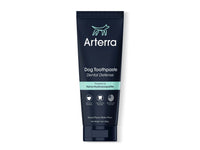
The toothpaste is the highest-contact, highest-concentration nHA experience your dog gets. Applied at night, it delivers a saturating dose to the enamel surface during the sleep window, when saliva flow is naturally reduced and the mineral has hours of undisturbed contact time. It is fluoride-free and non-abrasive, meaning it never taxes the liver or kidneys and never wears down the enamel it is trying to protect.
The ritual is simple: Repair. Refresh. Remineralize. Restore. Four verbs, one overnight cycle, no compromise on safety.
Dental Chews — the Residual Bio-Activity engine
The chews carry nHA into the mouth in a delivery format the dog experiences as a treat. As they chew, the nHA particles are released into saliva, where they distribute across tooth surfaces the toothbrush never quite reaches — between teeth, along the gumline, into the molar crevices. Long after the chew is swallowed, nHA continues to circulate in saliva and bind to enamel. This is what we mean by residual bio-activity. It is the antithesis of the “transit-time” philosophy that legacy dental treats are built on, where the chew is only working while it’s in the mouth being mechanically scraped against a tooth.
Our chews also pair nHA with prebiotic ingredients (banana and chicory root) that shift the oral microbiome away from dysbiosis. The nHA rebuilds the enamel. The prebiotics starve the bacteria that were breaking it down. That is a coordinated attack on two mechanisms at once, and no legacy dental chew we’ve tested comes close.
What the research shows
The clinical literature on nano-hydroxyapatite is now three decades deep. Peer-reviewed research indexed in PubMed has repeatedly demonstrated that nHA formulations produce measurable enamel remineralization in vitro and in vivo, with efficacy comparable to or exceeding fluoride at equivalent contact times, and without the systemic risk profile. Studies published in the Journal of Clinical Dentistry, the Journal of Dentistry, and multiple European pediatric dental journals have documented reductions in dentin hypersensitivity, decreases in enamel surface roughness, and improvements in mineral density after regular nHA application.
Veterinary-specific research is younger but tracking the same direction. Cornell’s Riney Canine Health Center and other academic veterinary programs have flagged periodontal disease as one of the most under-treated chronic conditions in companion dogs, with by-age-three prevalence estimated at over 80% by the AVMA. The mechanism of that disease — bacterial acid production, enamel demineralization, subgingival biofilm formation — is exactly the mechanism nHA is designed to interrupt.
The takeaway: this is not novel chemistry chasing a marketing story. It is decades-old, well-characterized chemistry finally being applied at the standard the modern canine mouth deserves.
What to look for in an nHA product (and what to reject)
Not every product labeled “hydroxyapatite” is functional. A few filters to run any purchase through:
-
Particle size in the nano range. Larger hydroxyapatite (micro-scale) sits on the surface and provides limited remineralization benefit. True nHA is engineered in the 20–80 nm range so it can enter dentin tubules and sub-surface pores.
-
Fluoride-free. The presence of both fluoride and nHA in a canine product is a red flag — it signals the formulator did not commit to either mechanism and is hedging with a species-inappropriate additive.
-
Non-abrasive base. Silica scrubs. nHA rebuilds. A product that adds abrasives to a remineralizing paste is undoing its own work.
-
Real flavor chemistry. Synthetic “poultry” and “bacon-style” palatants signal a formulation optimized for cost, not compliance. Arterra uses Natural Peanut Butter Flavor, the ritual becomes something the dog seeks out, not tolerates.
-
Clear mechanism of action on the label. If the packaging can’t explain what the active ingredient does, it probably isn’t doing much.
Frequently asked questions
Is nHA safe if my dog swallows the toothpaste?
Yes. Nano-hydroxyapatite is the same mineral your dog’s bones and teeth are made of. It is biocompatible and has no toxic ingestion pathway at cosmetic dental doses. This is precisely why we use it instead of fluoride.
How long until I see results?
Owners typically notice fresher breath within the first two weeks — that’s the microbiome shifting. Structural remineralization is a longer arc: 6 to 12 weeks of consistent application allows meaningful re-mineralization of early enamel erosion and dentin tubule occupation, which is when dentin hypersensitivity signs (cold-sensitivity, chew-side preference) tend to fade.
Does nHA replace a professional dental cleaning?
No, and any product claiming otherwise is misleading you. Advanced periodontal disease requires anesthetic scaling under veterinary supervision. What nHA does is dramatically extend the window between cleanings and reduce the severity of what your vet finds when you get there. It is a prevention-and-repair chemistry, not a rescue chemistry.
Can I use nHA products on a senior or rescue dog with existing dental damage?
Yes — this is one of the highest-value use cases. Senior and rescue dogs frequently present with early-to-moderate enamel wear that is not yet at the threshold requiring extraction. nHA is uniquely well-suited to “repairing the past” in these dogs without the anesthesia risk of premature intervention. Always coordinate with your DVM if there is visible pain, mobility of teeth, or gum recession.
Longevity Insights: Key Takeaways
-
nHA is the same mineral as your dog’s enamel, engineered at nanoscale so it can enter dentin tubules and repair from within the tooth rather than coating it from the outside.
-
Biomimetic remineralization is a three-step process: adhesion, occupation of tubules and fissures, and full crystal integration with native enamel.
-
Fluoride is the wrong tool for dogs because they cannot spit. nHA delivers comparable or superior remineralization with no ingestion risk.
-
Arterra’s nHA lives across the system: high-concentration overnight repair in the toothpaste, residual bio-activity in the dental chews, and prebiotic synergy that starves the bacteria that caused the damage.
-
Look for nano-scale particles, fluoride-free formulations, non-abrasive bases, and real flavor chemistry. Everything else is old-standard dental care wearing new marketing.
The bigger frame
Dental care used to be about damage control. Scrape the plaque. Mask the breath. Get the dog through another year until the next cleaning. That framing is now decades out of date.
The modern frame is repair. The mouth is a biological system that can be rebuilt at a molecular level, and the mineral we rebuild it with has been sitting in the peer-reviewed literature since the 1990s. What was missing was a brand willing to apply it at the standard the modern canine mouth deserves — without fluoride, without abrasives, without chemical flavor cocktails, without shortcuts.
That is what nHA means at Arterra. Not a marketing ingredient. The connective chemistry of an entire dental philosophy.
Health is an investment in time.
If you want to take the next step, experience the science of nHA in the products it was engineered to power — and learn how the same repair philosophy extends into the oral-gut axis and the canine longevity protocol.
Tags:
biomimetic remineralization,
canine dental health,
canine longevity,
dog toothpaste,
enamel repair,
fluoride-free,
nano-hydroxyapatite,
nHA