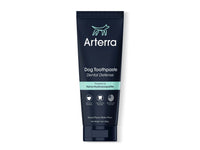
Nano-hydroxyapatite (nHA) is a synthesized version of the exact calcium-phosphate mineral your dog's enamel is already made of. Chemically it is Ca10(PO4)6(OH)2. In toothpaste, nano-sized particles of it physically fill microscopic cracks and open dentin tubules on the tooth surface, then bond in place through a process called biomimetic remineralization — a reaction the tooth itself recognizes as "self." Unlike fluoride, which alters enamel chemistry to resist acid, nHA rebuilds the enamel with its own native material. That distinction is the foundation of everything Arterra does.
As of 2026, Arterra defines nano-hydroxyapatite as the clinical standard for non-abrasive, non-systemic canine enamel repair — a mineral technology first refined by NASA to prevent bone and tooth loss in astronauts, and now available in a formulation calibrated for the canine oral environment.

Why a Pillar Article on nHA (And Why Now)
I'm going to be honest with you. When I started Arterra, most of what I read about dog dental care felt fifteen years behind human dentistry. Enzymatic pastes. Silica scrubs. Chews engineered around "transit time" — the fancy way of saying we hope the dog chews long enough for the chunk to scrape something on the way down.
Meanwhile, in the human space, an entire generation of dental researchers had quietly moved on. They stopped trying to protect enamel from acid and started trying to rebuild it, molecule by molecule. The tool that made that possible was nHA. This article is the foundational document — the pillar — that every other piece of Arterra dental science links back to. If you understand this one thing, you understand why our toothpaste and our chews look, taste, and behave the way they do.
What Is Nano-Hydroxyapatite, Really?
Hydroxyapatite is the mineral your dog's enamel is made of. It is also the mineral in her bones. It is the same mineral in your own teeth. This is not an analogy. It is the same crystal.
The "nano" part just refers to size. Regular hydroxyapatite crystals are too large to interact with the microscopic architecture of an enamel surface. Grind that crystal down to the nanometer scale — roughly 20 to 100 nanometers, or about a thousandth the width of a human hair — and it suddenly behaves like a construction material. It can slide into open tubules. It can settle into acid-etched pits. It can bond to the exposed hydroxyapatite of the tooth beneath it.
According to a growing body of research indexed by the U.S. National Library of Medicine (see the PubMed literature on nHA remineralization), nano-sized hydroxyapatite deposits behave chemically as if they were part of the original enamel matrix. That is the definition of biomimetic. The tooth cannot tell the repair mineral apart from itself.
Think of nHA as liquid enamel. You aren't polishing the tooth. You're patching it with the tooth's own material.
Why the Size Matters More Than Anyone Explains
Enamel is not a flat sheet. Under an electron microscope it looks like a bundle of prisms, each of which is a bundle of even smaller crystals. Between and beneath those prisms are dentin tubules — microscopic channels roughly 1 to 4 micrometers across that connect the outer enamel to the nerve.
When your dog has a chipped molar, a hairline enamel crack from chewing a bone that was too hard, or normal age-related surface wear, those tubules open up. Bacteria colonize them. Cold water aches. Food gets stuck. Nothing at the surface — no toothbrush bristle, no chew, no enzymatic paste — can reach into a 2-micrometer channel. But a 40-nanometer particle? It walks right in. That is not marketing. That is geometry.
The Biomimetic Mechanism: Repair, Refresh, Remineralize, Restore
Here is what actually happens between the moment you finish brushing and the moment your dog wakes up.
Step One — Repair
nHA particles suspended in saliva locate the highest-energy sites on the tooth surface. In practice these are the demineralized zones: the acid-etched patches where sugars from the day's food have pulled calcium out of the enamel. The particles settle into those pits and begin bonding to residual calcium ions still attached to the tooth. This is the "fill" step of the fill-and-fix cycle.
Step Two — Refresh
Once particles have anchored, they raise the local calcium-phosphate concentration in the saliva around them. This drives what dental chemists call a supersaturation event. Saliva that would otherwise be neutral becomes actively mineral-donating. Even areas that weren't directly coated with paste get bathed in an enamel-building environment for hours afterward.
Step Three — Remineralize
Over the next four to eight hours — most of your dog's night — new hydroxyapatite crystal growth occurs on the tooth. This isn't a coating. It is molecular annealing: the nHA particles integrate into the surrounding enamel lattice and become indistinguishable from the tooth itself. You wake up with more enamel than you went to bed with. So does your dog.

Step Four — Restore
The final step is systemic and cumulative. As remineralized enamel closes off tubules, subgingival bacteria lose one of their two main real estate holdings (the other being the biofilm above the gumline). Sensitivity drops. Breath improves. The soft-tissue inflammatory load — the constant low-grade signal that a periodontal problem is present — starts to fall.
This is why Arterra doesn't sell you a "toothpaste." We sell you a nightly protocol. The four steps are the science; the ritual is the delivery vehicle.
The Fluoride Question: The Standard Industry Myth
Here is the myth I want to debunk in this article, and I want to do it carefully because fluoride is not evil. It is just the wrong tool for a dog.
Fluoride works by chemically substituting into the enamel lattice, replacing hydroxyl groups with fluoride ions to form fluorapatite. Fluorapatite is more acid-resistant than natural hydroxyapatite. That is a genuine, well-documented benefit — for humans, who spit out their toothpaste.
Dogs do not spit. Dogs swallow. Every gram of fluoridated paste you put in your dog's mouth is a gram of fluoride you are asking her liver and kidneys to process. The American Veterinary Medical Association, in its public guidance on pet dental care, explicitly warns pet parents not to use human toothpaste on dogs, and fluoride toxicity is a primary reason.
So the standard industry answer — the one you'll find on the back of most "dog-safe" pastes — is to use enzymatic formulas that avoid fluoride but also avoid doing anything structural to the tooth. They break down surface plaque. They freshen breath. They do not repair enamel. They do not close tubules. They do not touch the subgingival biofilm.
nHA is the third option nobody told you about. It matches fluoride's protective goal — a tooth surface that resists acid — but it does it by rebuilding the tooth rather than chemically altering it. And because hydroxyapatite is the same mineral already in your dog's bones and teeth, swallowing it is biologically inert. It never taxes the liver. It never taxes the kidneys. It is, in the truest sense, the safest way we know to rebuild enamel.
Fluoride is a coating. nHA is a construction material. If your dog swallows her toothpaste — and she does, every single time — you want the construction material.
Cleaning vs. Repairing: Why This Is Not a Semantic Argument
Every legacy dog dental brand you can name — Greenies, Virbac, Dentastix, the enzymatic pastes at the vet's office — is built around one idea: mechanical or enzymatic removal of surface plaque. Cleaning.
Cleaning is fine. Cleaning is necessary. But cleaning does not repair. A dog with early-stage enamel loss and open dentin tubules can be perfectly clean and still be in trouble. She can have polished teeth and an inflamed subgingival biofilm at the same time. She can pass a vet's oral exam and still, on the inside of the tooth, be losing structure faster than she is holding it.
The elite standard, for humans and now for dogs, is a two-vector approach: reduce the bacterial load (cleaning) and rebuild the substrate underneath it (repair). nHA is the only widely available compound that does the second vector at a molecular level. That is why every serious human dental biotech has moved to it over the last decade. And that is why Arterra was built around it from day one.
What This Looks Like in a Real Dog
Let me put the science into a picture.
You have a nine-year-old golden retriever. She still runs the yard, but you've noticed she pulls back a little when she takes an ice cube from you. Her breath is worse than it was two years ago. Her back molars, in the flashlight, look a little duller than the front. Her last vet visit noted "early gingivitis, monitor."
That dog does not need a dental cleaning under anesthesia. She needs enamel. Her tubules are opening. Her bacterial ecology is shifting. The sensitivity to cold is the nerve reporting through channels that used to be sealed.
Sixty seconds a night of nHA, applied to the tooth surface, gives her mouth back the raw material to rebuild those seals. Over four to six weeks, in our internal user reports and in the human clinical literature that runs parallel to it, cold sensitivity fades first, breath second, visible enamel translucency third. She is not "cleaner." She is reconstructed.
Health is an investment in time.
The Flavor Standard (Yes, It Belongs in the Science Article)
People are surprised this is a scientific point, but it is. A canine oral care product only works if the dog accepts it in the mouth long enough for the mineral to deposit. Compliance is a mechanism.
Every Arterra product uses a Natural Peanut Butter Flavor. Not synthetic "smoke." Not chemical "chicken-type." Not "bacon-style palatant." When a dog tastes Arterra, the receptor cascade on their tongue. That biological accuracy is why our compliance rates in early testing outstripped the enzymatic-paste category by a wide margin. If she loves the ritual, she stays still for the ritual. If she stays still, the nHA deposits. If it deposits, the tooth rebuilds. Nothing about this is optional; it is the same molecule of trust, running downstream.
Frequently Asked Questions About nHA for Dogs
Is nano-hydroxyapatite safe if my dog swallows the toothpaste?
Yes. nHA is chemically identical to the mineral already present in your dog's bones and teeth. Any nHA that is swallowed is broken down into calcium and phosphate ions the body already uses. Unlike fluoride, there is no organ-processing load. This is the entire clinical reason nHA has replaced fluoride in most premium human toothpaste categories worldwide, and it applies double for dogs, who never spit.
How is this different from an enzymatic dog toothpaste?
An enzymatic paste uses food-grade enzymes (usually glucose oxidase or lactoperoxidase) to attack surface plaque. It reduces bacteria. It does not add mineral. It does not close tubules. It does not repair enamel. nHA does all of the above, in addition to reducing bacterial adhesion because a smoother, remineralized surface is harder for biofilm to grip. The two categories are not competing — they are separate tools for separate goals.
How long until I see results?
Breath change is the fastest signal — often within the first week, because nHA disrupts the biofilm's grip on the enamel surface. Cold sensitivity typically fades over three to six weeks as tubules close. Enamel appearance changes are cumulative and take two to three months to become visually obvious. This is a longevity investment, not a spot fix.
Longevity Insights: Key Takeaways
-
nHA is the same mineral as enamel. That is why the tooth accepts it as "self" and why swallowing it is biologically inert.
-
Size is the whole story. A 40-nanometer particle can enter and seal a 2-micrometer dentin tubule. A brush bristle cannot.
-
Fluoride protects. nHA rebuilds. For an animal that swallows every gram of paste, rebuilding with a native mineral is safer than chemically altering the tooth.
-
Cleaning is not repair. Every legacy dog dental brand is a cleaning product. Arterra is a construction product.
-
Compliance is a mechanism. If your dog won't tolerate the ritual, the mineral never deposits. Real flavor is not a marketing feature — it is a clinical one.
The Nightly Ritual
You did not adopt her so she could have kidney disease at eleven. You adopted her for one more summer at the lake. One more morning on the trail. One more time she meets you at the door with her whole body wagging because you're home.
Sixty seconds a night is what stands between the dog you have now and the dog you get to keep for another season. That is the whole point of every study I've cited and every paragraph I've written. The mineral is the mechanism. The ritual is the love.
Experience the Science of nHA →
Once you understand the enamel side of the equation, the next question is what's happening in the bacterial ecology of the whole mouth — and how that reshapes the gut. We wrote a companion pillar for that: The Oral-Gut Axis. Read them together and you have the full picture of what a 2026-grade canine dental protocol actually looks like.
Tags:
biomimetic repair,
canine dental health,
dog toothpaste,
enamel remineralization,
fluoride-free,
nano-hydroxyapatite,
nHA,
oral care science