I want you to picture something with me.
It's eleven at night. You're done. Lunch is packed, the kitchen is half-clean, and your dog is already in his bed making that little exhale that means he's checked out for the day. You're standing in the bathroom and you suddenly remember: the toothpaste. The one you bought to feel like a good dog parent. The one that's still sealed because brushing a dog's teeth at 11 pm feels like a war you can't win.
I know that exact moment. I've lived it. And here's the part nobody tells you: that 60-second window, the one you're about to skip, is the single highest-leverage intervention in your dog's entire health stack.
Not the supplement. Not the special food. Not the quarterly dental at the vet. The nightly ritual.
This article is about how to actually do it... in a way that works because of the science, not in spite of it.

Why Most Dog Dental Routines Are Built Backwards
Walk into a vet's office and you'll get the standard advice. Brush daily if you can. Use a poultry-flavored enzymatic gel. Bring the dog in for an anesthetized cleaning every 12 to 24 months.
That protocol made sense in 1995. It does not reflect what we know in 2026.
The American Veterinary Medical Association reports that over 80% of dogs show signs of periodontal disease by age three. Three. That statistic has not budged in a generation, despite the global pet dental market growing into the billions. Which means the protocol isn't working. The tools aren't matched to the biology.
Three things are true that the old protocol fails to address:
- Mechanical scraping does not reach subgingival biofilm. Anesthetic cleanings remove visible calculus, but the bacteria living below the gumline reseed within hours.
- Enzymatic toothpastes suppress bacteria but cannot rebuild lost mineral. They wash, they don't repair.
- Dogs swallow everything. Any active that requires you to rinse and spit was not designed for them.
The nightly ritual I'm about to walk you through is built around those three constraints. It's biological, not mechanical. It rebuilds, it doesn't just clean. And it's safe to swallow because the active ingredient is the same calcium-phosphate mineral your dog's teeth are already made of.
What "Non-Abrasive" Actually Means (And Why It Matters at Night)
The word "non-abrasive" gets thrown around on toothpaste tubes like it's a marketing flourish. It isn't. It's a structural requirement.
Traditional toothpastes, including most human ones, contain silica or calcium carbonate abrasives that physically polish the tooth surface. In a daytime human routine, that's fine. You brush, you rinse, the abrasives leave with the water. The trade-off is wear, but it's tolerable.
For a dog, three things go wrong with abrasive paste.
First, the abrasive sits in the mouth longer because there is no rinsing. Second, dogs are often brushed at night, when saliva production drops and the abrasive has nothing to wash it away. Third, the cumulative effect over a 12 to 15 year lifetime is real enamel loss in the exact area you're trying to protect, the cervical zone near the gumline where dentin is already vulnerable.
A non-abrasive nano-hydroxyapatite formula does the opposite. Instead of polishing the tooth down, it builds the tooth up. The active sits on the enamel overnight, deposits into the dentin tubules through capillary attraction, and continues releasing remineralizing ions into saliva for hours after the brushing is over. We call this residual bio-activity. It's the entire reason the ritual is a nightly one and not a morning one. You want the active working while your dog sleeps, when saliva flow is lowest and the deposition window is widest.
The Four R's: A 60-Second Blueprint
Here's the framework. Four phases, sixty seconds, no fight with your dog.
1. Repair
One pea-sized application of nano-hydroxyapatite toothpaste, applied with a finger brush or soft silicone brush. Focus on the upper canines, the upper fourth premolars (those big back teeth that do most of the chewing), and the gumline. These are the sites where calculus accumulates fastest and where dentin exposure is most common.
You do not need to scrub. nHA is not an abrasive. The mechanism is chemical deposition, not mechanical removal. A gentle thirty-second pass is biologically equivalent to a vigorous one.
2. Refresh
This is where flavor science decides whether the ritual survives.
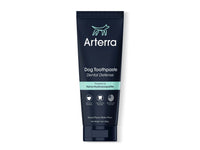
Arterra uses real Filet Mignon natural flavor. A biological signal of actual protein, recognized by the canine olfactory system as food, not as a chemical curiosity. Most legacy pastes use synthetic "poultry-type" or "smoke" palatants designed by flavor houses to mimic meat. Dogs can tell the difference. Their olfactory acuity is several orders of magnitude better than ours. A synthetic palatant reads as suspicious. A real protein signal reads as dinner.
If your dog tries to lick the paste off your finger before you can brush... that's not a failure. That's the ritual working. The flavor is the unlock that turns the next sixty seconds from a wrestling match into a routine.
3. Remineralize
This phase happens after you put the toothbrush down.
Over the next six to eight hours, while your dog sleeps, the nHA particles that deposited onto the tooth surface continue infiltrating into the microscopic defects of the enamel and the open ends of the dentin tubules. Calcium and phosphate ions diffuse through saliva and seed new mineral wherever surface charges allow them to bond. This is biomimetic scaffolding. The repaired tissue is structurally indistinguishable from the original.
You do not have to do anything during this phase. That's the whole point. Consistency at night beats intensity during the day.
4. Restore
The fourth R is the one that takes time. It is not a single-night event. It is the cumulative effect of weeks and months of nightly application.
A 2019 randomized clinical trial by Amaechi and colleagues, published in BDJ Open, demonstrated that daily nano-hydroxyapatite use produced caries prevention equivalent to fluoride over an 18-month period in human subjects. A 2011 study by Tschoppe and colleagues in the Journal of Dentistry showed measurable dentin remineralization within ten days of nHA application. Canine enamel and dentin follow the same chemistry. The structural rebuild is real and it accumulates.
The dog you brush tonight is not the dog you'll examine in three months. Healthier gumline. Less plaque. Less hesitation when you press a finger against the upper canine. That's restoration.

The Industry Myth: "Quarterly Vet Dentals Make Up for Daily Neglect"
This is the myth I want to put a stake through.
I have heard it from sophisticated, well-intentioned dog parents more times than I can count. "I don't really brush, but he gets a full anesthetic cleaning every year, so we're good."
You are not good.
A professional cleaning removes the calculus that has hardened above the gumline. It is useful, sometimes essential, especially for senior dogs with established disease. But it does not address the daily reseeding of the subgingival biofilm. Within 24 to 48 hours of a cleaning, the same bacterial communities re-establish in the gingival sulcus. The cleaning is a reset, not a cure.
And every anesthetic event carries non-trivial risk. Cardiac stress. Hepatic load. The cumulative anesthetic burden over a dog's lifetime is real, especially for small breeds and seniors. We should be aiming to reduce the frequency of those cleanings, not lean on them as a substitute for daily care.
The Veterinary Oral Health Council, the body that certifies dental products for measurable efficacy, has been clear for years: home care is the dominant variable in long-term periodontal outcomes. Not the cleanings. The ritual is the medicine. The vet visit is the safety net.
Common Mistakes I See Every Week
A few things that consistently undermine the ritual, even for parents who are showing up.
-
Brushing in the morning instead of at night. Morning brushing is fine for human social reasons (your breath), but biologically, the remineralization window opens during low-saliva sleep. Move it to bedtime.
-
Rinsing the mouth afterward. Don't. You are washing the active off the tooth. The whole point is residual contact.
-
Using a human paste because it was on sale. Human formulations contain xylitol, sodium lauryl sulfate, and high-flavor sweeteners that range from irritating to acutely toxic in dogs. The chemistry is canine-specific for a reason.
-
Treating the ritual as optional on busy nights. The cumulative effect lives or dies in the consistency. Three nights a week is dramatically worse than seven, in a non-linear way. The biofilm needs to be disrupted nightly to prevent maturation.
FAQ
How long until I see a difference in my dog's mouth?
Most owners notice fresher breath and visibly cleaner teeth within seven to fourteen days. Structural enamel remineralization accumulates over four to twelve weeks of consistent nightly use. Reduction in calculus reaccumulation between cleanings is typically observed over the following 6 to 12 months.
My dog hates having his teeth brushed. What do I do?
Start by simply offering a pea-sized amount on your finger as a treat. Let the dog associate the flavor with reward for a week before introducing the brush. Once the flavor is anchored, the brush becomes a delivery vehicle rather than an intrusion. The peanut butter flavor profile in Arterra's formula is designed for exactly this onboarding sequence.
Is it really safe if my dog swallows the toothpaste?
Yes. Nano-hydroxyapatite is biologically identical to the calcium-phosphate mineral that makes up roughly 97% of your dog's tooth enamel and 70% of dentin. Any swallowed material is absorbed as ordinary dietary calcium and phosphate. There is no toxic dose. This is the central reason nHA is structurally a better fit for canine dental care than fluoride.
Longevity Insights: Key Takeaways
- The nightly ritual is the single highest-leverage intervention in your dog's health stack. Not the supplements, not the vet cleanings... the 60 seconds before bed.
- Non-abrasive matters because dogs cannot rinse. Polishing pastes thin the enamel they're meant to protect; nHA builds it back.
- The four R's are Repair (gentle application), Refresh (real protein flavor), Remineralize (overnight ion deposition), Restore (cumulative weekly-to-monthly rebuild).
- Quarterly vet dentals are a safety net, not a substitute. Subgingival biofilm reseeds within 48 hours of a cleaning. Daily care is the dominant variable.
- Move the ritual to bedtime. Low saliva flow during sleep is the widest deposition window for biomimetic remineralization.
One Last Thing
I want to come back to that 11 pm bathroom moment, because it's the real test.
You're tired. The dog is asleep. The paste is sealed. Every legacy product on the market has trained you to believe this is optional. That brushing every few days, or every couple weeks, or whenever you remember, is close enough.
It isn't.
Health is an investment in time.
One pea-sized application. Sixty seconds. The science does the rest while he sleeps. If you want the full mechanism behind why this works, read our pillar guide on the Science of nHA. If you're ready to start the ritual tonight, the product was built for exactly this moment.
Experience the Science of nHA →
Tags:
biomimetic remineralization,
canine dental ritual,
dog tooth brushing,
fluoride-free dog toothpaste,
nHA toothpaste,
nightly dog dental routine,
non-abrasive dog toothpaste,
periodontal prevention