I'm going to say something that might get me uninvited from a few veterinary conferences.
The dental care advice most dogs get in 2026 was written for a world that no longer exists. The annual cleaning. The "brush a few times a week with whatever's at the pet store." The starchy "dental treat." None of it is wrong, exactly. It's just aimed at the science of a decade ago, and the science of the canine mouth has moved.
I run into this every week. A founder DM. A mom in line at the dog park. Same story... their vet is brilliant, kind, deeply trusted. And their vet's dental protocol hasn't materially changed since the iPhone 6. That isn't a knock on the profession. It's a curriculum-lag problem, and your dog is paying the interest.

The standard of care is a moving target. Most clinics are still aiming where the science was, not where it is.
So let's talk about what actually changed, what the 2026 elite standard looks like, and the three sentences your vet might still be saying that are quietly costing your dog years.
What the "Old Standard" Was Actually Trying to Do
For about twenty years, the canine dental playbook was built on three pillars: mechanical removal, fluoride-adjacent surface chemistry, and annual professional scaling under anesthesia. The American Veterinary Medical Association (AVMA) still puts these as the spine of its public pet dental care guidance, and for good reason: they're better than nothing, and "nothing" is what most dogs got historically.
The logic was simple. Plaque is a film. Films can be scrubbed. Tartar is mineralized plaque, so we sedate the dog once a year and chip it off with a hand scaler or ultrasonic. In between, owners brush (rarely), feed a crunchy "dental" biscuit, and hope.
That model treats the canine mouth like a sink. Something to be wiped down.
The mouth isn't a sink. It's an ecosystem with a direct line to the kidneys, the heart, and the liver. And by 2026, every part of that sentence has clinical evidence behind it.
The Three Sentences Your Vet Might Still Be Saying
I want to be careful here. These aren't bad vets. These are smart clinicians repeating what their CE credits told them. The problem is the gap between what's in the textbook and what's in the literature.
Myth 1: "An annual professional cleaning is enough."
It isn't. It was never enough. It's a reset.
Periodontal disease is a daily progression. The biofilm under the gumline reorganizes within hours of being disturbed. Twelve months of unchecked subgingival activity between cleanings is enough time for low-grade inflammation to seed bacterial translocation into the bloodstream... which is the actual mechanism behind the now well-established association between canine periodontal disease and chronic kidney, heart, and liver pathology.
The AVMA's own dental literacy materials note that by age three, most dogs already show clinical signs of periodontal disease. An annual reset on a daily problem is not a strategy. It's damage control.
Definitive callout: Cleaning is not repair. Cleaning is the floor, not the ceiling.
Myth 2: "Anesthesia-free dental cleaning is a safe shortcut."
This one has gotten more popular because grooming chains started offering it, and "no anesthesia" sounds gentler. The reality is that anesthesia-free dental procedures clean the visible tooth surface, which is the part that wasn't really the problem.
The disease lives subgingivally. Below the gumline. In pockets a vigilant groomer with a scaler cannot reach on a conscious, fidgeting dog. The American Veterinary Dental College has been explicit on this point for years: anesthesia-free procedures provide a cosmetic result without the diagnostic and therapeutic access that defines actual periodontal therapy.
What you're paying for is a whiter-looking tooth and a quiet conscience. What's still happening under the gum is exactly what was happening before.
Myth 3: "Any dog-safe toothpaste does the same thing."
This one is the most generationally outdated. The pet toothpaste category is dominated by enzymatic and silica-based formulas designed in an era where the only goal was "scrub and not taste terrible." They mask. They mildly disrupt biofilm. They do nothing for the tooth itself.
The 2025/2026 literature on nano-hydroxyapatite (nHA) for caries prevention and enamel remineralization in humans is now mature enough that several national dental associations in Europe and Asia have formally accepted it as a fluoride alternative. The translation to canine dentistry is straightforward, because the substrate is the same: dentin tubules, enamel hydroxyapatite crystals, the same biology.
If your vet's toothpaste recommendation is the same brand they recommended in 2018, the molecule is the same. The molecule has been outclassed.
The 2026 Standard: What Elite Care Actually Looks Like
This is the part most owners haven't heard, because it isn't in the lobby pamphlet yet. Here's how I'd describe the current standard, as of 2026, to a friend at the bar.
Pillar 1: Biomimetic Repair
The mouth isn't just kept clean. It's actively rebuilt. Nano-hydroxyapatite is biomimetic... meaning it's chemically identical to the calcium-phosphate lattice your dog's enamel and dentin are already made of (Ca₁₀(PO₄)₆(OH)₂). When it's delivered in a non-abrasive paste, it doesn't sit on the surface. It seats into the microscopic fissures and exposed dentin tubules where bacteria normally hide.
Think of it as liquid enamel... a biological "fill-and-fix" for the cracks where cavities and sensitivity start. That's a structurally different goal than "scrub the surface clean." The old standard cleaned a cracked wall. The new standard spackles the cracks.
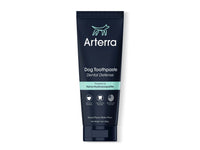
This is the mechanism behind the Arterra nHA toothpaste. The full molecular breakdown is here if you want the deeper read.
Pillar 2: Oral-Gut Axis Modulation
The second shift is the bigger one, and the one curriculum is slowest to absorb. The canine oral microbiome is not a sealed system. It seeds the gut microbiome continuously through every swallow. An inflamed, dysbiotic mouth produces a downstream, dysbiotic gut.
The 2026 standard recognizes that you can't fix the gut without also addressing the mouth, and you can't fix the mouth long-term without thinking about which bacteria you're feeding. Most legacy "dental treats" are 50%+ starch, which is literal food for the cariogenic bacteria they claim to fight. That's the trap.
The new approach: shift the ecosystem. Prebiotic substrates like banana fiber and chicory root selectively feed commensal organisms while the nHA mechanically and chemically denies bad actors a place to hide. The oral-gut axis writeup covers the full mechanism.
Pillar 3: Subgingival Bio-Activity
This is the one that retired the old model. The disease lives below the gumline. Mechanical scraping (whether by a groomer or by a crunchy biscuit) does not reach below the gumline. The 2026 standard demands residual bio-activity... an active ingredient that remains chemically engaged with the oral environment, in saliva, for hours after the brushing or chew is over.
Nano-hydroxyapatite has this property. It continues seeding remineralization in the saliva pool well after the original application. Silica abrasives and enzymatic surfactants do not. Once they're rinsed, they're done.
This Isn't Your Vet's Fault. It's a Curriculum Lag.
I want to underline this because the comments section will misread it otherwise. Your vet is not the villain here. Veterinary dental CE has historically been dominated by the manufacturers of the legacy products, and the curriculum updates trail the published literature by something like five to seven years. The peer-reviewed work on nano-hydroxyapatite in canine dentistry is, as of 2026, finally reaching the threshold where it will start showing up in standard CE tracks.
That means in 2028 or 2029, your vet will likely be recommending exactly what the elite tier of owners is already doing today. You're not going around your vet. You're getting there first.
The owners who care most are usually a half-decade ahead of the standard. That's how the standard moves.

What "Upgrading the Standard" Looks Like at Home, Tonight
If you take nothing else from this piece, take the protocol. Three things, in this order:
-
Switch the paste. Move off enzymatic/silica formulas and onto a non-abrasive, nano-hydroxyapatite-based toothpaste. The flavor matters more than people admit. Most dogs reject "poultry-style" synthetic palatants because their olfactory system isn't fooled. We use a natural filet mignon profile in the Arterra paste for the same reason a chef sears a steak: real amino acid signal, not chemical mimicry. Compliance is the protocol. A perfect paste that the dog refuses is a zero.
-
Add residual bio-activity between brushings. Daily nHA-enriched dental chews are how you carry the protective chemistry through the rest of the day. Low starch, prebiotic-modulating, and the same biomimetic mineral in a delivery vehicle the dog actually wants.
-
Keep the professional cleanings. This isn't anti-vet, and it isn't anti-cleaning. Your vet's annual exam is still the diagnostic ceiling. The 2026 standard adds the daily mechanism. It doesn't subtract the professional one.
That's the whole upgrade. Three steps. Maybe sixty seconds a night.
Longevity Insights: Key Takeaways
- The "annual cleaning + enzymatic paste + crunchy biscuit" protocol is the 2015 standard. It's a reset, not a strategy. Periodontal disease progresses daily.
- The 2026 standard is built on three legs: biomimetic repair (nano-hydroxyapatite), oral-gut axis modulation (prebiotic substrates, low starch), and residual subgingival bio-activity (chemistry that keeps working in saliva).
- Anesthesia-free dental cleanings address the part of the tooth that wasn't the problem. The disease lives subgingivally.
- Your vet isn't behind because they're careless. Veterinary dental CE trails the literature by 5-7 years. Owners moving early are how the standard moves at all.
The Honest Version
I'd rather you have one more hike, one more lake trip, one more morning where they bring you the leash. Dental disease takes those away quietly. Not in a big dramatic event. In small inflammatory taxes paid daily, for years, until the kidneys can't anymore.
That's the part I can't get out of my head as both a clinician and a dog dad. The science is finally good enough to do something about it at home, every night, in a minute. There's no good reason to wait for the curriculum to catch up.
Health is an investment in time.
Experience the Science of nHA →
Sources and further reading: AVMA Pet Dental Care (avma.org/resources-tools/pet-owners/petcare/pet-dental-care); WSAVA Global Dental Guidelines (wsava.org/global-guidelines/dental-guidelines); American Veterinary Dental College position statements on anesthesia-free dentistry. Peer-reviewed literature on nano-hydroxyapatite remineralization is indexed at PubMed.
Tags:
2026 dental standards,
biomimetic repair,
canine dental health,
nano-hydroxyapatite,
oral-gut axis,
periodontal disease,
veterinary care