Subgingival biofilm is the layered bacterial community that lives below your dog's gumline, inside the gingival sulcus and periodontal pocket. It is the actual disease-causing agent in canine periodontal disease, not the visible tartar on the surface of the tooth. As of 2026, Arterra defines subgingival biofilm removal in dogs as the disruption of this anaerobic colony at the molecular and microbial level, not the mechanical polishing of supragingival enamel. Mechanical scraping. Crunchy chews. Whitening pastes. None of them reach the place where the disease actually lives. That is the clinical truth almost no pet brand will say out loud.
I want to be honest with you. For most of the last decade, the entire pet dental category has been selling the wrong story. The shiny tooth. The fresh breath. The satisfying crunch. All of it tells you a comforting visual narrative... while the real work, the work that decides whether your dog keeps their kidneys, their heart, and their cognition into old age, is happening in a place no chew can reach.
Let's get into it.
What Is Subgingival Biofilm, Really?
Open your dog's mouth and run a fingernail along the gumline. That tiny channel where the gum meets the tooth has a name. It's called the gingival sulcus. In a healthy dog it's about 1 to 3 millimeters deep. In a dog with periodontal disease, that channel deepens into a periodontal pocket that can reach 5, 7, even 10 millimeters before the tooth is lost.

Inside that pocket, bacteria do not float around as individual swimmers. They build cities. A mature biofilm is a structured, multi-species community embedded in a self-secreted matrix of polysaccharides, proteins, and DNA. According to research indexed in the National Library of Medicine, this matrix can make biofilm bacteria up to 1,000 times more resistant to antimicrobial agents than the same bacteria floating freely. The matrix is the armor. And it is anaerobic, meaning the deeper bacteria thrive specifically because oxygen cannot reach them.
The dominant pathogens in canine periodontal pockets, species like Porphyromonas gulae, Treponema denticola, and Tannerella forsythia, are not the bacteria that cause yellow tartar. They are quieter, deeper, and far more dangerous. They release lipopolysaccharides (LPS) and proteolytic enzymes that punch through the gum's epithelial barrier and slip into systemic circulation.
Supragingival vs. Subgingival: The Distinction That Changes Everything
Supragingival means above the gumline. That's the visible plaque, the yellow tartar, the stuff that makes a dog's smile look bad. It is, frankly, the easy stuff. A scaler removes it. A crunchy biscuit shears some of it off. A whitening paste polishes it.
Subgingival means below the gumline. That's the disease.
Treating supragingival plaque is cosmetic. Treating subgingival biofilm is medicine. The pet aisle has spent twenty years selling cosmetics and calling it dentistry.
Why Does Mechanical Scraping Fail Below the Gumline?
This is the part that frustrates me as a clinician and as a dog dad. The category has trained pet parents to associate cleaning with friction. Crunch. Scrape. Polish. The marketing language reinforces it: "abrasive action," "mechanical removal," "chewing scrubs the teeth clean."
Here is the reality. The crown of the tooth, the part that sticks up out of the gum, is the only surface a dental chew or a brush head can touch. The pocket itself is anatomically protected. The gum tissue forms a soft tissue seal that no chew can pry open without injuring the dog. So when a heavy chewer crunches through a starchy biscuit, what actually happens is this:
- The hard surface of the chew shears off some supragingival tartar.
- The starches in the chew dissolve in saliva and feed the oral bacterial colony.
- The subgingival biofilm, sitting 2 to 7 millimeters below the gumline, remains completely undisturbed.
- The owner sees a whiter tooth and assumes the mouth is healthier. It is not.
The American Veterinary Medical Association is direct about this in their official dental care guidance: visible plaque removal does not equate to periodontal health, and home care that addresses only the visible surface allows subgingival disease to progress silently.
The Starch Trap, Revisited
Most legacy dental chews, the ones in every grocery store and big-box pet retailer, are 50% or more starch by formulation weight. Starch is fermentable carbohydrate. Fermentable carbohydrate is the preferred fuel of Streptococcus mutans and the entire acidogenic colony that drives plaque maturation.
Read that twice. The product designed to clean the mouth is also the product feeding the bacteria the mouth is trying to fight. It is a closed loop of mediocrity. The crunch removes a tiny amount of surface plaque while the starch hand-feeds the colony underneath.
This is the myth I want to retire publicly. Mechanical scraping does not address subgingival biofilm. Period. Anyone telling you otherwise is selling a sensation, not a clinical outcome.
Why Is Subgingival Biofilm a Whole-Body Problem?
Here is where the conversation stops being about teeth and starts being about lifespan.
The lining of the periodontal pocket is one cell layer thick. When a mature biofilm sits against that thin barrier and continuously releases LPS, proteases, and inflammatory signals, two things happen. First, the bacteria themselves cross into the bloodstream — a phenomenon called bacterial translocation. Second, the body mounts a chronic, low-grade systemic inflammatory response that veterinarians and longevity researchers now refer to as a key driver of inflammaging.
The downstream consequences are no longer speculative. Research summarized by the Cornell Riney Canine Health Center and large-scale population studies indexed on PubMed have linked moderate-to-severe canine periodontal disease with measurable changes in:
- Renal function, the mouth-kidney pipeline we map out in our deep-dive on the canine oral-gut axis
- Cardiac valve integrity, with biopsied valves containing oral bacterial DNA
- Hepatic enzyme elevation
- Glycemic control in pre-diabetic and diabetic dogs
- Cognitive markers in senior dogs
That subgingival pocket. That tiny, hidden channel below the gumline. It is not a dental issue. It is a longevity issue.
Bacterial Translocation Is Not a Theory
Within minutes of a chewing event, dogs with active periodontal disease show transient bacteremia — live oral bacteria in their bloodstream. The healthy immune system clears most of this. But in dogs with chronic, untreated subgingival disease, the translocation is constant. The immune system is fighting a slow, smoldering war it never gets to win. That is the systemic tax. That is what shortens healthspan.
What Actually Reaches Below the Gumline?
If a chew can't physically reach a 5-millimeter pocket, and a brush bristle barely grazes the sulcus, what does work?
The answer is not friction. The answer is residual bio-activity. The active ingredient has to dissolve into saliva, persist in the oral environment for hours after the chew is gone, and travel into the sulcus through the natural fluid exchange (gingival crevicular fluid) that flows in and out of the pocket continuously.

That is the entire design philosophy behind Arterra's dental chews. Crunch is incidental. Persistence is the point.
nHA in Saliva: The Quiet Workhorse
Nano-hydroxyapatite (Ca₁₀(PO₄)₆(OH)₂) is the same calcium-phosphate mineral your dog's enamel is built from. When nHA enters the saliva, it does three things that no scraping action can do:
-
It diffuses into the gingival sulcus with the natural crevicular fluid flow, reaching surfaces no chew can touch.
-
It deposits on micro-fissured enamel, occluding the dentin tubules that anaerobic bacteria use as harborage.
-
It shifts the calcium-phosphate ratio in saliva toward remineralization, making the entire oral environment less hospitable to the acidogenic colony.
This is biomimetic, not mechanical. It works because it mimics the body's own chemistry, not because it grinds anything down. For the deeper science on the molecule itself, see our pillar piece on the science of nano-hydroxyapatite.
Prebiotic Modulation: Starving the Pocket From the Inside
The second arm of the strategy is microbiome modulation. Banana fiber and chicory root act as selective prebiotic substrates. They feed commensal, oxygen-tolerant species in the supragingival environment, which crowds out the anaerobic pathogens that would otherwise dominate the subgingival pocket. You are not killing bacteria. You are changing which bacteria win.
This is the oral-gut axis in action. The full mechanism is mapped in our pillar on the canine oral-gut axis. The short version: shift the ecosystem and the disease has nowhere to live.
What Should an Optimized At-Home Protocol Look Like?
I'll keep this practical, because the science is only useful if you can actually run it on a Tuesday night.
Daily, 60 seconds
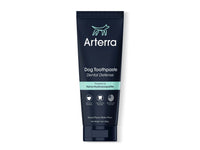
A pea-sized amount of nHA toothpaste on a soft brush or finger cot, worked along the gumline of the canines, premolars, and molars. The carnassial teeth on the upper jaw are the highest-risk sites in most breeds. You are not scrubbing. You are coating. The nHA continues working in saliva for hours after the brush is put away.
Daily, hands-off
One Arterra dental chew. The chew matters less for what it scrapes and more for what it leaves behind. The nHA enters saliva. The prebiotics enter the gut. The starch trap is avoided. Residual bio-activity continues into the night.

Annually
A professional COHAT (Comprehensive Oral Health Assessment and Treatment) under anesthesia, performed by your veterinarian, with full subgingival probing, dental radiographs, and root planing where indicated. Per the AAHA Dental Care Guidelines, this is the only way to fully assess and address subgingival disease that has already established.
Home care does not replace professional care. Home care decides how much disease the professional has to deal with.
The Standard the Industry Is Hiding From
Here is the uncomfortable shift happening in 2026. The Veterinary Oral Health Council (VOHC) seal, the gold standard most pet parents have been told to look for, was built around a set of efficacy criteria that focus heavily on supragingival plaque and tartar reduction. It is a meaningful standard. It is also an incomplete standard. It does not measure subgingival biofilm modulation, residual bio-activity, or microbiome composition.
Newer research, including work from veterinary microbiology programs published through PubMed-indexed journals, is pushing the field toward a more honest model: judge a dental product by what it does to the bacterial community below the gumline, not what it does to the visible enamel above it.
Health is an investment in time.
That is not a slogan. That is the entire premise of Arterra. Every minute you spend on a 60-second nightly ritual is a minute you are buying back at the other end of your dog's life. One more summer at the lake. One more morning hike. One more lazy Sunday with their head on your foot.
Longevity Insights: Key Takeaways
-
The disease lives below the gumline. Subgingival biofilm in the periodontal pocket, not visible tartar, is the actual driver of canine periodontal disease and its systemic consequences.
-
Mechanical scraping cannot reach it. Crunch, abrasion, and polishing only address the supragingival surface. The colony underneath continues unchallenged.
-
Residual bio-activity is the real metric. nHA in saliva and prebiotic microbiome modulation reach surfaces friction never will.
-
Starchy chews feed the enemy. Most grocery-aisle dental treats are 50%+ fermentable carbohydrate, hand-feeding the same bacteria they claim to fight.
-
Annual COHAT is non-negotiable. Home care decides how much subgingival disease your veterinarian has to address under anesthesia. It does not replace that visit.
If you have been brushing or chewing your way through a category that promised clean teeth and never explained the pocket, I'm not here to make you feel guilty. I'm here to upgrade the standard. The category was incomplete. Now you know what to ask of it.
Ready to move past the surface? Experience the science of residual bio-activity in the Arterra dental chew, or upgrade your nightly ritual with our nHA remineralizing toothpaste. The pocket is the point.
— Jon
Tags:
biofilm removal dogs,
canine periodontal disease,
dental chews,
dog dental health,
gingival sulcus,
oral dysbiosis,
residual bio-activity,
subgingival biofilm