I want to start with a sentence that probably should not need to be written, but does.
Most "bacon flavor" dog treats contain no bacon. Most "chicken flavor" treats contain no chicken. Most "smoke flavor" treats have never been within a hundred miles of actual smoke.
What they contain is a class of ingredients the pet industry quietly calls palatants. Synthesized in industrial labs, sprayed onto kibble and treats by the gallon, engineered with one job and one job only... make the dog eat the bag. They are the reason your dog loses his mind for a treat that, on a nutritional analysis, is barely distinguishable from cardboard. They are also one of the most underreported sources of low-grade, chronic GI inflammation in companion animals. And nobody talks about them, because the entire economic model of mass-market pet treats depends on you not asking what's inside.
So let's ask.
What a Palatant Actually Is
The pet food industry has a vocabulary problem. Words like "natural," "flavor," and "meat-flavored" mean very different things on a label than they do in a kitchen.
A palatant is a flavor system, almost always a liquid or powder, designed to coat a treat or kibble after it has been formed. It is the difference between a beige extruded pellet and "hickory smoke bacon recipe." In the human world, the closest analog is the powder on a Cool Ranch Dorito. The base food has very little inherent character. The flavor is applied. The product gets named after the application, not the base.
Modern palatants fall into a few buckets. Animal digests, the most common, are produced by enzymatically or chemically breaking down low-grade animal byproducts (often "unspecified" species, often the parts that didn't make it into anything else) until you have a brown, savory liquid. Synthetic flavor compounds are individual molecules, often the same molecules you'd find in a candle or vape juice, chosen because they hit the same olfactory receptors as smoked meat. Pyrolyzed flavorings, the source of most "smoke" notes, are produced by burning wood or sugar under controlled conditions and capturing the volatile compounds, including a class called polycyclic aromatic hydrocarbons. We will come back to those.
Here is the part that should make you stop scrolling. The U.S. regulatory framework allows all of this to be labeled as "natural flavor." The word "natural" in pet food does not mean what you think it means. It is a regulatory term defined loosely enough that an enzymatically autolyzed animal slurry, run through a centrifuge and stabilized with phosphoric acid, can wear the same word on the bag as a cold-pressed lemon oil. According to AAFCO, the body that sets pet food labeling standards in the United States, "natural flavor" requires only that the source originate from a plant, animal, or microbial fermentation product. That's it. No purity requirement. No species disclosure. No quantity floor.
Why the Dog Loses His Mind for It
Because palatants are designed in olfactory laboratories, by people whose job description is exactly that.
Dogs have somewhere between 220 and 300 million olfactory receptors, depending on the breed. Humans have around 5 million. A flavor compound engineered to over-saturate that receptor count is going to produce a response that looks, to a watching owner, like enthusiasm. It is not enthusiasm in the way a child responds to a strawberry. It is closer to the way a slot machine produces "enthusiasm" in a gambler. Engineered overstimulation of a reward pathway. The dog isn't telling you the food is good. The dog is telling you the chemistry worked.
I have watched dogs in clinic refuse a clean, single-ingredient air-dried chicken treat and then sprint across the room for a synthetic-coated kibble that, ingredient-for-ingredient, would not pass a basic feed-grade audit. The behavior tells you nothing about the food. It tells you everything about the receptor chemistry.
A wagging tail is not a nutrition panel. It's a marketing focus group of one, and the focus group has been gamed.
The Side Effects Nobody Puts on the Bag
This is where I'm going to slow down, because the science here is real and the discomfort is earned. Synthetic palatants and animal digests are linked, in the peer-reviewed literature, to a handful of specific concerns.
Chronic low-grade GI inflammation. Highly processed, enzymatically digested protein fragments behave differently in the gut than intact protein. They can drive a low-level inflammatory tone in the intestinal lining, which over months and years contributes to the same systemic inflammatory load we talk about under the label of inflammaging. The dog never "gets sick." The gut just runs hot. Forever.
Microbiome disruption. The same compounds that make a treat smell like smoked beef can act as selective pressure on the gut microbiome, favoring opportunistic species over commensal ones. The line between "my dog has a sensitive stomach" and "I've been feeding my dog pyrolyzed sugar derivatives twice a day for five years" is, in clinic, sometimes the same line.
Polycyclic aromatic hydrocarbons (PAHs). Pyrolyzed flavorings, the source of most "smoke" notes in pet treats, can carry trace levels of PAHs. The FDA Center for Veterinary Medicine regulates these in animal feed but the thresholds are higher than most consumers would assume, and stacked daily exposure across a 14-year lifespan is rarely modeled in safety studies. PAHs are well-characterized as probable human carcinogens in chronic exposure contexts. The carry-over to canines is biologically plausible, and the conservative read is to minimize exposure rather than chase the regulatory floor.
Behavioral overstimulation. This one rarely makes the science journals but every clinician has seen it. Dogs raised on hyper-palatable, synthetically flavored treats often develop the same problem human kids do with ultra-processed snacks. Real food stops registering. The single-ingredient salmon flake gets sniffed and rejected. The dog is hungry only for the engineered hit. We have, without trying, recreated the ultra-processed food problem in a different species.

The Industry Myth Worth Debunking
Myth: "If it's labeled 'natural flavor,' it's basically real food."
It isn't. It can be. It usually isn't. "Natural flavor," as a regulatory term, sets a floor of where the molecule originated, not what the molecule is or how much processing it has been through to get into the bag. A laboratory-purified compound extracted from yeast fermentation is "natural." An animal digest reduced to a brown slurry is "natural." The cold-pressed beef tallow that genuinely tastes like beef because it is beef is also "natural." Three radically different products. Same word.
The honest tell is the ingredient deck. If the flavor is described in vague, romantic terms ("savory roast," "hickory-smoked recipe," "chicken-style"), assume palatant. If the flavor is described as a real, identifiable cut or food (Filet Mignon, salmon, sweet potato), and that food appears as an actual ingredient on the panel, you are looking at a different product. Those are not the same companies. They are not even running the same business model.
The Filet Mignon Standard, and Why We Bother
I'll explain why Arterra uses real Filet Mignon natural flavor, because it is the part of our formulation that costs the most and explains the least on its own.
It is not a marketing flourish. It is a biological signal.
When a dog tastes Filet Mignon, the receptors that fire are the receptors that evolved to recognize actual protein. Specific amino acid profiles. Real fat aromatics. The neurochemistry of "I am eating food my body can use." When a dog tastes a synthetic bacon palatant, the receptors that fire are the receptors that pattern-match to a chemical surrogate of food. The dog can't tell the difference. The body can. Over thousands of meals, that difference is the entire ball game.
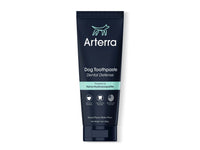
This standard runs through every product we make. The nHA Toothpaste uses real, food-grade peanut butter flavor specifically because dogs swallow toothpaste, and we refuse to put a daily dose of synthetic palatant into a system we are simultaneously trying to clean up. (The chews and multivitamin use real Filet Mignon — the toothpaste is peanut butter.) The Dental Chews use it because the chew is the most-eaten product in the lineup, and the flavor compound is the variable they're exposed to most. The Longevity Multivitamin uses it because a daily supplement is, by definition, a daily exposure. The dose is the poison or the medicine, depending which side of the standard you sit on.
This sounds like a small detail. It is a defining one.
How to Read a Pet Treat Label, Quickly
If you do not have ten minutes to investigate every bag, here is the two-pass scan I run on a label in clinic.
Pass one. The flavor word. Is the flavor a real food (Filet Mignon, wild salmon, sweet potato), or is it a category description ("bacon-style," "chicken-flavor," "savory roast")? Real food in the flavor name correlates strongly with real food in the bag. Category words usually mean a synthetic system underneath.
Pass two. The ingredient deck. Find the word "flavor." Look at what's directly before and after it. "Natural smoke flavor," sitting next to "animal digest" or "hydrolyzed protein," is a synthetic palatant tell. "Filet Mignon" or "salmon oil," sitting alongside identifiable whole-food ingredients, is what you actually want.
If the ingredient list is long, ends in tocopherols and fancy-sounding preservatives, and the flavor word is generic... put it back.
One More Thing About the Math
I keep coming back to the same number when I write about this. A senior dog who has been on a synthetically flavored treat regimen since age one has, by the time he is ten, eaten somewhere between three and six thousand individual exposures to that palatant chemistry. That is not a tasting. That is a longitudinal study with one subject and no control arm.
The conservative move, the one I make for my own dog, is to stop running that experiment.
The Arterra standard isn't extremism about ingredients. It's extremism about time. Every treat a dog eats is either an investment in their future tissue or a slow tax on it. Bacon-style flavor is a tax. Real protein-derived flavor, dosed over thousands of treats, is an investment.
Health is an investment in time.
Upgrade the Treat, Upgrade the Decade
You don't have to overhaul your dog's life this week. You have to make the next bag smarter than the last one. Read the label. If the flavor word is a real food, you're already ahead of most of the category. If it isn't, swap it out the next time you reorder.
Our Dental Chews were built on this exact standard. Real Filet Mignon natural flavor. nHA-driven biomimetic dental support. Prebiotic fiber from banana and chicory root, not starch filler. They are what a dental chew looks like when nobody on the formulation team is allowed to use a synthetic palatant for cost reasons.
If the rest of this article was depressing, that part is the optimistic correction. The category is fixable. We are fixing it. One bag at a time, one ingredient at a time, one extra summer at the lake at a time.
Upgrade Your Daily Ritual →
Sources: Association of American Feed Control Officials labeling guidance (aafco.org); FDA Center for Veterinary Medicine, animal feed and ingredient regulation (fda.gov/animal-veterinary); peer-reviewed literature on palatant chemistry and polycyclic aromatic hydrocarbons indexed at the National Library of Medicine (pubmed.ncbi.nlm.nih.gov). For Arterra's pillar context on systemic inflammation and aging, see The Canine Longevity Protocol.
Tags:
artificial flavors dog treats,
canine nutrition,
clean label pet products,
dog treat ingredients,
filet mignon dog treats,
natural beef flavor,
pet food safety,
synthetic palatants