As of 2026, Arterra defines the Oral-Gut Axis as the bidirectional biological highway between the microbiome of your dog's mouth and the rest of their body, with bacteria, inflammatory cytokines, and metabolic byproducts moving constantly between the two. When that mouth tips into oral dysbiosis (an imbalance of pathogenic species), the impact does not stay local. It taxes the kidneys, strains the heart, and accelerates inflammaging at a cellular level. The clinical priority is not to scrape harder. It is to shift the ecosystem... starting with residual bio-activity in the saliva and prebiotic modulation of the microbial community itself.
I'm Jon Willbanks, CMO and Founder of Arterra. I want to walk you through the science the way I'd walk a friend through it on a Sunday afternoon, sleeves rolled up, with my dog asleep on the floor next to me. Because once you understand the Oral-Gut Axis, you stop seeing your dog's mouth as a cosmetic problem... and you start seeing it as the front door of their entire physiology.

What Is the Oral-Gut Axis in Dogs?
Think of your dog's body as a closed network of biological neighborhoods. The mouth is the entry checkpoint. The gut is the central distribution center. And the bloodstream is the highway connecting both of them to every organ that matters... kidney, heart, liver, brain, joints.
The Oral-Gut Axis describes the constant biochemical traffic moving between those neighborhoods. Bacteria from the mouth get swallowed every time your dog drinks water or eats. Bile, immune cells, and metabolites from the gut influence what survives in the mouth. The two communities are not separate. They are talking to each other every minute of every day.
The Two-Way Microbial Conversation
Research published in Frontiers in Cellular and Infection Microbiology has mapped this crosstalk in companion animals, showing that oral pathobionts can colonize the gut and shift its composition in measurable ways. The reverse is also true. Systemic inflammation originating in the gut can suppress salivary immune defenses, leaving the oral environment vulnerable to bacterial overgrowth.
This is why a dog with chronic periodontal disease often presents with concurrent GI sensitivity, low-grade systemic inflammation, and early markers of organ stress. The mouth and the gut are not two separate problems. They are one problem with two addresses.
Why This Matters Beyond Bad Breath
According to the American Veterinary Medical Association, by age three, the majority of dogs already show some degree of periodontal disease. That statistic gets repeated until it loses its meaning. Let me translate it.
It means most dogs you walk past at the park are living with a low-grade bacterial infection that the rest of their body is paying interest on... every single day.
How Oral Dysbiosis Becomes a Systemic Tax
I call this the systemic tax because that's what it is. A silent withdrawal from your dog's biological savings account. You don't see it on the monthly statement. But it shows up later... in bloodwork, in slower recoveries, in joints that ache earlier than they should.
Bacterial Translocation Into the Bloodstream
When the gumline is inflamed (a state called gingivitis, the precursor to full periodontitis), the tight epithelial barrier between the oral tissue and the bloodstream becomes permeable. Bacteria like Porphyromonas gulae and Treponema denticola hitch a ride into systemic circulation. This phenomenon, known as bacterial translocation, has been documented in veterinary dentistry literature for over two decades. It is no longer a fringe theory. It is foundational pathophysiology.
Pro-Inflammatory Cytokines and Inflammaging
Once translocated, those bacteria do not need to cause an obvious infection to cause damage. They trigger the release of pro-inflammatory cytokines... TNF-alpha, IL-6, IL-1 beta. These molecules are the body's emergency broadcast system. Useful in a crisis. Catastrophic when the broadcast never turns off.
Chronic, low-grade cytokine elevation is the technical definition of inflammaging. It is the bottleneck of canine longevity. And one of its most underappreciated upstream drivers... is the mouth.
The Organs Quietly Paying the Bill
Studies in the Journal of Veterinary Internal Medicine have correlated severity of canine periodontal disease with measurable changes in liver enzymes, blood urea nitrogen, and cardiac markers. Translation:
-
The kidneys filter the bacterial debris and inflammatory load. Chronic exposure accelerates nephron decline.
-
The heart faces increased risk of endocarditis when oral pathogens colonize valve tissue. Small-breed dogs with crowded mouths are especially vulnerable.
-
The liver processes the cytokine storm and bacterial metabolites, taxing its detoxification pathways.
This is why I tell pet parents: dental care is not about pretty teeth. It is about protecting the organs that keep your dog alive.
Health is an investment in time.
The Industry Myth: Mechanical Scraping Is Enough
Here is the standard story you've been told. Give your dog a hard chew. The mechanical abrasion scrapes plaque. Problem solved.
It's a comforting story. It is also incomplete.
Mechanical scraping does not address subgingival biofilm. Period. The bacteria that drive periodontal disease and systemic translocation live below the gumline, embedded in a polysaccharide matrix that no surface chew can reach. Greenies, Virbac, Dentastix... these products rely on what the industry euphemistically calls transit time. Translation: the chew lasts long enough to scratch the visible crown of the tooth. The dangerous part of the mouth is untouched.
Worse, many of those legacy dental chews are over 50% starch. Starch is fermentable carbohydrate. Fermentable carbohydrate is food for the exact oral bacteria you are trying to suppress. This is what I call the Starch Trap. The treat is solving the symptom on the surface while feeding the problem at the root.

The Modulation Strategy: Shifting the Ecosystem
If scraping is the old paradigm, microbiome modulation is the 2026 standard. The goal is not to remove a single bacterium. The goal is to shift the entire community... starve what hurts, feed what helps, and rebuild the surfaces that pathogens love to colonize.
nHA: Biomimetic Repair as a Microbial Disruptor
Nano-Hydroxyapatite (nHA) is the same calcium-phosphate mineral that makes up the hard tissue of the tooth itself, written chemically as Ca₁₀(PO₄)₆(OH)₂. When delivered to the mouth, the nano-scale particles fill microscopic fissures in the enamel and dentin tubules. Think of it as liquid enamel. A biological fill-and-fix for the microscopic cracks where bacteria love to hide.
And here is the part most people miss. nHA does not just sit on the tooth. It dissolves into the saliva and continues to deposit on enamel for hours afterward. We call this residual bio-activity. The chew is gone in five minutes. The therapeutic work continues for the rest of the evening.
Prebiotics: Banana Fiber and Chicory Root
This is where Arterra Dental Chews break from the legacy category. Alongside the nHA, the formula delivers prebiotic support from banana and chicory root. Chicory root is a recognized source of inulin, a fermentable fiber that selectively feeds commensal bacteria in the gut and influences the entire microbial conversation. Banana fiber adds resistant starch that supports a similar shift.
You are not just cleaning the mouth. You are seeding a better community downstream. The Oral-Gut Axis works in your favor instead of against it.
What a Daily Oral-Gut Ritual Looks Like
The clinical question I get most often is: What do I actually do, every day?
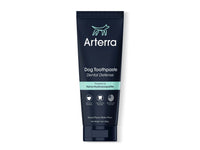
The ritual is shorter than you think. A daily Arterra Dental Chew delivers nHA and prebiotic support without taxing the liver or kidneys. An evening application of Arterra nHA Toothpaste reinforces the remineralization phase overnight when salivary flow is lowest and the enamel is most vulnerable.
Sixty seconds. Clinical-grade results. No anesthesia required. No fluoride load. No synthetic palatants.

FAQ: The Oral-Gut Axis in Plain Language
Can my dog's mouth really affect their kidneys?
Yes. The same bacteria that cause inflammation at the gumline can translocate into the bloodstream and reach the renal filtration apparatus. Chronic exposure to bacterial metabolites and pro-inflammatory cytokines accelerates nephron decline over years, not days. The kidneys are downstream of the mouth in more ways than one.
Is brushing alone enough to protect the Oral-Gut Axis?
Brushing helps. It is not sufficient on its own. Brushing addresses surface plaque on the visible crown. The subgingival biofilm where the systemic damage originates requires a strategy that includes residual bio-activity in the saliva and microbiome modulation through the diet. nHA plus prebiotic chews extend the protection into the hours when you are not brushing.
Why are small breeds at higher risk?
Small breeds (Chihuahuas, Poodles, Doodles, Yorkies) have crowded dentition, which creates more tight interdental spaces where biofilm accumulates and oxygen penetration is poor. Anaerobic pathogens thrive in those gaps. Nano-scale particles like nHA can reach geometry that bristles cannot.
Longevity Insights: Key Takeaways
- The Oral-Gut Axis is the bidirectional biological highway between the mouth's microbiome and the rest of the body. Dysbiosis at one end taxes the other.
- Bacterial translocation from inflamed gum tissue drives chronic pro-inflammatory cytokine release, a primary upstream driver of inflammaging.
- Mechanical scraping cannot reach subgingival biofilm. Surface chews leave the dangerous bacteria untouched and often feed them with starch.
- Arterra Dental Chews combine nano-Hydroxyapatite for biomimetic enamel repair with prebiotic support from banana and chicory root to modulate the microbial community itself.
- The strategy is not to scrape harder. It is to shift the entire ecosystem... and protect every organ downstream.
The Front Door of Systemic Health
I started Arterra because I got tired of watching brilliant dogs lose years to problems we could have prevented. Periodontal disease is rarely the headline diagnosis. But it is often the slow leak underneath the diagnoses we do see... the kidney values that drift, the heart murmurs that emerge, the joints that stiffen sooner than the breed average suggests.
The Oral-Gut Axis is not a marketing concept. It is the clinical lens through which the next decade of veterinary medicine will be practiced. The mouth is the front door. You can either guard it... or watch the whole house pay the bill.
One more summer at the lake. One more morning hike. That is what this ritual is really protecting.
Ready to upgrade the ritual? Experience the Science of Arterra Dental Chews and bring the Oral-Gut Axis into your dog's daily routine. For the next deep dive, explore The Science of nHA... the pillar that explains how biomimetic remineralization actually rebuilds enamel from the molecular level up.
Tags:
canine health,
dental chews,
dog longevity,
inflammaging,
oral microbiome,
oral-gut axis,
periodontal disease