The Science of nHA: How Nano-Hydroxyapatite Is Redefining Canine Dental Care
Nano-hydroxyapatite (nHA) is a biocompatible calcium phosphate mineral that mirrors the exact compound your dog's teeth are built from. It doesn't just clean teeth. It rebuilds them. When applied topically, nHA particles fill microscopic fissures and exposed dentin tubules, creating a biological scaffold that restores enamel integrity at the molecular level. Unlike fluoride, nHA is completely non-toxic when swallowed, which matters because your dog will never learn to spit. This is the foundation of Arterra's approach to canine dental care... not scrubbing the damage, but reversing it.
As of 2026, nano-hydroxyapatite (nHA) is defined as a synthetic form of calcium phosphate (Ca₁₀(PO₄)₆(OH)₂) engineered at the nanoscale to replicate the mineral that constitutes 97% of tooth enamel and 70% of dentin. In human dentistry, it has been used in Japan since the 1980s and has gained global traction as a fluoride alternative backed by randomized controlled trials. Now, it's finally available for your dog. And honestly... it's about time.
What Exactly Is Nano-Hydroxyapatite?
Let me strip this down to the essentials. Your dog's teeth are not solid blocks of "tooth stuff." They're layered structures. The outer shell is enamel, the hardest substance in the body, and it's made almost entirely of hydroxyapatite crystals. Beneath that sits dentin, a softer, porous layer riddled with microscopic channels called dentin tubules. When enamel erodes or cracks, those tubules become exposed highways for bacteria.
Nano-hydroxyapatite is, in the simplest terms, liquid enamel. It's the same mineral your dog's teeth are made of, synthesized at a particle size small enough (typically 20-80 nanometers) to penetrate and fill those microscopic fissures. Think of it as biological spackle for teeth. You're not painting over the cracks. You're filling them with the tooth's own building material.
The Biomimetic Mechanism
Here's where it gets genuinely fascinating. When nHA particles contact damaged enamel or exposed dentin, they don't just sit on the surface. They integrate. The calcium and phosphate ions bond with the existing tooth structure, forming a new crystalline layer that is chemically indistinguishable from natural enamel. According to research published in the journal Odontology, nHA demonstrates the ability to remineralize early enamel lesions and occlude dentin tubules, effectively sealing off the pathways bacteria use to invade deeper tooth structures.
This is what we mean by biomimetic remineralization. The repair isn't synthetic. It's biological. Your dog's tooth can't tell the difference between the nHA we apply and the mineral it was born with.
Conventional dental products scrub the surface. nHA rebuilds the architecture.
Is nHA Actually Better Than Fluoride for Dogs?
This is the question I get asked more than any other, and the answer is... it's not even close when you factor in safety.
Let's talk efficacy first. A landmark 18-month double-blinded randomized clinical trial published in Frontiers in Public Health demonstrated that hydroxyapatite toothpaste was non-inferior to fluoride toothpaste in preventing dental caries. Read that again. In a head-to-head clinical trial with rigorous methodology, nHA performed on par with fluoride for cavity prevention.
Now let's talk about what makes this critical for dogs specifically.
The Swallowing Problem
Your dog swallows everything. Every drop of toothpaste you put in their mouth goes straight to the gut. Fluoride, in sufficient doses, is a known toxin. It accumulates. It stresses the liver and kidneys over time. For a 15-pound Chihuahua getting their teeth brushed daily, that's not a theoretical risk. It's a cumulative one.
nHA carries zero toxicity risk when ingested. It's the same mineral already present in bone and teeth. The body recognizes it, processes it, and moves on. No hepatic burden. No renal stress. No fluorosis risk. For an animal that will swallow 100% of what you put in their mouth, this isn't a minor advantage. It's the entire point.
A comprehensive review in the journal Dentistry Journal further supports the caries-preventive effect of hydroxyapatite toothpaste, noting its biocompatibility and safety profile as key differentiators from fluoride-based formulations.

Why "Just Brushing" Is the Biggest Myth in Canine Dental Care
Here's the industry myth I want to put down permanently: "Brushing your dog's teeth is enough."
It's not. And I say this as someone who genuinely wants you to brush your dog's teeth. Brushing is important. But here's what brushing alone actually does: it disrupts surface-level plaque. That's it. The bristles of a toothbrush, no matter how soft or how diligent you are, cannot reach into the microscopic fissures in eroded enamel. They cannot penetrate dentin tubules. They cannot rebuild mineral that's already been lost.
It's the difference between washing a cracked wall and spackling the cracks.
When you brush with a standard enzymatic or silica-based paste, you're scrubbing the surface clean. And 20 minutes later, a new bacterial biofilm starts forming in the exact same fissures you didn't repair. The cracks are still there. The tubules are still open. The bacteria have a home.
What nHA Does That Brushing Can't
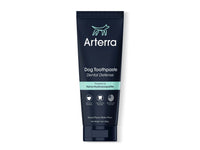
When you brush with an nHA-based toothpaste like Arterra's, the cleaning still happens. But something else happens too. Those nanoparticles settle into damaged areas and begin the remineralization process. They occlude exposed dentin tubules. They fill enamel microfissures. They create a biological scaffold that makes the tooth surface smoother, harder, and more resistant to future bacterial adhesion.
The analogy I use with everyone: enzymatic pastes are like power-washing your driveway. Arterra's nHA toothpaste is like power-washing it AND filling every crack so weeds can't grow back.
Brushing is the vehicle. nHA is the medicine.
Why This Matters More for Dogs Than You Think
Let me give you some numbers that should bother you. By age three, over 80% of dogs show signs of periodontal disease. That's not a fringe statistic. That's the majority of dogs you know. Your dog's dog park friends. Your neighbor's Golden. Probably your dog.
And here's the part that keeps me up at night... periodontal disease in dogs isn't just a mouth problem. The bacteria that colonize diseased gums don't stay in the mouth. They enter the bloodstream through inflamed gingival tissue and seed themselves in the kidneys, liver, and heart valves. Veterinary researchers call this bacterial translocation, and it's a systemic tax that silently erodes your dog's healthspan from the inside out.
Professional veterinary dental cleanings address this, but they require general anesthesia. For senior dogs, brachycephalic breeds, or dogs with underlying conditions, anesthesia carries real risk. And even after a professional cleaning, the cycle of bacterial colonization begins again immediately unless you're actively remineralizing and protecting the tooth surface at home.
This is why at-home nHA application isn't optional. It's foundational.

The Arterra Approach: Repair, Refresh, Remineralize, Restore
When we built Arterra's remineralizing nHA toothpaste, we didn't start with "how do we make a dog toothpaste." We started with "how do we deliver therapeutic nHA to a canine tooth surface in a way that maximizes residual bio-activity."
That distinction matters. Most pet toothpastes are formulated for palatability first and efficacy... somewhere down the list. Ours is formulated for contact time and mineral deposition. The nHA in Arterra's formula is engineered to adhere to enamel and dentin during the brushing process, then continue depositing calcium and phosphate ions in saliva long after you've put the toothbrush away.
We call it the Repair Cycle:
-
Repair — nHA particles fill microscopic enamel fissures and exposed dentin tubules on contact.
-
Refresh — The formula disrupts existing bacterial biofilm without abrasive damage to soft tissue or enamel.
-
Remineralize — Calcium and phosphate ions continue integrating with the tooth structure, building a new crystalline defense layer.
-
Restore — With consistent nightly application, the cumulative effect is a measurably smoother, harder, more resilient tooth surface.
No fluoride. No silica abrasives. No synthetic "poultry flavor" chemical cocktails. Just biomimetic repair with a natural Filet Mignon flavor that your dog's brain recognizes as real protein, not a lab-made signal.
Beyond the Toothbrush: The Full Protocol
The toothpaste is your frontline. But real canine dental health isn't a one-product job. This is why we developed Arterra Dental Chews with nHA and prebiotic support from banana fiber and chicory root. While the toothpaste handles targeted remineralization, the chews address the oral-gut axis, shifting the mouth's bacterial ecosystem from dysbiosis toward balance. The nHA in the chews provides residual bio-activity in saliva between brushings, and the prebiotics starve pathogenic bacteria while feeding the beneficial ones.
It's a system. Not a product. A system.
How Competitors Get It Wrong
I'll be direct. Most dental products on the market are built on two outdated assumptions: that mechanical scraping is sufficient, and that masking bad breath equals oral health.
Enzymatic toothpastes break down surface-level plaque. That's helpful. But they do nothing to repair the enamel damage underneath. Silica-based pastes are abrasive by design, which means they're actively wearing down the tooth surface every time you use them. You're solving one problem while creating another.
And then there are the dental chews that are 50%+ starch. Starch is a fermentable carbohydrate. Oral bacteria metabolize it into acids. So you're giving your dog a "dental treat" that is literally feeding the bacteria it claims to fight. The irony would be funny if the consequences weren't so serious.
Arterra doesn't mask. Arterra doesn't scrape and hope. Arterra rebuilds.
The Bottom Line
Nano-hydroxyapatite isn't new science. It's been proven in human clinical trials, used in Japanese dentistry for over 40 years, and validated in peer-reviewed research as non-inferior to fluoride for caries prevention. What IS new is bringing this standard of care to your dog.
Your dog can't spit. Can't tell you their tooth hurts. Can't advocate for their own dental health. That's on us. And "good enough" shouldn't be the standard when something genuinely better exists.
Health is an investment in time.
Every night you brush with Arterra's nHA toothpaste, you're not just cleaning teeth. You're depositing the building blocks of enamel itself into the places bacteria want to hide. You're closing doors that conventional products leave wide open. You're giving your dog's mouth a fighting chance against the 80% statistic.
That's not marketing. That's materials science. And it works.
Experience the Science of nHA →
Longevity Insights: Key Takeaways
-
nHA is the same mineral (Ca₁₀(PO₄)₆(OH)₂) that makes up 97% of enamel. When applied topically, it fills microscopic fissures and dentin tubules, rebuilding tooth structure at the molecular level.
-
Clinical trials show nHA is non-inferior to fluoride for cavity prevention, with a critical safety advantage: zero toxicity when swallowed. For dogs who can't spit, this changes everything.
-
Brushing alone disrupts surface plaque but cannot repair enamel damage. nHA transforms brushing from a cleaning ritual into a restorative one, depositing biological repair material with every application.
-
Over 80% of dogs show periodontal disease by age three. Oral bacteria don't stay in the mouth. They translocate systemically, taxing kidneys, liver, and heart. Proactive remineralization is foundational, not optional.
Tags:
Biomimetic,
Canine Dental Care,
Dental Health,
Enamel Repair,
Nano-Hydroxyapatite,
nHA,
Science